
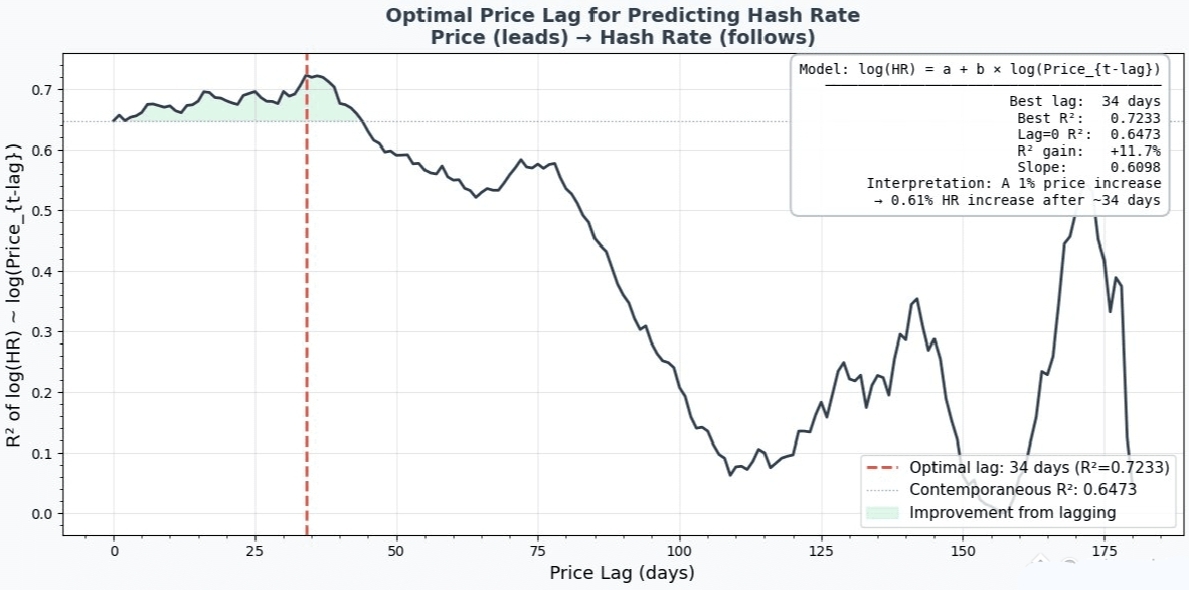
 There is a common myth that hashrate drives the price of Bitcoin. But the raw data from our current February 2026 market cycle tells a different story: Price leads, and hashrate follows with a lag. ⏳
Following the "Warsh Shock" earlier this month that saw $BTC dive toward $60K, we are seeing a massive adjustment in the mining sector.
📊 The 34-Day Lag Rule
Recent regression analysis shows that Bitcoin's hashrate responds to price shifts with a 30–34 day delay.
The Logic: Price drops → Miner revenue falls → Older rigs become unprofitable → Miners shut down.
The Result: Hashrate doesn't drop instantly; it "absorbs" the price shock over a month-long structure.
🔢 Key Metrics to Watch:
The Hashrate Gap: We are seeing a -12.8% gap right now. Actual hashrate is sitting around 901M TH/s, while the price-implied hashrate should be closer to 1,033M TH/s.
Elasticity: Data suggests a +1% move in BTC price results in a +0.61% move in hashrate—but only after that ~34-day window.
Difficulty Reset: We just witnessed one of the largest difficulty drops since 2021 (approx. -11.2% on Feb 7), confirming that the "Great Miner Retreat" is in full swing. ❄️
💡 The Core Insight
Hashrate is a delayed confirmation, not a leading signal. When hashrate falls faster than the lagged-price model implies (as it is now), it signals miner capitulation. 🏳️
Historically, when miners "throw in the towel" due to squeezed margins, it often marks the local bottom of a correction. Price is the signal; hashrate is the echo. 📣
Are we watching the final flush before the next leg up? 🐂
