

A new chain can feel like a new city. Fresh streets, shiny billboards, new rules. Builders walk in with a working product and a hard question. Do we move, or do we stay put. Moving usually means paying a hidden bill. You rewrite contracts. You replace libraries. You retrain your team. You rebuild every little tool that made your app reliable in the first place.
Fogo does not pretend that bill is small. It tries to delete most of it by choosing a simple direction. Keep the Solana Virtual Machine, keep the Solana style runtime, keep the Solana style developer workflow, then compete on what happens around it.
To understand why that matters, it helps to slow down and name the parts.
The Solana Virtual Machine, or SVM, is the execution environment where programs run. A program on Solana style networks is a compiled piece of code that lives on chain. Users do not “call functions” the way they do on some other platforms. Instead they send instructions that reference accounts. Accounts hold state and balances. The runtime enforces rules about how accounts are read and written during execution. When a chain says it is SVM compatible, it is saying the engine behaves the same way, so the same style of programs can run without needing a new mental model.
Fogo’s own developer docs make that promise very direct. They say Fogo is fully compatible with the SVM, and that any Solana program can be deployed on Fogo without modification. They also say the compatibility covers program structure, account models, instruction processing, and runtime behavior.
That sentence carries real weight if you have ever shipped production code. It means you are not starting from a blank page. It means your auditors are not learning an unfamiliar bytecode. It means your bug history still teaches you something. It means the sharp edges you already found stay visible, instead of being replaced by brand new ones.
Compatibility also has a second layer that most users never see, but every developer lives inside. Tooling.
Fogo’s docs say it is compatible with the Solana runtime and the Solana RPC interface, so standard Solana tools can interact with Fogo. They also say Fogo wallet keypairs are compatible with Solana.
RPC is just a way for software to talk to a chain. You can picture it as a front door. Wallets, apps, dashboards, and bots send requests to an RPC endpoint to read account data, simulate transactions, and broadcast signed transactions. Solana’s own developer cookbook explains this in practical terms by showing that development starts by connecting to a cluster through an RPC endpoint URL.
Fogo turns that concept into a migration trick that feels almost too easy. Their docs show that you can point the Solana CLI to Fogo’s mainnet by setting the CLI URL to https://mainnet.fogo.io. After that, you use the same commands you already know.
That is the developer shortcut in plain form. Instead of learning a new CLI, you keep the one you have. Instead of rewriting scripts, you change the endpoint. Instead of replacing your deployment pipeline, you repoint it.
Anchor is another example. Anchor is one of the most common frameworks used in Solana development. Fogo’s “Building on Fogo” guide says Anchor works with Fogo, and it shows the change developers need to make. You update the cluster URL in Anchor.toml to the Fogo RPC endpoint, then you build and deploy the usual way.
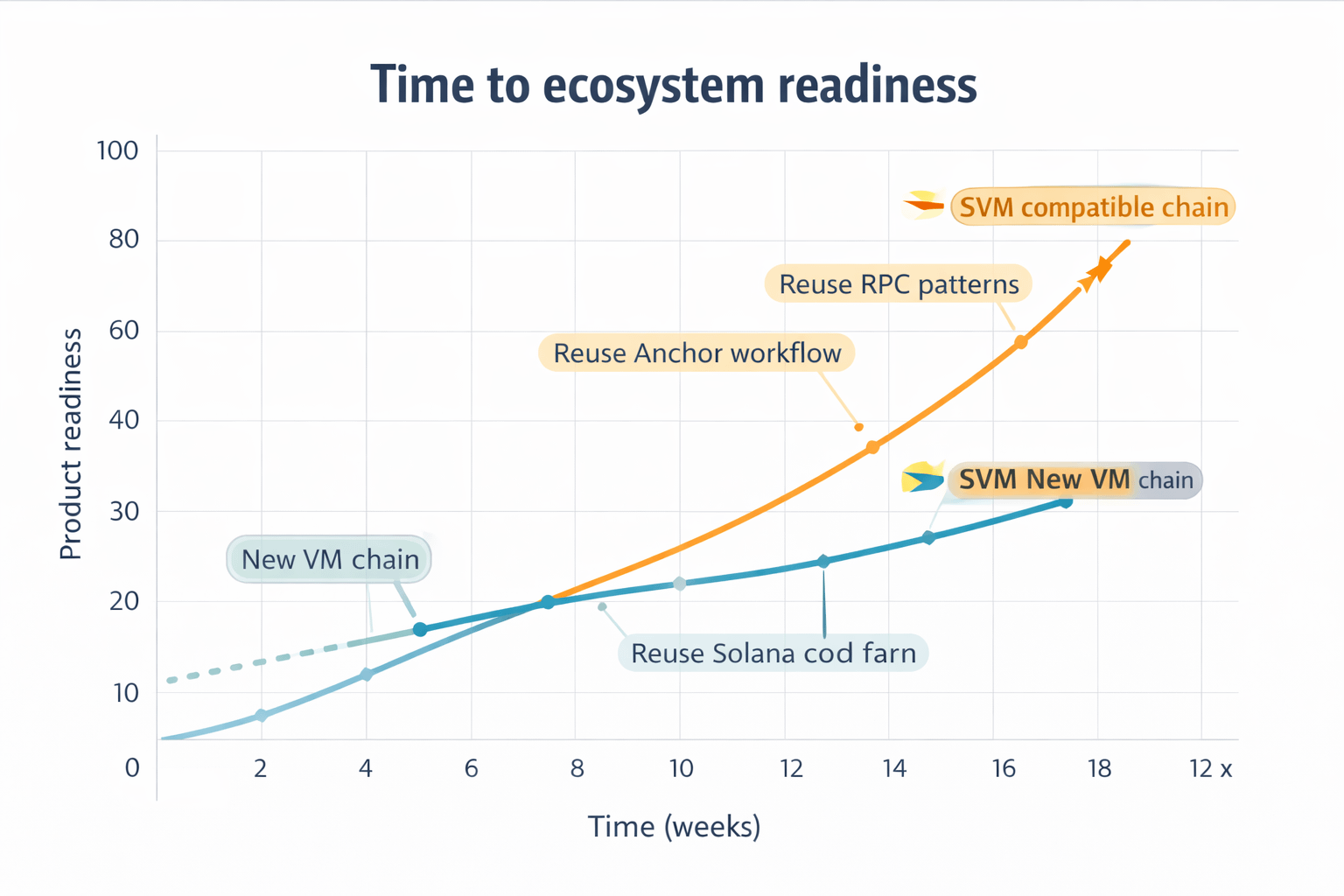
This kind of reuse is not only about convenience. It affects how fast an ecosystem can appear.
Every new Layer 1 fights a timing problem. Not block time, but market time. Users do not want an empty chain. Developers do not want to be alone. Liquidity does not want to wait around while tooling matures. Compatibility is one of the few levers that can shrink that bootstrap gap without asking people to take a leap into the unknown.
Fogo is explicit that it is not trying to be a general chain that slowly grows into everything. Its own homepage frames it as “built for traders,” and it markets 40ms blocks and about 1.3s confirmation. The same “Building on Fogo” doc ties compatibility to those network goals by saying applications built for Solana can leverage Fogo’s infrastructure benefits without code changes, including 40ms block times and geographic zone optimization.
So the pitch to builders is not just “your code runs here.” It is “your code runs here, and the environment is tuned for a specific kind of app.” Fogo positions that kind of app as DeFi where execution timing matters, especially trading.
That is where this becomes more than a technical convenience. It becomes a product strategy.
If you build a trading app, milliseconds can change outcomes. Even if users do not speak in milliseconds, they feel the difference between smooth and clunky. They feel it when a quote goes stale. They feel it when a liquidation hits before a hedge confirms. They feel it when the best price vanishes in the time it took to click through one more wallet prompt.
Fogo is trying to tackle those frictions with two parallel ideas. One is performance and latency. The other is user flow.
On the flow side, Fogo Sessions is described in the docs as a chain primitive that lets users interact with apps without paying gas or signing individual transactions. The same page describes Sessions as combining account abstraction with paymasters for fees. It states that users sign an intent message with a keypair, and that the intent can be signed using any Solana wallet keypair even if the wallet does not support Fogo natively. It also states that Sessions only allow interacting with SPL tokens and do not allow interacting with native FOGO, and it notes that paymasters are centralized today with economics and limitations under active development.
That matters for builders because it changes the shape of the front end. You can build an experience that feels more like a modern app, where permission is granted once and then actions flow, rather than a parade of approvals. Fogo’s approach does not remove tradeoffs, but it does put the friction in one place that developers can reason about and users can understand.
Now return to compatibility and ask a sharper question. Why does it matter that Fogo is SVM compatible if it is also trying new network choices and new UX primitives.
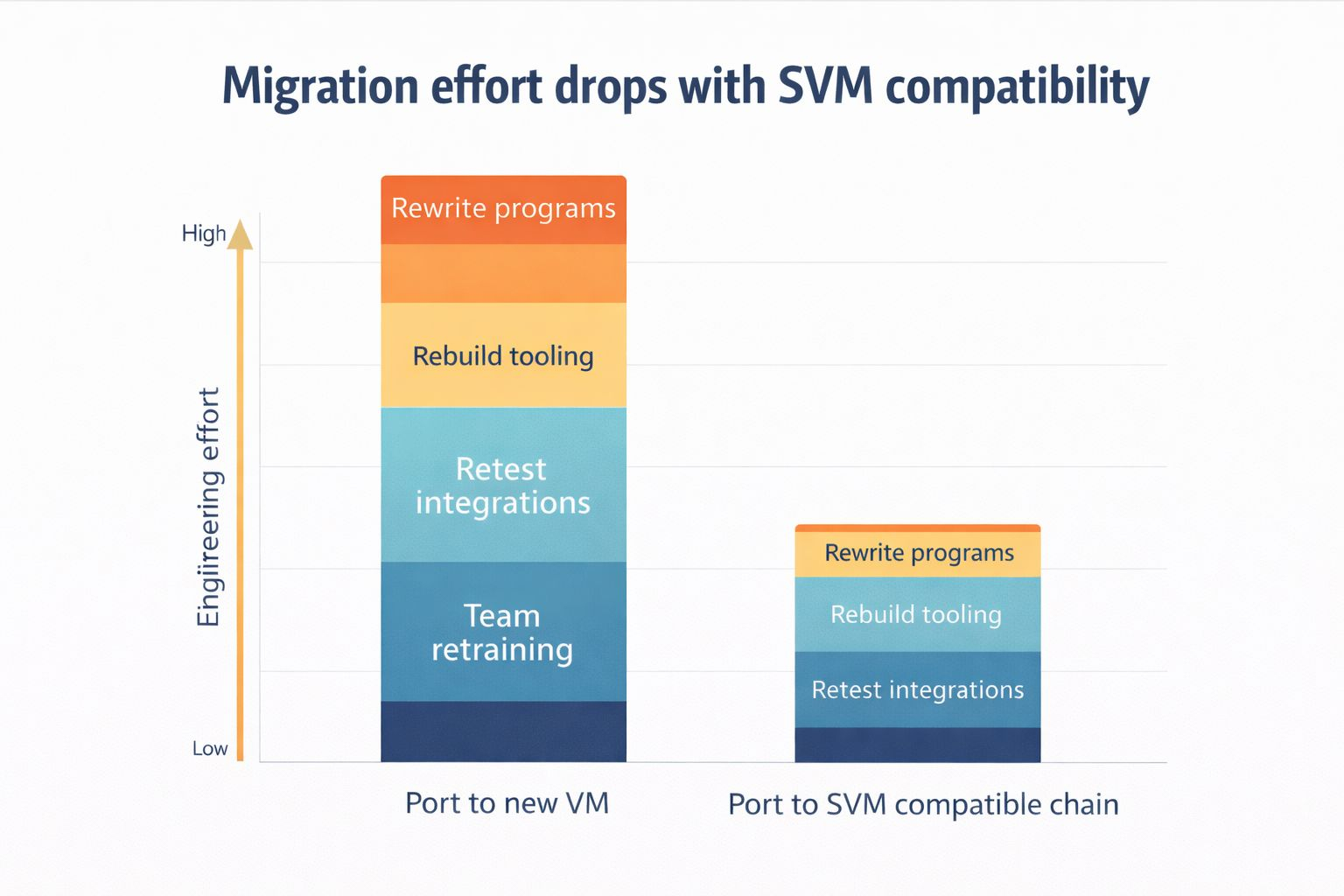
Because builders rarely adopt a new chain for one reason. They adopt when the full move feels survivable. Compatibility lowers the survival cost. A team can take an existing Solana program, deploy it, and test real user behavior in a new execution environment without rewriting the core.
That is also why SVM compatibility is a different kind of marketing claim than “EVM compatible.” The Solana model has its own structure. Programs, accounts, SPL tokens, and Solana style tooling create a distinct ecosystem shape. Fogo is choosing to plug into that shape rather than build a new one from scratch.
Fogo’s current position in the market also signals that it wants to reduce the “cold start” penalty. Wormhole’s own announcement says Fogo mainnet is live, that Wormhole is the ecosystem’s official native bridge, and that this connects Fogo to assets like USDC, ETH, and SOL. It also describes Fogo as an SVM based Layer 1 built for high performance DeFi applications, and it repeats the project’s framing around 40ms block times and 1.3s confirmation speeds.
For builders, bridges are not just a checkbox. They are how liquidity arrives. They are how users move value in and out without feeling trapped. A chain can have perfect developer docs and still fail if assets cannot move reliably. Having an official bridge partner at launch changes the practical calculus for teams deciding whether to deploy.
Then there is the mission layer, which is where a lot of chains drift into vague language. Fogo is unusually direct in its tokenomics post. It says Fogo was founded on the belief that true decentralization and high performance can exist together. It says the mission is to build the most performant SVM Layer 1, aligning speed, scalability, and community ownership. It also says the network launches with a custom Firedancer client optimized for stability and speed, and that validators operate in high performance infrastructure centers.
You do not have to accept the slogans to learn something from them. The message tells you what Fogo wants to be judged on. Not general purpose smart contracts. Not “the next everything chain.” It wants to be a place where high tempo DeFi can run, and where builders can arrive without throwing away years of SVM specific work.
So what problem is Fogo trying to solve for the future, through the specific lens of compatibility.
It is trying to shrink the gap between idea and deployment in performance sensitive DeFi. Today, a builder who wants faster execution often has to choose between speed and familiarity. Speed can come with a new VM, a new account model, a new toolchain, and a long period of ecosystem catch up. Fogo’s bet is that you can chase a trading first chain while still keeping the SVM world intact.
That also changes how the chain might grow. If developers can reuse existing Solana programs and tooling by switching RPC endpoints and keeping the same framework workflows, the time to a usable app landscape can compress. It does not guarantee success, but it changes the slope of the hill.
The DeFi and Web3 significance of that choice is practical. A chain’s culture is shaped by what is easy to build. If it is easy to port Solana style trading systems, money markets, and infrastructure, then the early ecosystem is more likely to look like a serious financial stack rather than a gallery of experiments. Fogo already positions itself as trader centric, and the compatibility story is how it tries to bring builders into that identity quickly.
In the end, SVM compatibility is not the flashy part of the story. It is the quiet part that keeps the story believable.
A new chain can promise speed. It can promise UX. It can promise fairness. The hard part is getting builders to ship and users to show up before the novelty fades. Fogo’s developer shortcut is simple. Keep the engine familiar, keep the tools familiar, and let builders spend their energy on product and market structure, not translation.