

A key development was the deeper articulation of the Neutron × OpenClaw integration. OpenClaw agents, which historically relied on local or file-based memory, faced inherent limits in portability and continuity. Neutron addresses this by making memory durable, queryable, and lineage-aware. In this model, agents themselves can be restarted or replaced without loss of accumulated knowledge. The agent becomes disposable, while intelligence persists. This same memory architecture underpins myNeutron, Vanar’s user-facing product, highlighting a consistent design philosophy across both developer and end-user layers.
On February 10, @Vanarchain participated in a live AMA on Binance Square. The discussion covered Vanar’s broader AI stack, persistent memory design, Neutron’s role for OpenClaw builders, and how agent infrastructure is evolving beyond short-lived, session-bound systems. The conversation emphasized that memory is no longer an enhancement, but a requirement for scalable agent ecosystems.

The following day, Vanar’s Founder and CEO Jawad Ashraf spoke in Dubai at the AIBC Eurasia roadshow. His remarks positioned AI as a global growth engine, extending the discussion of agents and persistent memory beyond crypto-native audiences and into broader business and policy contexts. This reflected Vanar’s intent to frame its infrastructure as relevant to enterprise and institutional use cases, not solely decentralized applications.

On February 12, Vanar joined Inflectiv, NodeOps, and Hela Network for an AI × Profitability panel. The discussion centered on AI’s commercial future and the necessity for intelligent systems to translate into sustainable economic models. Persistent memory again emerged as a structural requirement, enabling systems to compound value over time rather than repeatedly resetting context.

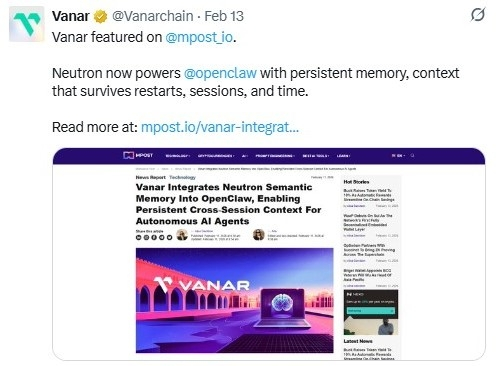
Independent media coverage followed on February 13, with mpost highlighting Neutron’s role in powering OpenClaw agents with cross-session memory. The coverage underscored a broader shift underway in AI development: moving from experimental, isolated agents toward infrastructure-grade systems designed for long-running autonomy.
Taken together, the week’s product updates, public discussions, and media coverage conveyed a consistent signal. Execution alone is no longer sufficient. The next phase of AI infrastructure is defined by durable, portable intelligence -- systems that retain context, evolve across deployments, and compound knowledge over time. This is the layer where #Vanar is positioning itself.
For holders of $VANRY , these developments provide insight into the network’s direction. Vanar is not optimizing for short-term narratives, but for foundational infrastructure aligned with how autonomous AI systems are expected to operate in production environments. The past week reflected that strategy moving from concept to visible, coordinated execution.
