
Fogo feels like a project that’s quietly obsessed with the parts of crypto most teams only talk about when something breaks: latency, consistency, and the little bits of friction that turn “fast chain” marketing into a slow real-life experience for traders. The simple description is that it’s a high-performance Layer-1 built on the Solana Virtual Machine, but the more accurate way to describe it is that Fogo is trying to behave like trading infrastructure first and a general blockchain second, because the moment you care about real execution and real timing, average performance stops being the story and the worst-case moments become the whole story.
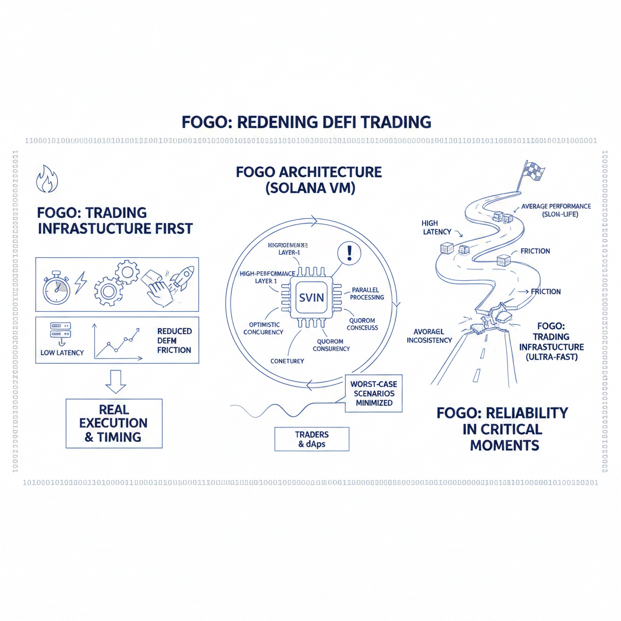
What makes that approach matter is that trading isn’t just about throughput on a dashboard, it’s about how quickly and predictably a user can get from intent to execution, and that path includes everything from network distance to wallet confirmations to whether the chain suddenly feels sluggish during volatility. Fogo’s premise is basically a finance-native take on blockchains: if you want on-chain order books, auctions, liquidations, and high-frequency strategies to feel natural, you need a chain designed around tight latency and stable confirmation behavior, not just one that can occasionally post huge TPS numbers in ideal conditions.
Under the hood, the project leans into a physics-aware architecture that tries to reduce the distance on the critical consensus path, which is where blockchains quietly lose time when validators are spread across continents and every vote has to cross the planet. In Fogo’s litepaper, that shows up as a zoned or multi-local approach, where validators are organized into zones and only one zone is active in consensus for an epoch while the others remain synced, and the zone can rotate in a structured way, even with a “follow-the-sun” style rotation that aims to keep consensus closer to where it can run most efficiently at that moment. The practical goal isn’t to sound clever, it’s to cut tail latency so confirmations feel consistent, because in finance the slowest slice of the distribution is the slice that costs users money and confidence.
Another part of the behind-the-scenes story is that Fogo ties its performance identity to the Firedancer lineage, and while the branding is easy to repeat, the intent is more important than the name: reduce variance, push the validator stack toward high performance, and avoid the “every validator is a snowflake” effect where the network’s user experience is limited by uneven setups and unpredictable bottlenecks. The litepaper also talks through Solana-style fee mechanics and an inflation model on mainnet, which signals that Fogo is not reinventing the economics just to be different, it’s keeping the basics familiar while concentrating its innovation on the performance and UX layers where it believes the largest gaps still exist.
Where Fogo starts to feel especially real is the user experience layer, because they are not treating “wallet prompts” as a minor inconvenience, they are treating them like a fundamental performance problem. Fogo Sessions is framed as the way to make trading feel uninterrupted: a user creates a session with one signature, a temporary session key can operate within scoped permissions and expiration, and applications can sponsor fees so the user isn’t forced to juggle gas balances or get interrupted mid-flow. When you zoom out, this is Fogo admitting something most chains avoid saying plainly, which is that confirmation time and signature friction are both forms of latency, and the chain that wins trading mindshare will be the one that makes the entire loop feel smooth rather than making users tolerate constant little pauses.
The token story is presented in a similarly practical way, because $FOGO is positioned as the network fee token, the staking token that secures validation, and the asset that sits in the middle of an ecosystem flywheel narrative where the foundation supports builders and partners can route value back into the network through revenue-sharing arrangements. The tokenomics breakdown published by the team lays out allocations across community distribution, contributors, investors, advisors, foundation programs, and liquidity, and it emphasizes that a significant portion of supply was locked at genesis with multi-year vesting schedules, which matters because it sets expectations about how circulating supply changes over time rather than leaving the market to guess.
On the community side, the airdrop write-up describes a broad distribution across tens of thousands of wallets with a defined claim window and a heavy anti-sybil approach, and while every project says it cares about fairness, the detail here is that Fogo seems to view distribution integrity as part of credibility, not just part of marketing. That aligns with the broader brand they are building, because a chain that wants to be taken seriously by traders and builders eventually has to be trusted not only for speed, but also for predictability in how it governs, distributes, and supports the ecosystem.
In terms of where the project stands right now, the mainnet and token launch happened in January 2026, followed by the kind of ecosystem wiring that decides whether a chain becomes usable or simply remains interesting: bridges, oracle support, multisig tooling, and data infrastructure are all highlighted across official materials, and the ecosystem page presents live applications that fit the trading-first narrative rather than a random assortment of unrelated dApps. It reads like a network that is trying to make sure the first impression is not “welcome to another chain,” but “welcome to a place where trading workflows actually fit.”
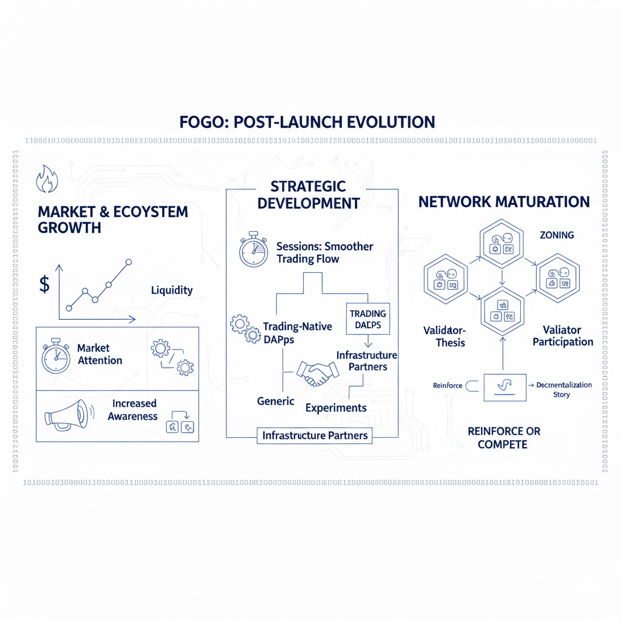
For the most recent movement around the project, there is clearly ongoing market attention and exchange activity around $FOGO since launch, and trackers reflect that attention with frequent updates, but the cleanest way to describe “what’s new” without inventing anything is that Fogo is in the post-launch phase where awareness, liquidity, and ecosystem usage begin to matter more than launch announcements. If the next chapter is coherent with what the team has already signaled, you should expect Sessions to keep evolving into a smoother, more complete trading flow, you should expect more trading-native applications and infrastructure partners to appear rather than generic experiments, and you should watch how the network’s zoning and validator participation develops over time, because that is where Fogo’s performance thesis and its decentralization story will either reinforce each other or start competing.
My personal takeaway is that Fogo is not trying to convince people with a single metric, it is trying to win by removing the little breaks in the experience that make on-chain trading feel like work. If they can keep confirmations consistent, keep Sessions genuinely safe and simple, and keep the ecosystem focused on serious, latency-sensitive products, then the project’s narrative becomes more than hype because it turns into a daily habit for users who actually trade, and habits are what decide which networks stay alive after the first excitement fades.