
I once sat up very late, watching three columns of numbers for Fogo take turns lighting up on my screen: fees ticking up step by step, volume taut like a guitar string, active users rising as if they’d never heard of fatigue. And I sighed not because it was bad, but because I’d seen this scene far too many times.
After multiple cycles, I no longer treat fees, volume, and active users as trophies to show off. I see them as three layers of waves, each of which can be real, and each of which can be a mirage. Maybe what makes me picky is that I’ve built products during cold markets, when nobody retweets, when there’s no reward program to “pull people in,” and when fast good looking numbers disappear as quickly as they arrive. Fogo brings back an old question: which of these three reflects genuine demand, which reflects mechanism, and which is just herd psychology.
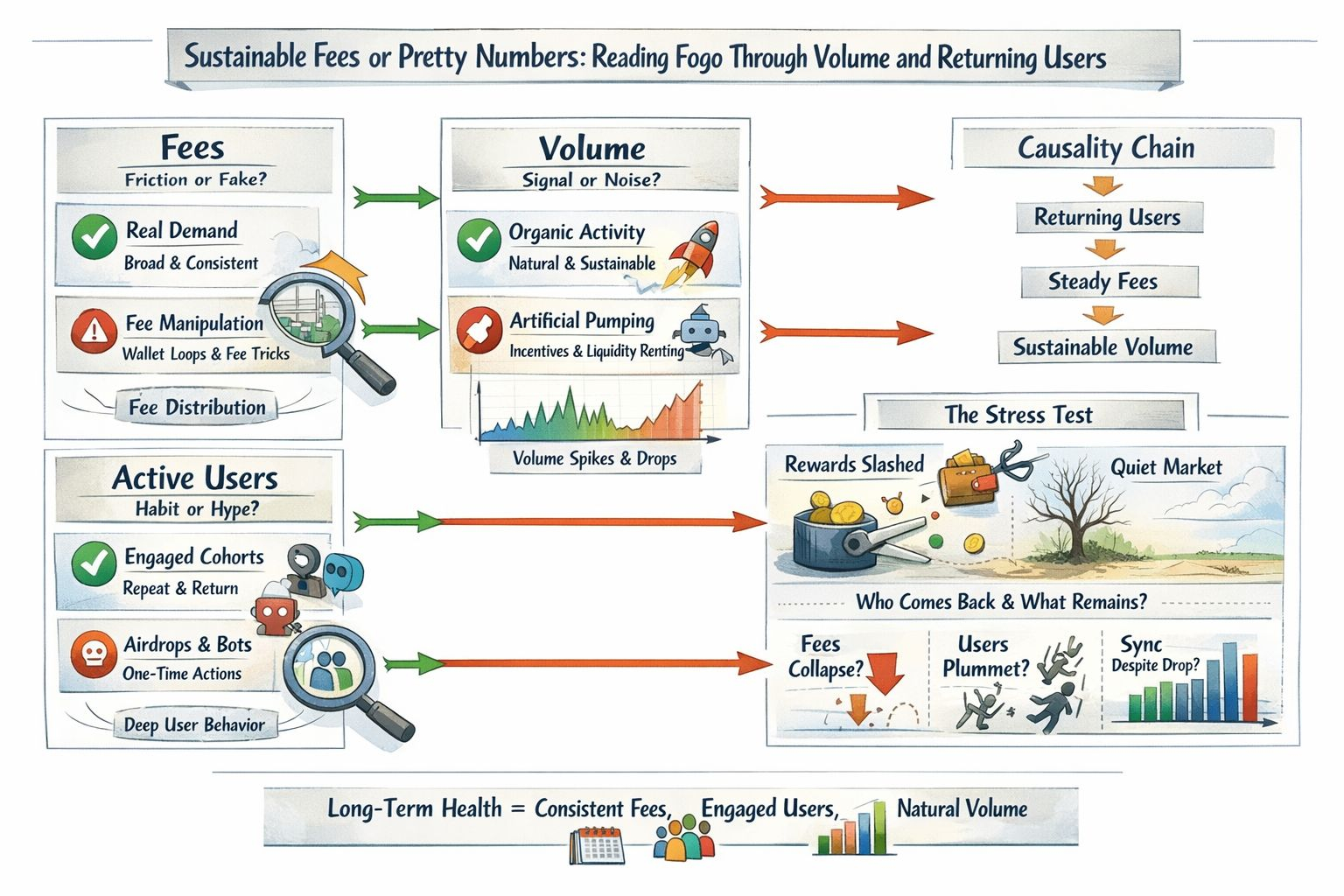
Fees are where I start, because fees sound like the little click when someone truly commits to a decision. To be honest, fees aren’t always “real money” in the final sense, but they are friction, and friction doesn’t usually appear on its own unless the behavior is strong enough. If Fogo fees rise on days with no narrative, no reward hunting season, I start to believe some demand is forming. But fees can also be “minted” by a few large wallets looping activity, or by behaviors designed specifically to generate fees. In that case, I’m not looking at the fee level, but at distribution: how many people are generating it, how the pattern repeats, and whether it depends too heavily on a small group.
Volume always makes me cautious. Ironically, volume is the number that most easily convinces people “the market is here,” but it’s also the easiest to inflate. A system can create big volume by renting liquidity, or by designing rewards that push people to trade more than they truly need. I’ve watched volume spike vertically, and then one day the program gets reduced and volume drops like a stone. With Fogo, if volume rises while fees and user return behavior don’t rise in step, I consider it noise more than health. Volume can look great and still be hollow, and the longer you stare at it, the colder it feels.
Active users is the number that reassures people, because it sounds like humans. But there are many kinds of “active,” and this is where self deception is easiest. Someone comes in, does a single action to qualify for rewards, and they’re active. A bot running on a schedule is active. A group of airdrop hunters coordinating activity is active. No one expects that sometimes the higher active users goes, the more likely it is that nobody stays, if the motivation is one touch and then gone. With Fogo, I care about depth: what they do after the first time, whether they return weekly, and whether the second and third visits come with fee paying behavior.
These three metrics only matter when you place them into a causal relationship. I often imagine a simple chain: real users return and form habits, habits create steady fees, and only steady fees earn the right to call volume sustainable. If the chain is reversed, volume pops first, then active users chase it, then fees jump afterward, I still have to ask where the motivation really is. Maybe people love a volume explosion because it feels “right place right time,” but for a builder, an explosion says little about survival. A strong system can handle volume dropping without fees breaking, without active users collapsing, because people return out of need, not hype.
There’s a stress test I use often, and it sounds a bit cruel. Imagine Fogo cuts rewards down to the minimum, or the market sinks into a boring month where nobody wants to explore anything new. Then how much fee remains, and how many active users remain who come back to do work they genuinely need. If fees fall harder than active users, maybe people still show up, but there’s no longer enough valuable behavior to justify paying. If active users fall harder than fees, maybe the system is relying on a small but heavy group, with high concentration risk. And if volume falls while fees and the returning cohort keep their rhythm, that’s a rare signal, because it shows the system is less dependent on noise.
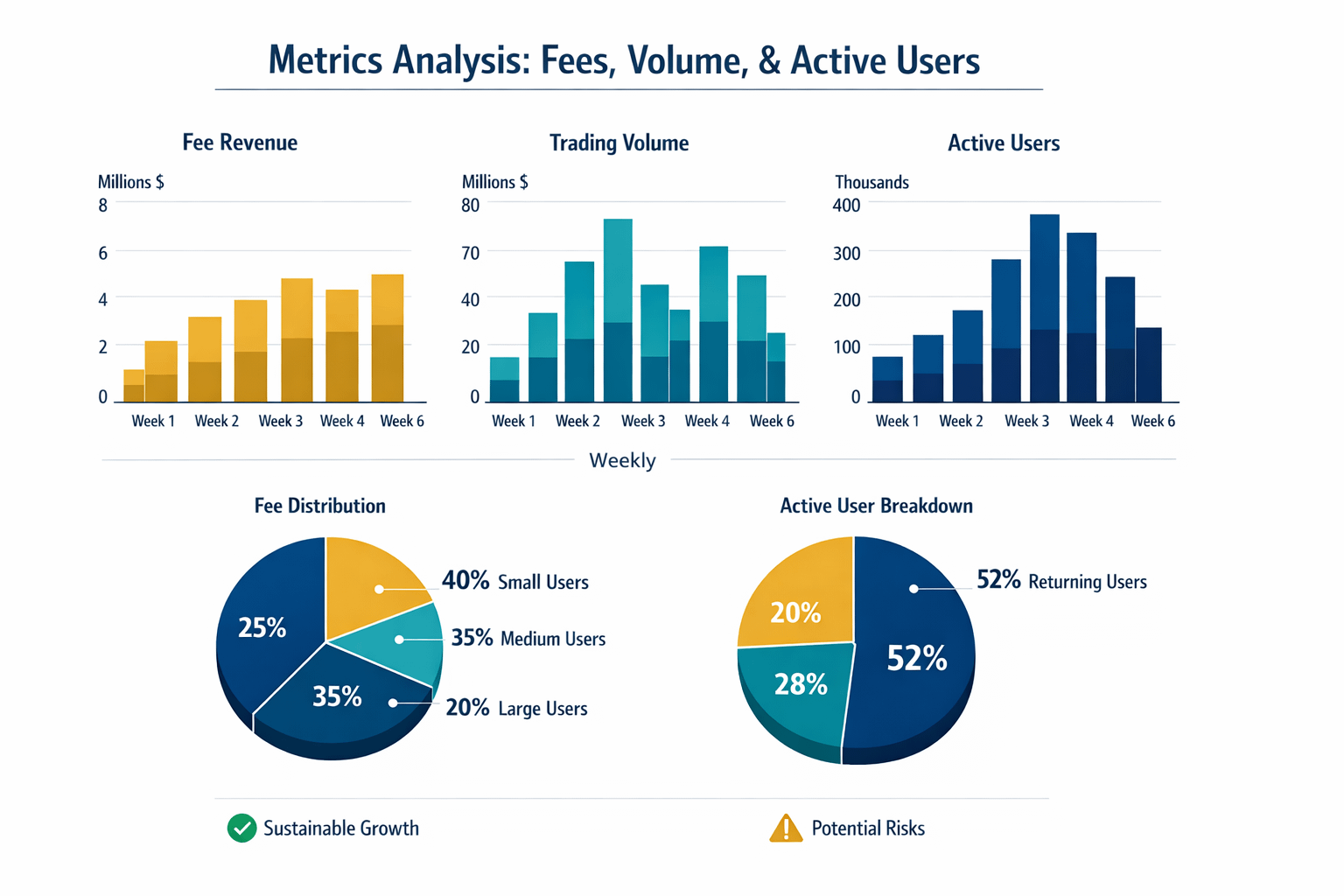
Going deeper, I think the most important thing isn’t the three numbers themselves, but their consistency over time. Many projects can buy a few weeks of pretty metrics, but they can’t buy a year of living in silence. With Fogo, I want to see fees repeat weekly, not just daily. I want to see clear user cohorts, not just a stream of passersby. And I want volume to reflect natural demand, not a reflex to incentives. When these three start to align, that’s when I feel Fogo is stepping out of the performance phase and into the operating phase.
The biggest lesson I’ve learned, after watching beautiful numbers appear and then dissolve, is not to worship any single metric. Fees are the trace of friction, active users are the trace of habit, and volume is a mix of signal and noise. I think Fogo will only truly mature when it no longer needs to make everything look busy, but instead focuses on bringing back a group of people because they need it, paying fees because it feels worth it, and generating volume as a natural consequence, not as a decorative goal.
If one day Fogo fees rise slowly but steadily, active users stop exploding but truly return, and volume no longer makes anyone shout, would that be the most reliable picture of the project’s long term health.
@Fogo Official #fogo $FOGO