
Most blockchain users naturally focus on visible metrics. They watch token prices, ecosystem announcements, partnerships, and narrative cycles. These signals dominate headlines because they are easy to measure and easy to discuss. But beneath these surface-level indicators lies a deeper and far more important layer that ultimately determines whether blockchain technology can scale into a global financial and computational infrastructure. That layer is execution.
Execution is the process where transactions are actually computed, validated, and applied to the blockchain’s state. Every action a user performs—sending tokens, interacting with decentralized finance protocols, executing trades, minting assets, or triggering automated logic—relies entirely on execution efficiency. Without fast and reliable execution, even the most innovative applications cannot deliver meaningful user experiences. For years, execution has been the hidden bottleneck that limited blockchain performance.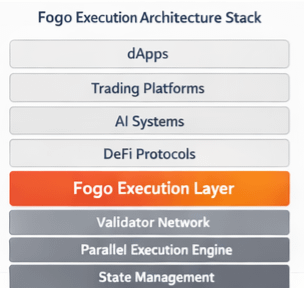
Fogo is emerging as a new execution-focused blockchain designed specifically to address this structural limitation. Instead of competing primarily through ecosystem hype or superficial performance improvements, Fogo focuses on optimizing the execution layer itself. This architectural focus represents a deeper evolution in blockchain design, one that prioritizes infrastructure capability over narrative momentum. By targeting execution as its core priority, Fogo is positioning itself within the most critical layer of blockchain scalability.
To understand why execution matters so deeply, it is important to examine how traditional blockchains operate. Most early blockchain systems were designed with decentralization and security as their primary goals. While these properties were essential for trustless systems, performance optimization was not a central design priority. Transactions are typically processed sequentially, meaning each operation must wait for the previous one to complete before execution can continue. This creates inherent delays and limits the network’s ability to scale efficiently.
As network usage increases, these limitations become more pronounced. Transaction queues grow longer, confirmation times increase, and execution latency rises. This results in congestion, unpredictable performance, and degraded user experience. Users experience delays, applications become less responsive, and developers face constraints when designing real-time systems. These issues are not simply inconveniences; they represent fundamental barriers to blockchain adoption.
Fogo approaches this problem from a fundamentally different perspective. Rather than treating execution as a secondary component, it treats execution efficiency as the foundation of network capability. Its architecture is designed to minimize execution latency, optimize transaction processing, and maintain consistent performance even as network demand increases. This approach recognizes that execution speed is not merely a performance metric but a foundational determinant of blockchain utility.
Execution latency is one of the most critical factors affecting blockchain usability. Latency refers to the time between when a transaction is submitted and when it is confirmed and finalized. High latency creates friction that disrupts user experience and limits the types of applications that can function effectively. Real-time systems, such as trading platforms, automated financial infrastructure, gaming environments, and AI-driven systems, require rapid and predictable execution.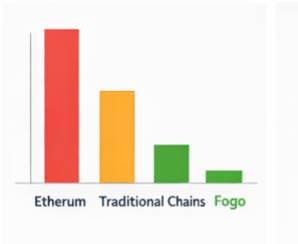
Fogo’s architecture focuses on reducing this latency by optimizing validator execution workflows and minimizing processing inefficiencies. Validators play a central role in executing transactions, updating network state, and maintaining consensus. In many traditional systems, validators must perform redundant computational tasks, creating inefficiencies that slow execution. Fogo improves this process by streamlining validator operations and ensuring that execution resources are used more efficiently.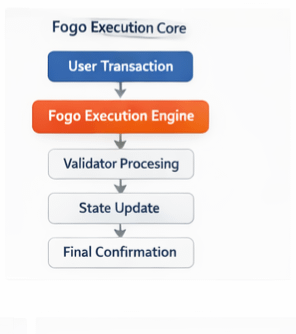
This optimization enables faster confirmation times and more predictable transaction processing. Predictability is especially important because application developers rely on consistent performance to design reliable systems. When execution timing becomes predictable, developers can build applications that behave more like traditional real-time software systems rather than slow and unpredictable distributed networks.
Another major limitation of traditional blockchain systems is execution bottlenecks caused by inefficient workload distribution. When execution responsibilities are unevenly distributed or poorly optimized, certain validators become overloaded while others remain underutilized. This imbalance reduces overall network efficiency and limits scalability.
Fogo’s design improves workload distribution and execution efficiency, allowing validators to process transactions more effectively. This ensures that network performance remains stable as transaction volume increases. Rather than slowing down under pressure, the network can maintain consistent execution capability even as adoption grows.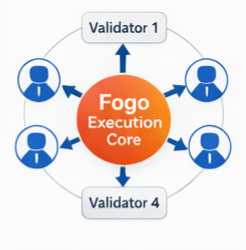
This consistency is essential for long-term scalability. Scalability is not simply about handling higher transaction volumes; it is about maintaining reliable performance as usage increases. Many blockchain systems experience performance degradation as adoption grows, creating barriers to widespread use. Fogo’s execution-focused architecture is designed to prevent this degradation, enabling sustainable growth without compromising performance.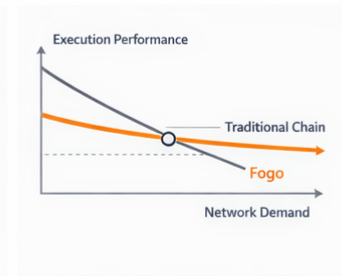
Execution efficiency also has direct implications for transaction costs. When execution is inefficient, validators consume more computational resources, increasing operational costs. These costs are often passed on to users in the form of higher transaction fees. This creates friction that discourages adoption and limits real-world usability.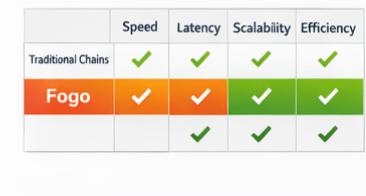
By optimizing execution efficiency, Fogo reduces computational overhead and improves resource utilization. This allows the network to operate more efficiently, helping maintain lower transaction costs while supporting higher throughput. Lower fees make blockchain systems more accessible and enable a wider range of applications beyond speculative trading.
Another critical advantage of execution optimization is improved application responsiveness. Modern digital applications require infrastructure that can support real-time interactions. Slow execution creates delays that disrupt user experience and limit application functionality. Fast execution allows applications to respond immediately to user actions, creating smoother and more intuitive interactions.
This capability is especially important for decentralized finance, automated trading systems, gaming platforms, and AI-driven automation. These applications depend on rapid execution to function effectively. Slow infrastructure creates friction that limits their potential.
Artificial intelligence represents one of the most important emerging use cases for execution-optimized blockchain infrastructure. AI systems increasingly rely on automated decision-making, real-time data processing, and autonomous asset management. These systems require infrastructure capable of executing transactions quickly and reliably.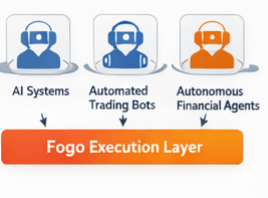
Fogo’s execution-focused design aligns closely with the requirements of AI-driven digital economies. By reducing latency and improving execution responsiveness, it enables infrastructure capable of supporting machine-driven financial systems and automated digital interactions.
Execution optimization also improves overall network reliability. Reliable execution ensures that transactions are processed consistently and predictably. This reliability is essential for building trust in blockchain infrastructure and enabling enterprise adoption.
Institutional systems require infrastructure that can support predictable and reliable execution. Financial institutions, automated trading platforms, and enterprise applications cannot rely on infrastructure that experiences unpredictable delays or performance degradation. Execution-optimized networks provide the reliability necessary for institutional integration.
Fogo’s architectural approach reflects a broader shift in blockchain evolution. Early blockchain networks focused primarily on proving that decentralized systems were possible. The next phase of blockchain evolution focuses on improving infrastructure performance and scalability.
Execution is becoming the central battleground in this evolution. Networks that optimize execution capability will be able to support more advanced applications, larger user bases, and more complex digital economies. Networks that fail to improve execution efficiency will face increasing limitations as demand grows.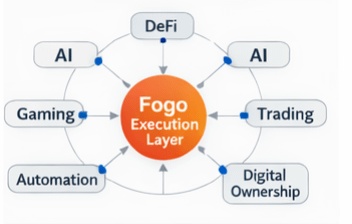
Execution efficiency also determines whether blockchain can function as a global infrastructure layer. Financial systems, automated economies, and digital ownership platforms require infrastructure capable of processing transactions reliably and efficiently at scale.
Fogo’s execution-focused design positions it as infrastructure built for this next phase of blockchain adoption. By prioritizing execution capability, it enables infrastructure capable of supporting real-time digital economies and automated systems.
Another important aspect of execution optimization is its impact on developer experience. Developers are more likely to build applications on networks that offer fast and reliable execution. Better execution performance enables developers to create more advanced and responsive applications.
This creates a positive feedback loop. Better execution attracts developers. More developers build applications. More applications attract users. More users increase network adoption. This cycle strengthens the overall ecosystem.
Execution optimization is not simply a technical improvement. It is a foundational shift that expands what blockchain infrastructure can support. Faster execution enables entirely new categories of applications that were previously impractical.
High-frequency trading systems, automated financial infrastructure, AI-driven applications, and real-time digital economies all depend on fast execution. Infrastructure limitations previously prevented these systems from operating efficiently on blockchain networks.
Fogo’s architecture addresses these limitations by prioritizing execution performance at the foundational level. This enables blockchain infrastructure capable of supporting advanced digital systems.
The long-term significance of execution optimization extends beyond individual networks. Execution capability determines whether blockchain technology can evolve into a global infrastructure layer supporting financial systems, automated economies, and digital ownership frameworks.
Infrastructure always determines technological outcomes. Faster, more efficient execution expands what is possible. It enables new applications, improves user experience, and supports larger digital ecosystems.
Fogo represents a shift toward infrastructure-driven competition. Rather than competing through narratives alone, it focuses on solving one of the most fundamental limitations in blockchain architecture.
Execution is the engine that powers blockchain systems. Improving execution capability improves everything built on top of it.
As blockchain adoption continues to grow, execution performance will become one of the most important factors determining network success. Networks capable of delivering fast, efficient, and reliable execution will form the foundation of the next generation of digital infrastructure.
While many users focus on visible metrics, the most important transformation is happening deeper within the execution layer. Fogo is being built within this critical layer, where execution performance determines whether blockchain infrastructure can truly scale.
In the long run, execution speed will not just be a technical detail. It will be the defining factor that determines which networks can support the future of digital economies. And in that future, execution-optimized infrastructure like Fogo will play a central role in shaping how blockchain systems evolve from experimental networks into global computational and financial infrastructure.