

Picture this: you're in the middle of a volatile market swing, trying to execute a high-frequency trade on a decentralized exchange. On most chains, latency creeps in like fog rolling over a racetrack, turning what should be a split-second decision into a costly delay. That's the compromise traders have accepted for too long, sacrificing speed for decentralization or vice versa. In 2026, as on-chain finance matures and institutional players demand CEX-level performance without giving up self-custody, Fogo stands out by refusing to make that trade-off. This Layer 1, built specifically for real-time trading, delivers sub-40 millisecond block times, near-instant finality around 1.3 seconds, and a setup engineered from the ground up for zero compromise execution. Having followed SVM ecosystems closely since Solana's early days, I see Fogo not as another competitor, but as the chain that finally prioritizes what traders actually need: speed that doesn't break the rules of decentralization.
At its core, Fogo's edge comes from a ruthless focus on performance. It runs a pure Firedancer-based client, the high-performance validator software originally crafted by Jump Crypto for Solana but optimized here without the usual compromises of multi-client diversity. By standardizing on one canonical client and using multi-local consensus with validators clustered geographically (think zones like Tokyo for tight coordination), Fogo slashes physical latency that plagues globally distributed networks. This isn't just tweaking parameters; it's rethinking architecture so block production hits 40ms consistently, with throughput pushing tens of thousands of TPS in real conditions. For context, while Solana and Sui chase raw throughput, Fogo targets deterministic low tail latency, meaning even in stressed scenarios, your order doesn't get frontrun by milliseconds of unpredictability. It's like upgrading from a crowded highway to a dedicated racetrack where every car knows exactly when the light turns green.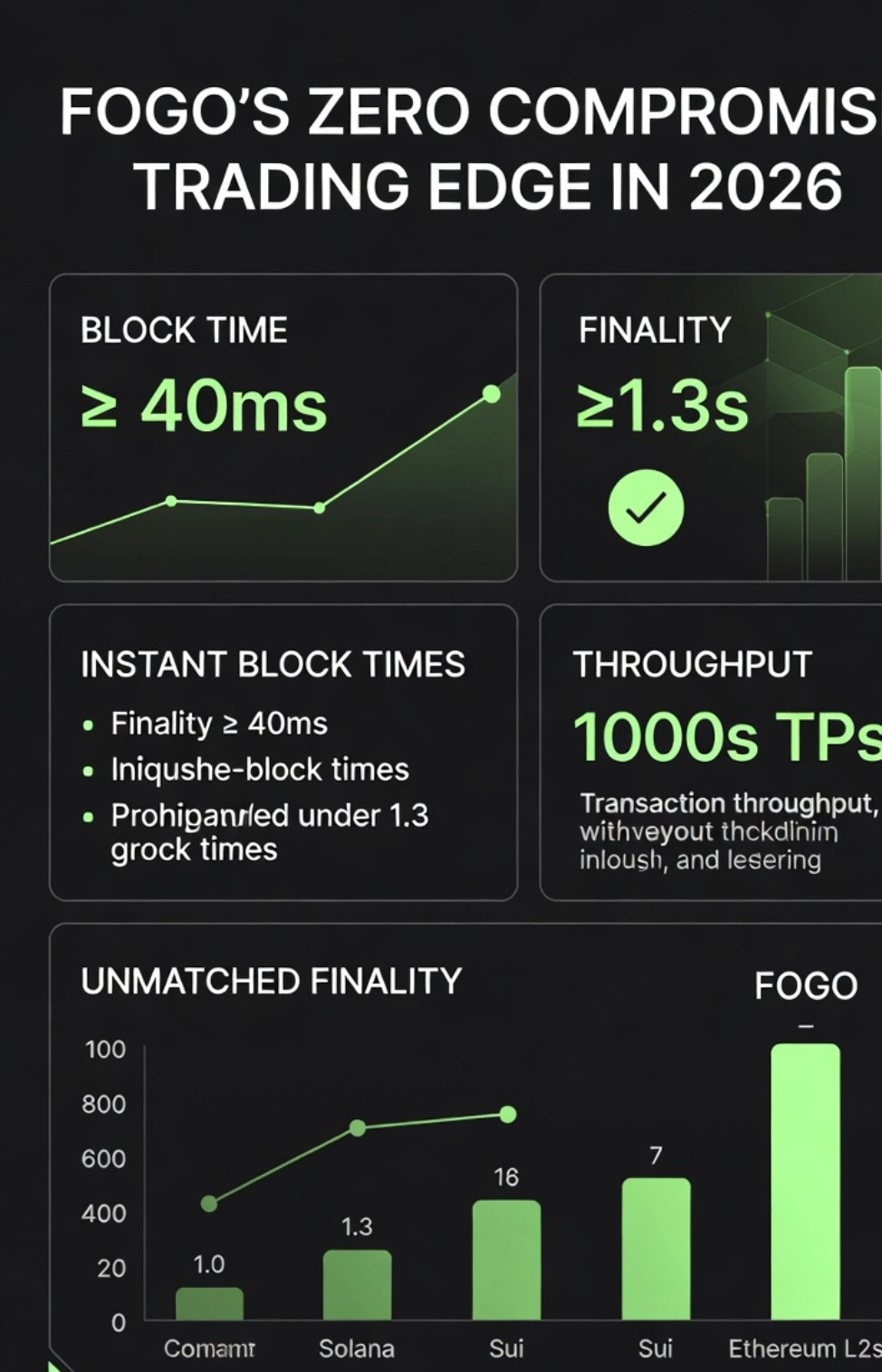
The trading primitives baked in amplify this advantage. Native enshrined order books, gas-free sessions via Fogo Sessions, wallet-agnostic access, and integrated oracles (leveraging Pyth for ultra-fast feeds) create an environment where high-frequency strategies, perps, and liquidations feel native rather than bolted on. Early ecosystem traction shows over ten live dApps, including Valiant DEX and lending protocols, already demonstrating how this speed translates to real user experience. In my view, this vertical integration is what separates Fogo from general-purpose SVM chains. As tokenized assets and on-chain derivatives explode in 2026 amid renewed DeFi narratives and regulatory clarity pushing institutions toward blockchain, platforms that deliver predictable, CEX-comparable execution will capture the serious liquidity.
[Here, insert a chart comparing Fogo's block times and finality latency against Solana, Sui, and Ethereum L2s in recent stress tests, using line graphs to showcase the sub-40ms advantage visually for maximum impact.]
Yet no project is without hurdles. Risks include the classic post-launch dynamics: after mainnet went live on January 15, 2026, following a strategic Binance token sale, $FOGO saw strong initial hype but has since corrected sharply from its ATH around $0.063 to current levels near $0.023, with market cap hovering in the mid-80 million range and circulating supply about 3.77 billion out of roughly 10 billion total. Upcoming unlocks, like the significant one in September 2026, could add sell pressure if adoption doesn't ramp fast enough. Network reliance on a single client variant, while boosting speed, introduces potential centralization concerns until pure Firedancer fully stabilizes. Competition is fierce too, with Solana itself integrating Firedancer upgrades and other SVM players vying for the same high-stakes DeFi niche.
Still, opportunities feel outsized. Fogo's design aligns perfectly with 2026 trends: the push for real-time on-chain finance, where every millisecond translates to edge in arbitrage, MEV protection, or precise executions. If the team delivers on roadmap items like hyperscaling and more institutional integrations, could become the default settlement layer for latency-sensitive apps. From my perspective, holding or staking here is a bet on execution quality winning out over sheer throughput hype.
[Here, insert a visual infographic or bar chart illustrating Fogo's key performance metrics (block time, TPS, latency) versus competitors, paired with ecosystem growth indicators like live dApps and TVL trends, to drive home the "zero compromise" narrative creatively.]
For investors, the takeaways are straightforward yet nuanced. Diversify entry points around dips tied to unlocks, prioritize staking for network participation rewards, and track on-chain metrics like trading volume on Valiant DEX as leading indicators of sustained demand. Don't chase short-term pumps; view $FOGO as exposure to the infrastructure layer powering next-gen trading. In a year where crypto finance bridges TradFi speed with DeFi transparency, Fogo's refusal to compromise feels like the right thesis. If it executes as promised, this could be the chain that makes on-chain trading truly competitive with centralized venues. I'm watching closely, and so far, the fundamentals suggest it's worth the attention.