


The U.S. dollar edged higher on Monday but remained broadly constrained after a week marked by mixed U.S. economic data and shifting interest-rate expectations.
The dollar index (DXY), which measures the greenback against a basket of major currencies, rose 0.18% to $97.09 but remains down about 1.18% for the year to date.
Dollar weekly moves and key drivers:
Over the past week, the index edged up 0.12%, reflecting cautious investor sentiment as markets assessed the outlook for U.S. growth, easing inflation pressures, and policy guidance from the Federal Reserve.
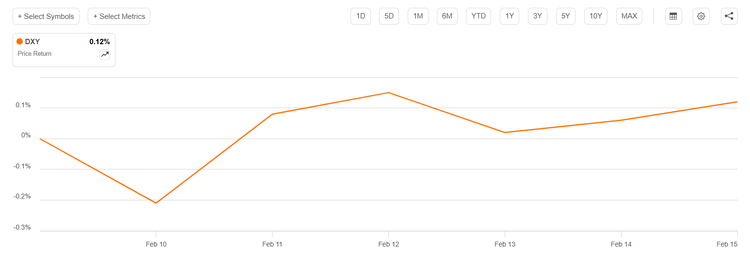
Softer Treasury yields and market pricing that the Federal Reserve will hold rates steady in the near term limited upside for the greenback, even as thin holiday trading provided intermittent support.
Currency moves elsewhere also shaped sentiment, with the Japanese yen drawing strength from political developments and expectations of policy tightening by the Bank of Japan, while the euro and Australian dollar found support from relatively firmer economic signals and hawkish policy outlooks.
Positioning data pointing to record underweight exposure to the dollar and continued uncertainty over the U.S. growth outlook contributed to a cautious and range-bound tone across global foreign exchange markets.
U.S. Treasury yields were soft, with the 10-year Treasury yield (US10Y) slipping 14 basis points to 4.05%, while the 2-year yield (US2Y) fell seven basis points to 3.42%.
Currency Highlights:
Major currency movements (February 9 to February 15)
Euro (EUR:USD)-0.38%
Pound Sterling (GBP:USD)-0.31%
Japanese Yen (JPY:USD)+1.40%
Chinese Yuan (CNY:USD)+0.19%
Swiss Franc (CHF:USD)-0.31%
Australian Dollar (AUD:USD)+0.19%
Canadian Dollar (CAD:USD)-0.47%
The Japanese yen (JPY:USD) was last down 0.45%, giving back some recent gains as the U.S. dollar steadied and Treasury yields moved lower.
Despite the pullback, the yen remained supported by lingering intervention risk and expectations that the Bank of Japan could continue to normalize policy following recent political developments.
The euro (EUR:USD) was last down 0.14%, easing as broader European market sentiment remained mixed despite improving regional data and a rebound in equity markets. Investors continued to assess growth signals and policy expectations from the European Central Bank amid a cautious global macro backdrop.
The pound sterling (GBP:USD) was last down 0.15%, edging lower amid mixed European market sentiment and global macro uncertainty.
Investors remained focused on U.K. growth signals and policy expectations from the Bank of England for further direction.
#BTCFellBelow$69,000Again #USNFPBlowout #TrumpCanadaTariffsOverturned #TrumpCanadaTariffsOverturned #VVVSurged55.1%in24Hours