

Forty milliseconds sounds unreal when you first read it. It feels like a marketing line. Less than the blink of an eye. Less than the time it takes to tap a screen. But on a blockchain, time is layered. The number on the homepage is only one piece of the picture.
@Fogo Official advertises around 40 millisecond blocks and roughly 1.3 second confirmation. Those numbers are real claims. They are also easy to misunderstand if you do not know how Solana derived systems measure time.
To understand what 40 milliseconds means, you need to start with a word that most users never see.Slot.
In Solana style systems, time is divided into slots. A slot is a scheduled window where a specific validator becomes the leader. During that slot, the leader can produce blocks. Slots tick forward in a fixed rhythm. The Solana documentation describes a slot as a period of time in which a validator may produce a block. Not every slot results in a block, but every block lives inside a slot.
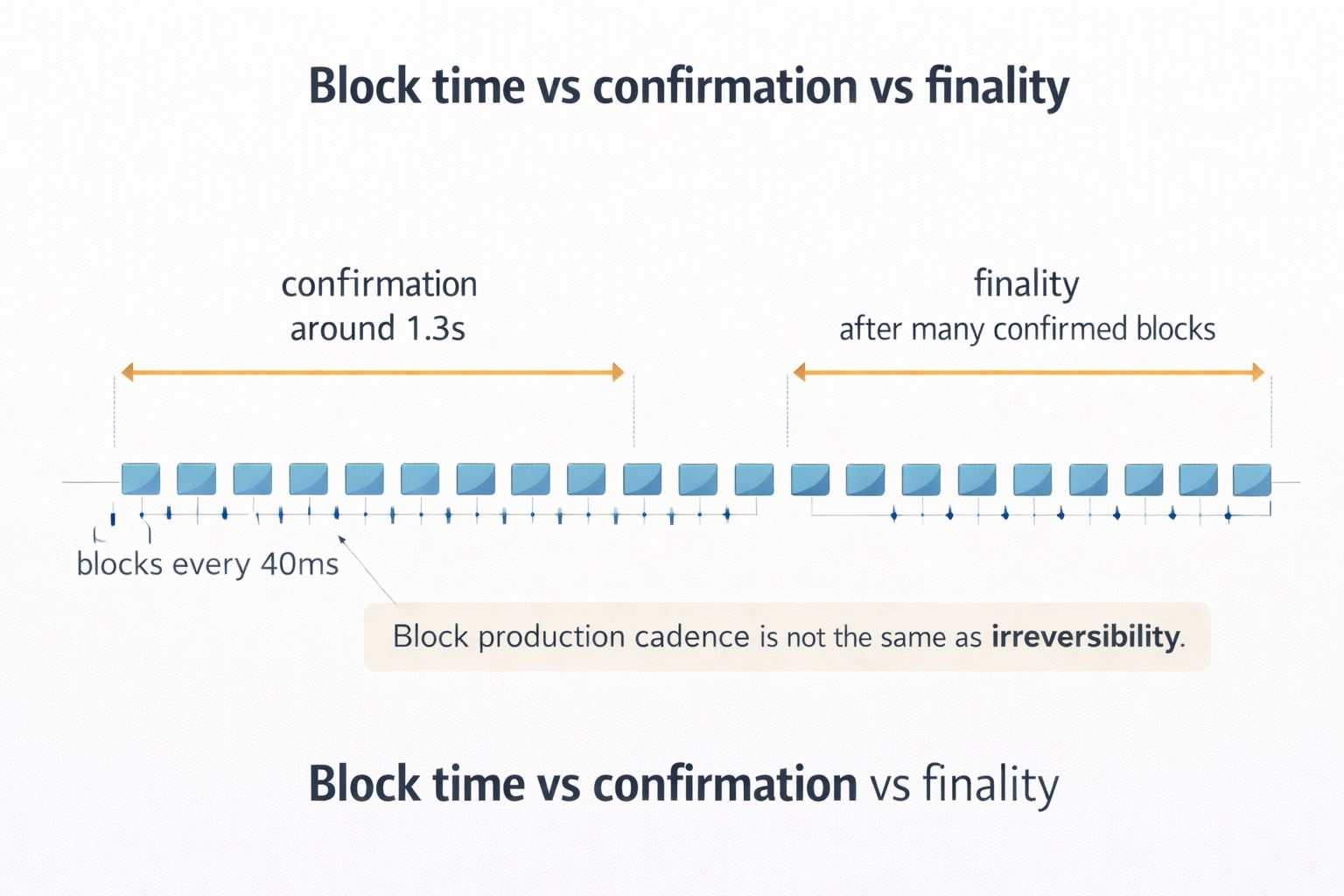
So when a chain says 40 millisecond blocks, it is talking about how often leaders can produce blocks in successive slots under normal conditions. It does not mean your trade is final in 40 milliseconds. It means the system is capable of proposing a new block at that pace.
Now add another word. Confirmation.
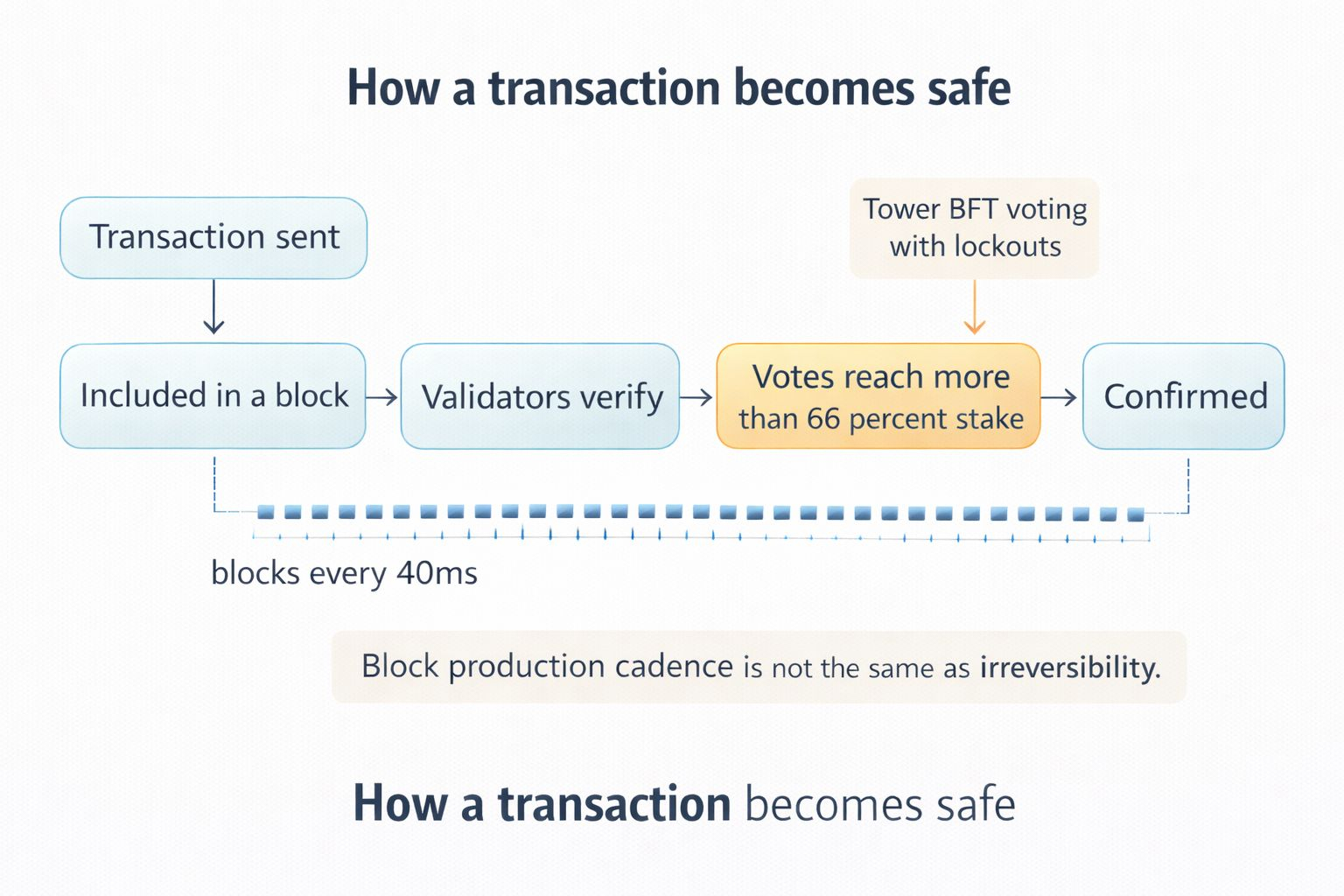
In Solana derived consensus, validators vote on blocks. A block becomes confirmed when enough stake has voted for it on the majority fork. Fogo’s litepaper explains that a block is considered confirmed once more than 66 percent of stake has voted for it on the majority fork. (api.fogo.io)
This step takes longer than the raw block production interval. Even if blocks are proposed every 40 milliseconds, votes still need to propagate across the validator set. The leader proposes. Other validators verify. They cast votes. Those votes travel back through the network. Only after the threshold is reached does the block reach confirmed status.
Then there is finality.
Finality is stronger than confirmation. It means the network has built enough additional blocks on top of a given block that reversing it would require a massive shift in stake and lockouts. Fogo’s litepaper notes that maximum lockout is commonly represented as 31 or more confirmed blocks built on top of a block. That is when it is considered finalized in practice. (api.fogo.io)
So the timing stack looks like this in human terms.
First, a block is proposed in a slot. That is the fast part. Then the block gathers votes until it is confirmed. That is slower. Then more blocks are built on top until it is finalized. That is slower still.
When Fogo markets around 40 millisecond blocks and about 1.3 second confirmation, it is separating these layers. The 40 milliseconds refers to the block production rhythm. The 1.3 seconds refers to the time it takes, under expected conditions, for enough stake to vote so that the block is confirmed.
This distinction matters for traders.
If you place an order, you care about inclusion first. Was your transaction included in a block. That can happen at the speed of block production. But you also care about how safe that inclusion is. Can it still be replaced by a competing fork. That question lives in the confirmation and finality layers.
Fogo is built on Solana style components such as Proof of History, Tower BFT, and Turbine. Its architecture documentation states that it builds on these foundations while maintaining compatibility at the SVM execution layer.
Proof of History gives the chain a verifiable ordering of events. It acts like a cryptographic clock. Instead of nodes constantly arguing about time, they verify a sequence that proves time passed in a specific order. That allows leaders to sequence transactions quickly.
Tower BFT is the voting system layered on top. Validators vote on forks. Each vote carries a lockout period. As validators keep voting on the same fork, the cost of switching grows. That is how the chain moves from fresh block to deep finality.
Turbine handles propagation. It spreads block data through a tree like structure so the network does not choke on gossip traffic.
In this model, block time is the pulse. Confirmation is the collective agreement. Finality is the long memory.
Where does Fogo’s 40 millisecond world fit inside that structure.
Fogo’s litepaper starts with a blunt constraint. Network distance sets a hard limit. Signals in fiber move at roughly two thirds the speed of light. Round trip times across oceans can easily hit 70 to 170 milliseconds. Consensus often requires multiple message exchanges across a quorum. That means global dispersion stretches settlement time.
Fogo responds with localized consensus zones. Validators are organized into zones, and only one zone is active in consensus during an epoch. Validators outside the active zone stay synced but do not vote or propose during that window.
This design tries to keep the critical voting path physically tight. If the active validators are close to each other, votes can travel faster. That helps shrink the gap between block production and confirmation.
The testnet documentation reinforces the target. It states that the testnet is set up to target 40 millisecond blocks and describes how epochs move consensus between zones.
Now look again at the 1.3 second confirmation figure.
If blocks arrive every 40 milliseconds, then roughly 25 blocks are produced in one second. Confirmation at around 1.3 seconds implies that several blocks are layered on top and enough stake has voted in that time window. That aligns with the idea that confirmation is not instant, even in a fast block regime.
What block time does not mean is instant irreversibility.
It also does not mean your transaction bypasses congestion rules. Execution still depends on leader schedules, transaction priority, and network load. A fast block rhythm can reduce waiting, but it does not remove competition inside a slot.
It also does not mean every slot will be perfectly filled. As Solana documentation notes, not every slot produces a block. Network conditions, leader performance, and other factors can affect output.
So when you hear 40 milliseconds, think cadence. Think heartbeat. Do not think guarantee.
For developers, this layered timing affects design choices.
If you are building a liquidation engine, you may treat confirmation as your safety threshold, not just inclusion. If you are building an order book, you may care about how quickly a competing order can land in the next slot. If you are building a derivatives platform, you may tune margin checks to confirmation depth rather than raw block count.
Fogo’s architecture keeps the execution layer familiar for Solana developers. It states full compatibility with the Solana Virtual Machine so existing programs can migrate without modification.
That means the semantics of accounts, instructions, and runtime behavior remain consistent. What changes is the network posture around them. Zones aim to compress the distance that votes must travel. A performance focused validator path aims to reduce variance that could stretch confirmation time.
In simple terms, Fogo is not redefining what a block is. It is trying to redefine how quickly blocks can move from proposal to agreement in practice.
Inside a 40 millisecond world, speed is real but layered. Blocks appear quickly. Confirmation takes longer. Finality takes longer still. The numbers only make sense when you place them in that stack.
The honest way to read the headline is this. Forty milliseconds is the rhythm of production. About one second is the rhythm of collective agreement. Finality sits deeper.
Once you see the layers, the claim stops sounding magical. It starts sounding engineered.
Mr_Green's view is simple. The headline number matters less than the structure behind it. Many chains compete with bigger figures, louder claims, and wider ambitions. Fogo feels narrower. It is not trying to be everything. It is trying to be precise. It is trying to shape how time behaves inside a network that was designed for trading first.
In the current market, Fogo sits in an early but defined position. It is live. It has launched with a performance identity built around 40 millisecond blocks and fast confirmation targets. It presents itself as an SVM compatible Layer 1 focused on latency sensitive DeFi. That places it inside the Solana style ecosystem rather than outside it. It is not fighting the SVM model. It is leaning into it while adjusting the network layer around it.
The broader crypto market today is crowded with general purpose chains. Many promise scale. Many promise throughput. Few focus their entire narrative on how confirmation timing feels under pressure. Fogo’s market posture is tied to that difference. It is competing in a segment where execution quality, slot cadence, and confirmation depth are part of the product itself.
Whether it becomes a major venue will depend on more than block intervals. It will depend on sustained performance under real load, liquidity depth, validator expansion, and how well its design choices hold up when markets are volatile. For now, its status is that of a performance driven SVM chain carving out a clear thesis in a competitive field.
Inside a 40 millisecond world, what matters is not only how fast a block appears. What matters is how the system behaves when it counts. That is the real test, and that is where Fogo is placing its bet.