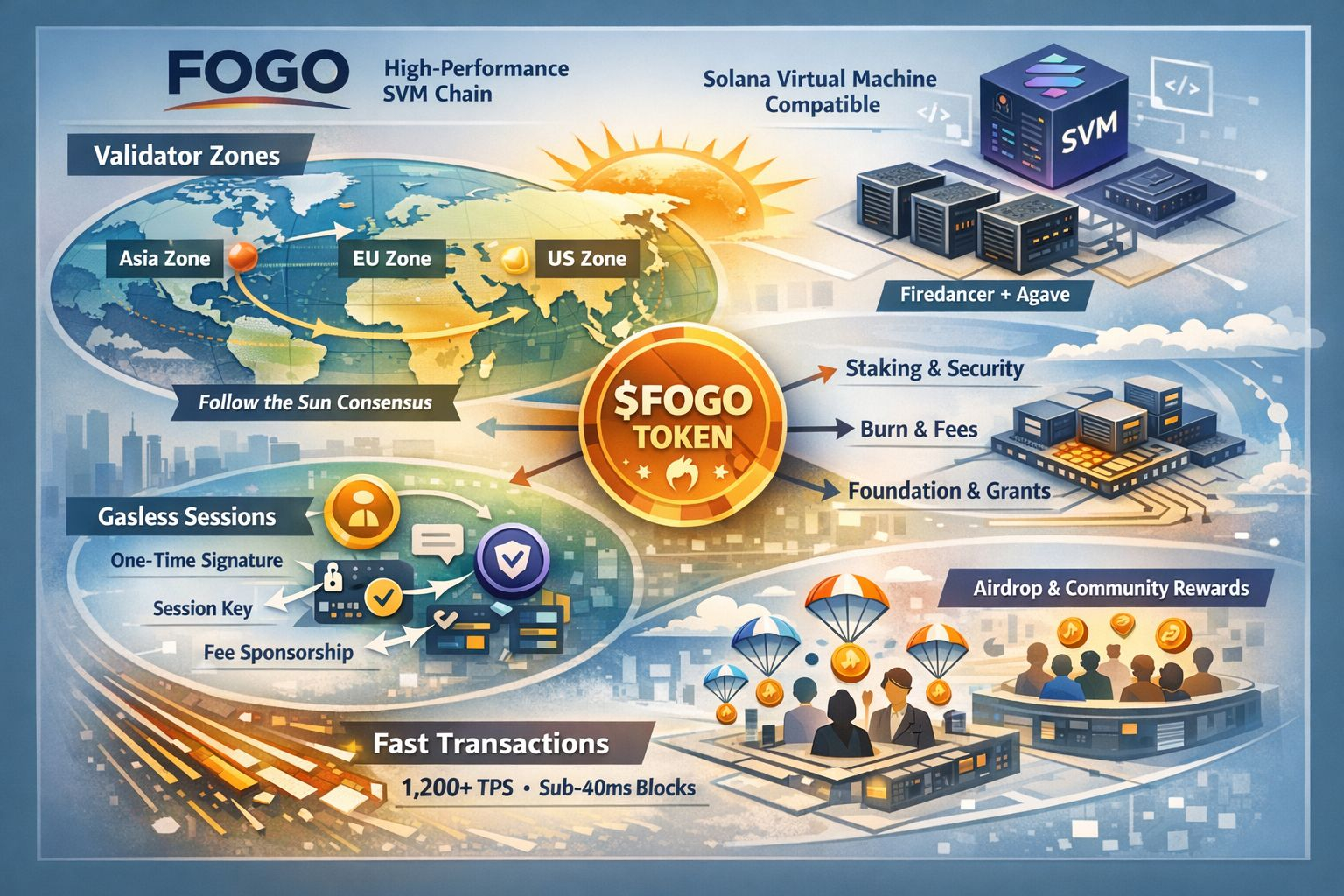
Fogo is built around a simple, uncompromising belief: if you want onchain apps to feel instant and fair, you have to treat latency as a core protocol problem—not an afterthought that “scales away” with more hardware. Instead of changing the developer paradigm, Fogo keeps the Solana Virtual Machine at the center so teams can build with the same mental model they already use for SVM programs, accounts, and high-throughput execution. The point isn’t novelty for its own sake; it’s to preserve what already works in the Solana-style stack while reworking the parts that most directly decide how fast and consistent confirmations feel in the real world.
Where many chains treat geography like an inconvenience, Fogo leans into it. Its architecture introduces validator “zones” and makes the active consensus set smaller and more localized during a given epoch, while the rest of the network stays synced but off the voting critical path. In practice, the protocol rotates which zone is active, and it even describes a “follow-the-sun” approach that shifts the active zone over a 24-hour cycle. The intention is direct: reduce the distance that votes and blocks must travel during the moments that matter, shrinking the latency tail that users actually notice.
That focus on consistency continues inside the validator client itself. Fogo emphasizes high-performance execution and networking components derived from the Firedancer lineage, describing a hybrid approach for mainnet that combines Firedancer pieces with Agave. It also highlights a “tile”-style decomposition—isolating functions, pinning them to dedicated CPU resources, and reducing overhead that can introduce jitter. This isn’t just a performance flex; it’s a philosophy of lowering variance so that the network behaves more predictably under load, not merely faster in ideal lab conditions.
The token is positioned to be essential rather than decorative. $FOGO is the native asset for fees and staking, with economics that are meant to reinforce active usage: base fee mechanics that split value between burning and the processing validator, priority fees that reward the block producer, and inflation-driven staking rewards distributed to validators and delegators according to epoch performance. This aligns the token with the network’s day-to-day function—moving transactions through the system and securing it—while keeping the “why hold it?” answer grounded in protocol demand and security participation.
Fogo also pays attention to the human side of onchain performance: user flow. One of its more practical contributions is the idea of Sessions—a pattern where users sign once to create a scoped, time-limited session key, reducing constant wallet prompts while still enforcing clear permissions and limits. Combined with fee sponsorship, this opens the door for apps to feel closer to traditional consumer software without abandoning self-custody. That matters because latency isn’t only about block time; it’s also the friction between intent and completion. A chain can be fast in milliseconds but still feel slow if every action demands repeated approvals and fee management.
On the distribution and incentives side, Fogo’s published tokenomics describe a structure that tries to balance early participation, long-term alignment, and ecosystem growth. The plan explicitly separates community ownership channels (including an airdrop and sales routes) from long-vesting allocations for contributors and investors, with a large portion of genesis supply described as locked and unlocking over multiple years. At the same time, it earmarks meaningful resources for a Foundation to support grants, incentives, and partnerships, including revenue-sharing arrangements intended to push value back toward the network’s center of gravity. The philosophy is clear: performance alone doesn’t produce an ecosystem; liquidity, apps, and sustained developer attention do—and those require deliberate capital formation and distribution rules that avoid short-term extraction.
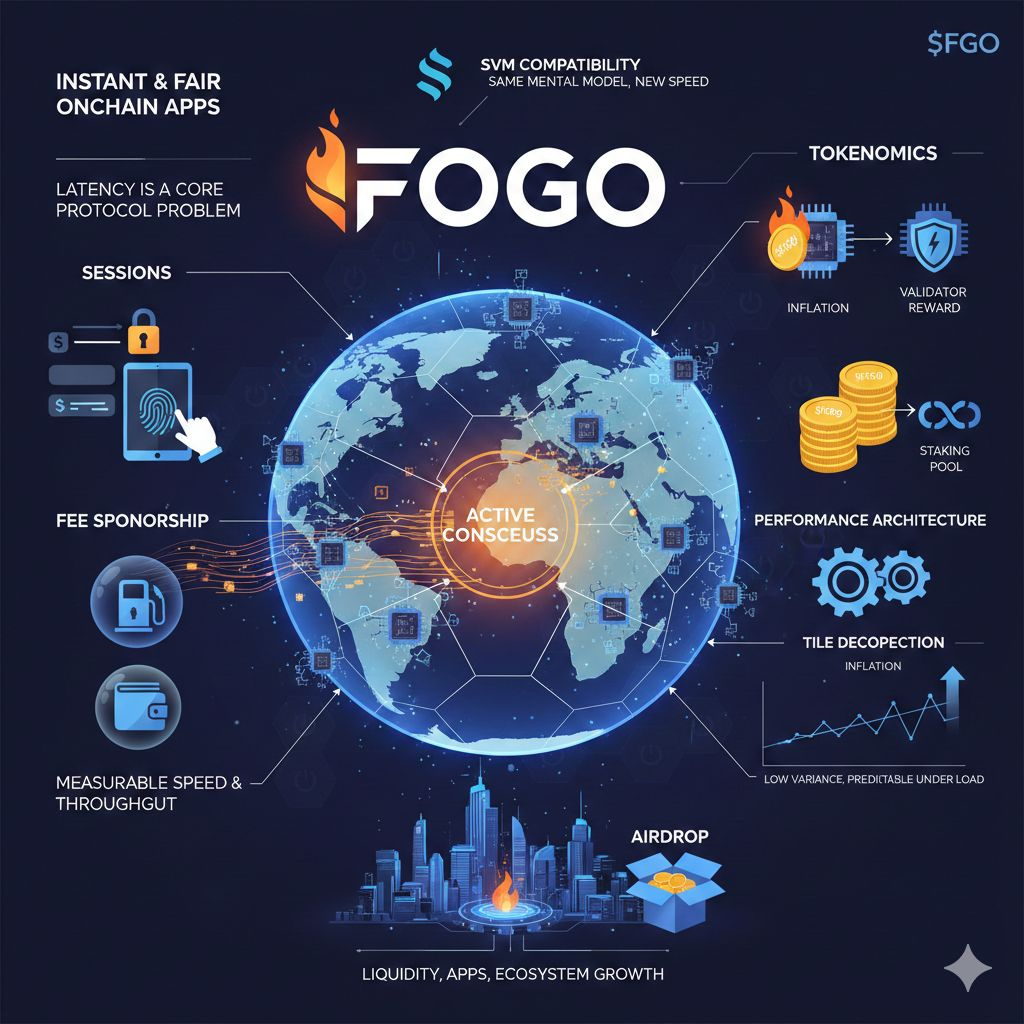
Recent launch-era signals add texture to the thesis. Fogo’s public mainnet launch was framed around live applications, exchange availability, and an airdrop with a defined claim window and eligibility filtering. Public reporting around launch also highlighted performance claims such as very low block times and four-figure TPS with early mainnet activity, presented alongside market snapshots from that period. Whether one treats those metrics as benchmarks to be proven over time or as initial traction points, they indicate what Fogo wants to be judged on: not abstract decentralization slogans, but measurable speed, throughput, and an ecosystem that can actually use them.
Fogo’s most natural place in the wider SVM landscape is as a chain optimized for applications where time is not a nice-to-have but the product itself—order books, auctions, liquidation engines, and any system where a few dozen milliseconds can change outcomes or reduce the value of adversarial latency games. SVM compatibility means it can meet developers where they already are, but the zone approach and performance-focused validator design are a statement that “SVM everywhere” doesn’t have to mean “same latency profile everywhere.” If Fogo succeeds, it won’t be because it offered another place to deploy familiar programs; it will be because it made the same kind of programs behave differently under pressure—more consistently, more fairly, and with a user experience that doesn’t make speed feel theoretical.
The real bet, then, is not simply that Fogo can be fast—it’s that it can make speed durable. Markets don’t reward peak TPS on a quiet day; they reward predictable execution when everyone shows up at once. A token becomes valuable when it sits at the center of that reliability: paying for throughput, securing it via staking, and capturing the upside of an ecosystem that chooses the chain specifically because the “milliseconds layer” is engineered, not wished into existence. If Fogo can keep its latency discipline as the validator set grows, zones rotate, and applications become more adversarial, it has a credible path to turning performance from marketing into moat—and turning $FOGO from a fee token into the financial instrument of that moat.