

Introduction
High-performance blockchains are competing to deliver faster transactions, lower latency, and scalable infrastructure for real-time decentralized applications. Among the most talked-about platforms today are Fogo, Solana, and Sui. Each represents a different architectural philosophy, and comparing their performance reveals how next-generation networks are evolving beyond traditional limits.
Raw Speed and Throughput
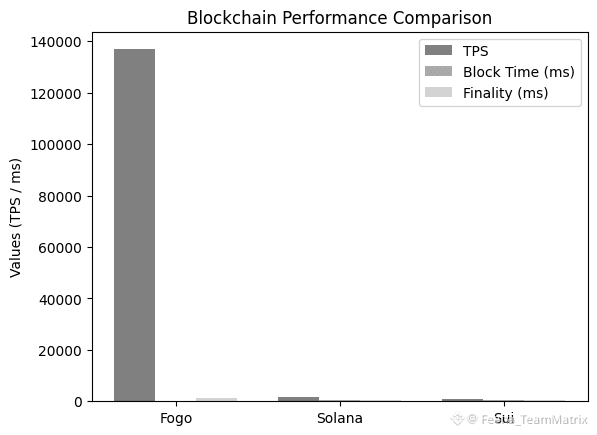
Fogo entered the market in January 2026 claiming up to 136,866 transactions per second (TPS) with 40 ms block times, positioning itself as about 18× faster than Solana and Sui in its early benchmarks.
Solana has long been considered one of the fastest major blockchains. Real-world averages vary depending on measurement methods, but it commonly achieves around 1,000+ TPS daily average, with peaks above 1,500 TPS and theoretical capacity of 65,000 TPS or more.
Sui, meanwhile, advertises extremely high theoretical throughput of about 297,000 TPS, though real-world usage shows much lower numbers, such as 36 TPS hourly averages and peaks near 926 TPS in recent block samples.
Takeaway: Fogo leads on claimed raw throughput, Solana dominates consistent real-world throughput, and Sui still has a gap between theory and practice.
Latency and Finality
Latency determines how fast a transaction becomes irreversible.
Fogo: ~40 ms block time and ~1.3 s finality.
Solana: Finality around 400–600 ms in real conditions.
Sui: Around 390–400 ms finality under optimal conditions.
While Fogo’s block production is extremely fast, Solana and Sui currently compete more closely in real-world confirmation speed.
Architecture Differences
Architecture is the real reason these performance differences exist.
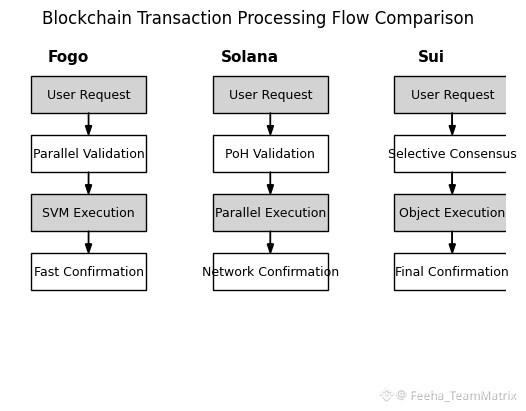
Fogo uses the Solana Virtual Machine (SVM) and parallel execution to maximize throughput while supporting real-time DeFi workloads.
Solana relies on Proof-of-History plus parallel processing, prioritizing synchronization speed across global nodes.
Sui uses an object-centric model and selective consensus, allowing simple transactions to bypass full validation for faster execution.
Each design represents a different optimization strategy: execution speed, synchronization efficiency, or consensus minimization.
Real-World Ecosystem Performance
Speed alone does not determine success. Ecosystem maturity matters:
Solana has millions of active users and a large developer ecosystem.
Sui’s ecosystem is growing but still smaller, with fewer decentralized applications.
Fogo is new, with only early-stage dApps testing its scalability claims.
This shows that adoption often lags behind technical capability.
Conclusion
Fogo represents a bold leap in blockchain performance claims, potentially redefining throughput standards if its real-world metrics hold up. Solana remains the most battle-tested high-speed chain, balancing strong real-world TPS with a mature ecosystem. Sui offers innovative architecture with massive theoretical capacity but still needs broader adoption and optimization to match its promises.