
1. Project Overview
Rain Protocol represents a sophisticated attempt to create the "Uniswap of Prediction Markets" - a fully decentralized, AMM-powered infrastructure for event-based trading. Built primarily on Arbitrum with cross-chain support for Ethereum, Base, and BNB Chain, the protocol enables permissionless creation of prediction markets across any scale of events, from global politics to niche scenarios.
Core Narrative: Rain aims to democratize prediction markets through automated market maker infrastructure, eliminating the need for centralized order books while maintaining capital efficiency. The protocol's differentiation lies in its AI-powered resolution system (Delphi oracle) and flexible market creation that supports both public and private prediction environments.
Current Status: Mainnet live since 2025, with ongoing ecosystem expansion through the "Pre-Season Raindrop" points program leading to eventual token distribution.
2. Product & Technical Stack
Core Architecture
Rain employs a standard constant product market maker (x*y=k) model for binary outcome tokens, rather than specialized prediction market AMMs like LMSR. This design choice prioritizes simplicity and compatibility with existing DeFi infrastructure while supporting markets of any size.
Market Creation Mechanics:
Permissionless creation with minimum $10 liquidity requirement
Two market types: Public (visible to all) and Private (code-gated)
Standard fees plus $1 additional for AI oracle resolution
Cross-chain deposit support (USDT, USDC, ETH, BNB across multiple networks)
Execution & Settlement: The protocol's most innovative feature is the Delphi AI Oracle developed by Olympus AI, which uses a multi-agent architecture:
Five "Explorer Agents" powered by leading LLMs independently gather information
One "Extractor Agent" analyzes findings and reaches consensus
Resolution requires majority agreement among agents
Built-in dispute process with human escalation capability
Rain VM Infrastructure: The protocol includes a specialized virtual machine that enables:
Spreadsheet-like syntax for contract creation
~6.6k gas to load scripts + 170 gas per opcode
5-10% overhead compared to optimized Solidity
Self-auditable code for users without development background
3. Tokenomics & Funding
RAIN Token Economics
Current Price: $0.0100 (as of 2026-02-16 13:00 UTC)
Market Cap: $4.78B
Fully Diluted Valuation: $11.3B
Total Supply: ~1.15 trillion RAIN
Circulating Supply: 478B (41.6% of total)
Token Utility: Governance, fee capture, staking incentives, ecosystem rewards
Supply Distribution: The token distribution remains somewhat opaque, but we've identified:
Enlivex Therapeutics holds approximately 76B RAIN (~6.6% of total supply)
Treasury allocation appears significant but undisclosed
Deflationary buy-and-burn mechanism via protocol fees
Funding History:
Q4 2025: $250M venture round during broader crypto VC surge
Strategic Investment: Enlivex Therapeutics allocated $212M to RAIN token treasury
Backers: Traditional VC details undisclosed; team appears pseudonymous
4. Users & On-chain Metrics
Network Activity (DeFiLlama Data)
TVL: $3.83M (entirely on Arbitrum)
24h Volume: $110,432
7D Volume: $579,127
Annualized Revenue: $671,451
Revenue Yield: 17.53% (Revenue/TVL)
Ecosystem Signals:
Recent Kraken exchange listing (February 2026)
Pre-season points program driving initial user acquisition
Social presence growing but still nascent (2,600-4,600 views per tweet)
Community engagement around "Rainor" mascot campaign
5. Protocol Revenue & Economics
Revenue Sources:
Trading fees (standard AMM fees)
Market creation fees
$1 AI resolution premium for public markets
Potential future governance-controlled fee parameters
Economic Alignment: The protocol creates multiple stakeholder value loops:
Liquidity Providers: Earn fees from market trading
Market Creators: Potentially earn from market activity
Resolver Network: AI oracle providers compensated via resolution fees
Token Holders: Value accrual through buy-and-burn mechanism
Capital Efficiency Analysis:
Rain demonstrates strong revenue yield (17.53% annualized) but extremely low volume-to-TVL efficiency (2.88%) compared to established players, indicating early-stage liquidity bootstrapping challenges.
6. Competitive Landscape
Comparative Analysis
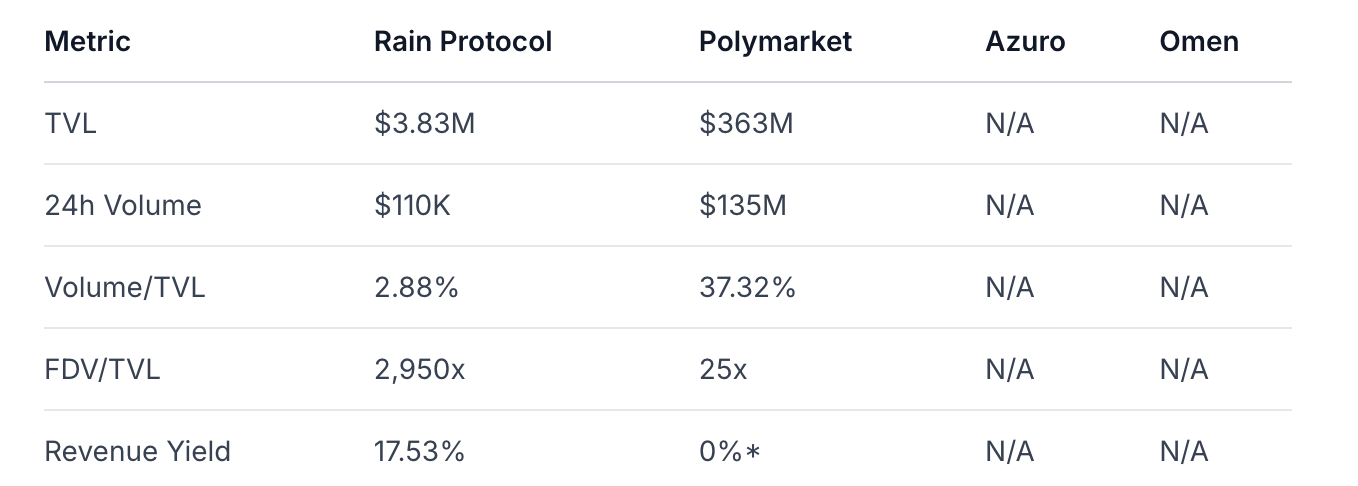
*Polymarket collects fees but doesn't currently distribute to token holders
Key Differentiators:
Technology: Rain's AI oracle vs. Polymarket's crowd-resolution
Market Creation: Permissionless vs. curated approach
Architecture: AMM-based vs. order book hybrid
Cross-chain: Native multi-chain support vs. Polygon-focused
7. Governance & Risk
Governance Model
The protocol is designed to evolve into full on-chain governance controlled by RAIN token holders, with authority over:
Treasury management and fund allocation
Fee parameter adjustments
Protocol upgrade decisions
Ecosystem incentive programs
Technical Risks
Oracle Manipulation: Despite multi-agent design, AI oracles represent unproven attack surfaces
Liquidity Fragmentation: Many small markets could dilute liquidity efficiency
Smart Contract Risk: Complex AMM + oracle integration increases potential vulnerability surface
Resolution Disputes: Human escalation process untested at scale
Regulatory Risks
Prediction markets face significant regulatory uncertainty across jurisdictions:
US CFTC approval for competitors creates both precedent and competitive moat
European markets often classify prediction markets as gambling
Asian jurisdictions particularly restrictive
Enlivex partnership provides some institutional validation but also concentration risk
Competitive Risks
Polymarket: Established liquidity network effects and regulatory progress
Kalshi: CFTC-regulated, traditional finance backing
Azuro/Omen: Earlier DeFi-native approaches with existing communities
Barriers to Entry: AMM design relatively easy to fork, though AI oracle provides some technical moat
8. Project Stage Assessment
Product-Market Fit: Early signs of traction with Kraken listing and Enlivex partnership, but actual usage metrics remain modest compared to valuation. The protocol addresses genuine pain points in prediction market accessibility.
Competitive Positioning: The "Uniswap of prediction markets" thesis is compelling but unproven. Rain's technical differentiation (AI oracle, Rain VM) provides potential moat, but liquidity network effects will be crucial for long-term success.
Growth Drivers:
Cross-chain expansion to Ethereum, Base, and BNB ecosystems
Creator-driven market adoption through low barriers to entry
Institutional usage via Enlivex partnership model
Potential regulatory arbitrage through decentralized structure
Final Score (1-5 stars)
Core Protocol Design: ⭐⭐⭐⭐☆ (4/5)
Innovative AMM + AI oracle combination, though unproven at scale
Liquidity Architecture: ⭐⭐☆☆☆ (2/5)
Current efficiency metrics concerning despite solid theoretical design
Token Utility: ⭐⭐⭐☆☆ (3/5)
Clear value accrual mechanism but extreme valuation raises questions
Market Infrastructure Moat: ⭐⭐⭐☆☆ (3/5)
Technical differentiation exists but easily forkable base AMM
Developer Ecosystem: ⭐⭐☆☆☆ (2/5)
Rain VM is innovative but ecosystem still early-stage
Governance & Risk Management: ⭐⭐☆☆☆ (2/5)
Pseudonymous team, regulatory uncertainty, concentration risks
Overall Score: ⭐⭐⭐☆☆ (3/5 - Speculative with High Risk/Reward Profile)
Summary Verdict
Rain Protocol represents a high-risk, high-potential infrastructure bet in the emerging prediction market sector. While the technology stack is innovative and the Enlivex partnership provides validation, current valuation vastly outstrips fundamental usage metrics. Investors should consider this a speculative position sized appropriately for the significant regulatory, execution, and liquidity risks involved.
Capital Allocation Perspective: For venture portfolios, a small position (1-2%) could capture upside from prediction market adoption while limiting exposure to early-stage risks. For liquidity providers, current yield attractive but dependent on volume growth. Traders should await clearer liquidity signals before significant allocation.
Data Current As: 2026-02-16 13:00 UTC
Sources: DeFiLlama, TokenTerminal, Dune Analytics, CoinGecko, project documentation, news reports
Limitations: Azuro and Omen metrics unavailable; team details pseudonymous; some tokenomics elements undisclosed
Developer Ecosystem: ⭐⭐☆☆☆ (2/5)
Rain VM is innovative but ecosystem still early-stage
Governance & Risk Management: ⭐⭐☆☆☆ (2/5)
Pseudonymous team, regulatory uncertainty, concentration risks
Overall Score: ⭐⭐⭐☆☆ (3/5 - Speculative with High Risk/Reward Profile)
Summary Verdict
Rain Protocol represents a high-risk, high-potential infrastructure bet in the emerging prediction market sector. While the technology stack is innovative and the Enlivex partnership provides validation, current valuation vastly outstrips fundamental usage metrics. Investors should consider this a speculative position sized appropriately for the significant regulatory, execution, and liquidity risks involved.
Capital Allocation Perspective: For venture portfolios, a small position (1-2%) could capture upside from prediction market adoption while limiting exposure to early-stage risks. For liquidity providers, current yield attractive but dependent on volume growth. Traders should await clearer liquidity signals before significant allocation.
Data Current As: 2026-02-16 13:00 UTC
Sources: DeFiLlama, TokenTerminal, Dune Analytics, CoinGecko, project documentation, news reports
Limitations: Azuro and Omen metrics unavailable; team details pseudonymous; some tokenomics elements undisclosed