

@Fogo Official The first thing I noticed about Fogo is that it doesn’t try to win you over with philosophy. It tries to win you over with behavior. When markets are calm, almost every chain looks acceptable from the outside.You only really see the difference when things get tense—when you’re late and price is moving. Fogo feels more serious there. It treats time as a hard limit, not marketing, and it treats reliability as something you engineer early, not promise later. Even the way it explains performance is grounded: real-world limits plus operational discipline, not just “better code.If you spend enough time around trading systems, you learn a quiet truth that doesn’t show up in glossy demos: most “fairness” debates are really “latency variance” debates in disguise. People argue about who got filled first, who saw what first, who had the advantage, but underneath that is a simpler question—how predictable is the path from intent to settlement? Fogo’s own writing leans into this without flinching. It talks about the speed limit of networks in plain terms, and it admits something many projects avoid admitting: the network is often governed by the slowest and noisiest parts of the system, not the average case. In other words, the story isn’t about the best moment. It’s about the worst moment, because that’s the moment that decides whether users feel safe.
What makes that matter emotionally is that traders don’t experience infrastructure as “technology.” They experience it as a sequence of tiny trust decisions. Do I click again? Do I cancel? Do I hedge? Do I wait? Every extra second, every uncertain confirmation, every inconsistent response trains people into defensive behavior. They start overpaying for safety, they start building habits around fear, and eventually they start assuming the system will betray them during volatility—because it usually does. Fogo’s thesis tries to reverse that training loop by making the system’s timing less of a mystery. It’s not asking users to be more patient. It’s trying to earn the right to be trusted under pressure.
There’s another layer here that I think “pros” instantly recognize: performance is never just a protocol problem. It’s an operations problem. The distance data must travel is real, and the variance between machines is real, and the chaos of adversarial conditions is real. Fogo’s litepaper spends an unusual amount of time acknowledging that reality and building around it—reducing the distance on the critical path and reducing the spread in validator behavior so that the chain is shaped less by outliers and more by a predictable quorum. That’s not romantic, but it’s the sort of unglamorous thinking that lets a system keep its promises when people are angry and liquidity is thin.
That same mindset shows up in how Fogo approaches geography. Instead of pretending the world is flat, it treats topology as a design parameter, with the ability to shift where “the fast path” lives over time. The point isn’t to create a perfect world where everyone is equally close every second; the point is to be honest about who is close right now, and to build a system that can rotate that advantage rather than freezing it permanently. Even if you’ve never read a line of consensus code, you can understand the human consequence: a market feels fairer when the playing field isn’t locked to one privileged location forever, and it feels safer when there’s an explicit plan for what happens if coordination fails.
I also pay attention to what a project says about failure modes, because that’s where incentives show. Fogo doesn’t frame security incentives as abstract virtue. It describes how rewards flow to the participants who actually show up correctly, on time, consistently—reward calculations tied to validator participation and epoch outcomes, and an ongoing emission rate designed to fund that security posture instead of starving it. That matters because honest behavior on a chain is rarely about morality; it’s about whether the economics punish laziness and reward correct work in a way that’s hard to fake. When incentives match the behavior you want, users feel it as stability.
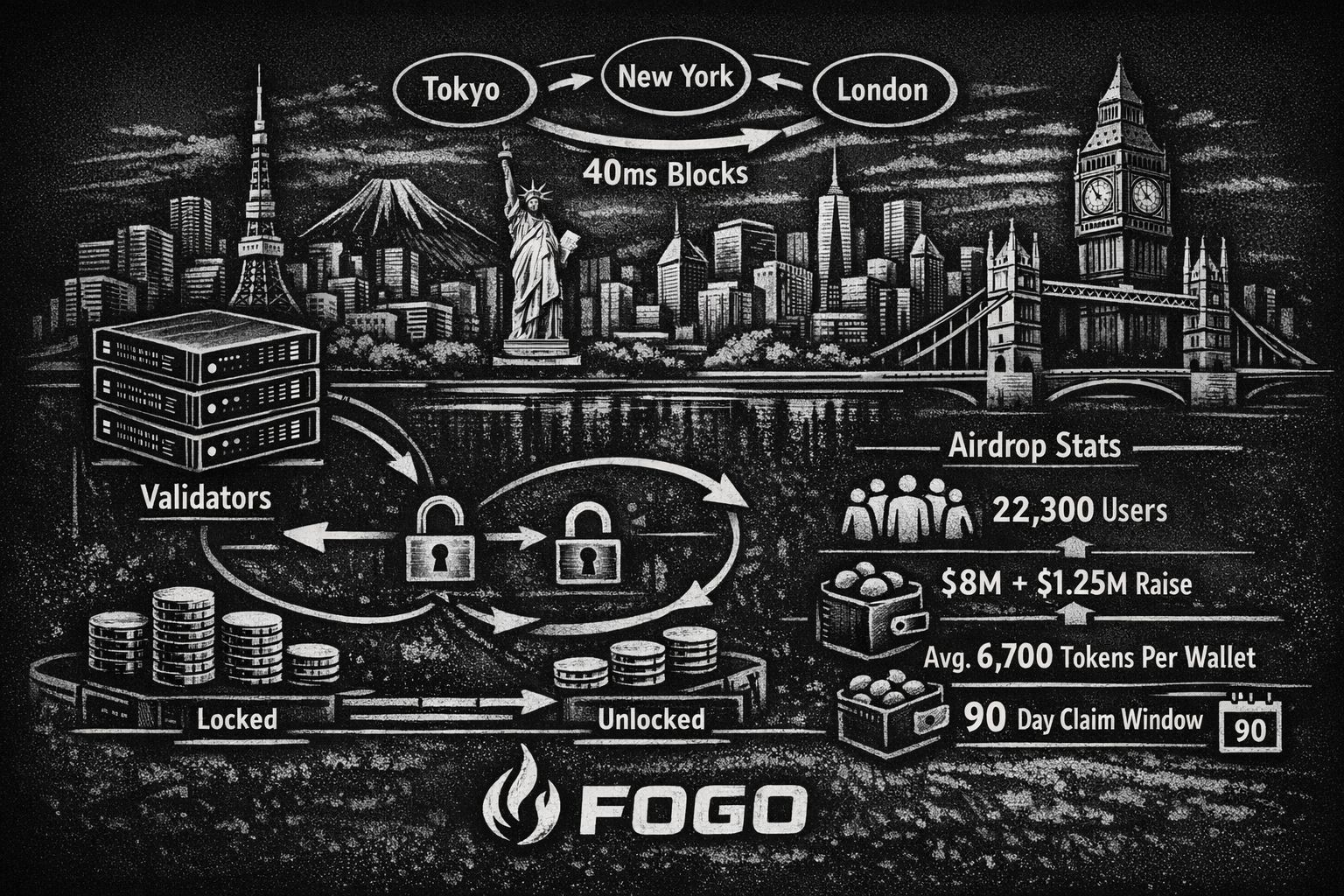
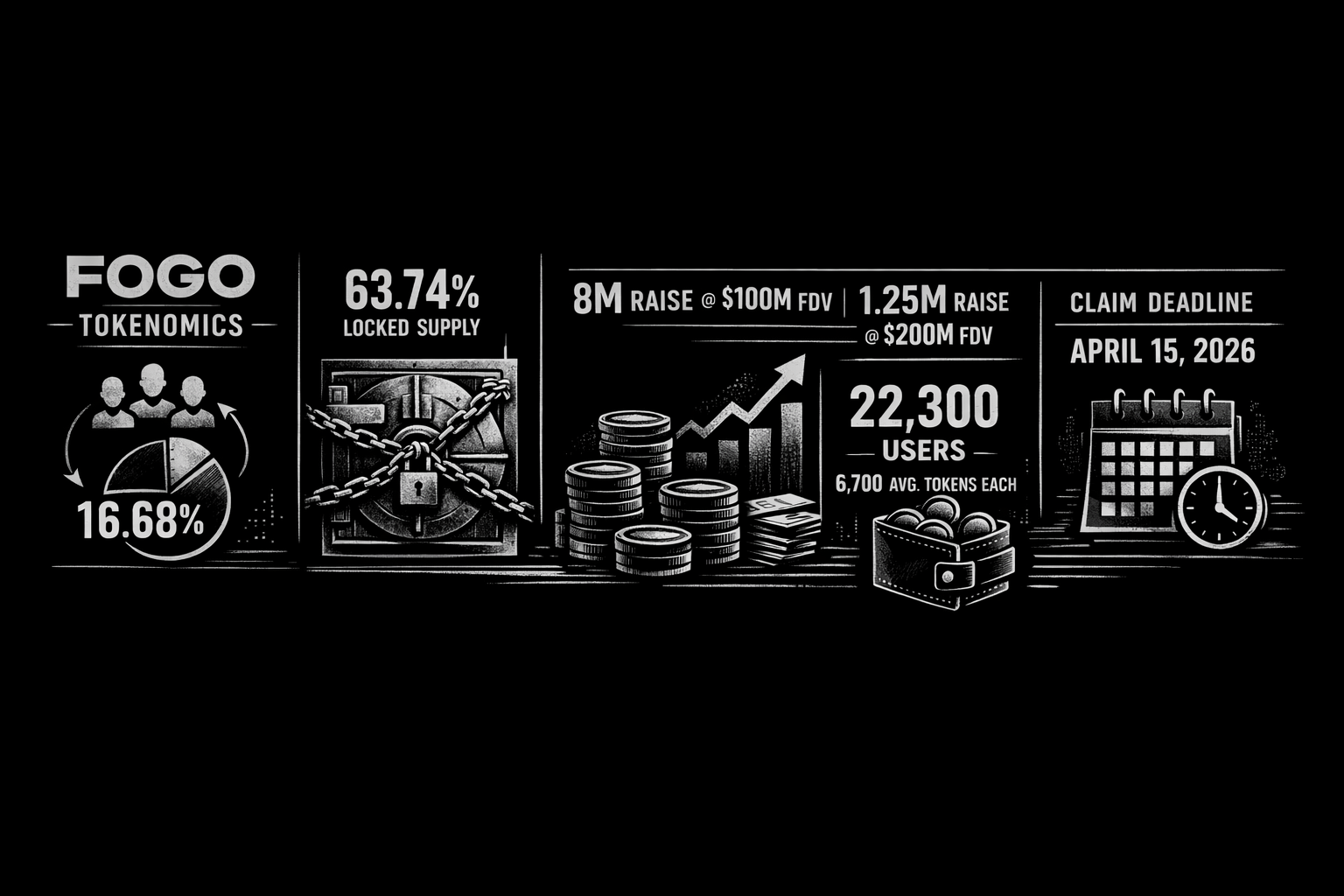
Token design is where a lot of projects accidentally tell the truth about themselves, and Fogo’s recent updates put unusually concrete numbers on the table. In the official tokenomics post dated January 12, 2026, Fogo lays out distribution categories and lock structures, including a combined community ownership bucket at 16.68% that aggregates multiple public/community routes, and it states that at launch 63.74% of the genesis supply is locked with gradual unlocking over four years. It also discloses two community raises on Echo—$8M at a $100M FDV and $1.25M at a $200M FDV across roughly 3,200 participants—alongside a public sale allocation and a fully unlocked airdrop allocation. You don’t have to agree with every choice to appreciate what the transparency does: it reduces rumor, and rumor is one of the most corrosive forces in a young market.
Then, three days later, the airdrop update dated January 15, 2026 gets even more specific in a way I respect. It says the distribution covers about 22,300 unique users, with an average allocation of roughly 6,700 tokens per wallet, fully unlocked. It states the claim window lasts 90 days and closes on April 15, 2026, and it spends real space on integrity work—filtering automated behavior, clustering, and minimum thresholds to avoid dust and reduce farming incentives. People underestimate how emotional this is for communities. When users believe distribution was gamed, they don’t just get mad; they disengage. They stop building, stop providing liquidity, stop taking the system seriously. Anti-abuse work is not a side quest in that context. It’s part of whether the ecosystem can hold its own narrative together.
What I find most telling is how these pieces connect: the performance story and the token story are both, in their own way, about reducing variance. On the network side, it’s variance in confirmation paths and validator behavior. On the economic side, it’s variance in who actually owns the system and whether participation is meaningfully rewarded. And when you reduce variance, you reduce fear. A trader who isn’t constantly guessing what the chain will do is less likely to overreact. A builder who isn’t constantly guessing who can rug the narrative is more likely to commit to shipping. That’s the quiet compounding effect most people miss.
Even the seemingly small design choice of reducing repeated wallet prompts—using a time-limited, scoped authorization model described in the litepaper—has a human consequence that’s easy to overlook. In fast markets, “friction” isn’t just inconvenience; it’s cognitive load at the worst possible moment. Every extra signature is another interruption where users second-guess themselves, or where they learn to accept unsafe defaults just to keep up. By making it possible for applications to sponsor fees and by constraining what delegated authority can do, Fogo is implicitly saying: we want users to move quickly without being tricked into giving away their safety. That is an infrastructure value, not a UX trick.
So when I read the title—built by pros who demand more—I don’t translate “pros” as pedigree. I translate it as intolerance for fragile systems. Professionals don’t need a chain to be loud. They need it to behave. What people need is clarity: what the system optimizes for, what it can’t change, and how it prevents rare glitches from becoming everyday chaos. Fogo’s official updates—tokenomics on January 12, 2026, and airdrop method + timelines on January 15, 2026—suggest they’re trying to ground the project in concrete details, not hype. I keep coming back to this: the best infrastructure is the kind you stop thinking about, because it’s dependable and frees your attention for decisions that actually matter. Fogo’s documents keep circling that responsibility—designing around physical limits, aligning incentives with correct participation, and putting hard numbers on ownership and distribution so fewer things have to be taken on faith. Quiet responsibility looks like that. Invisible infrastructure looks like that. And in modern finance—where uncertainty is already everywhere—reliability matters more than attention ever will.