

@Vanarchain I’ve learned to be cautious any time a project tries to sell me a “perfect triangle” of narratives. AI here, real-world assets there, gaming somewhere in the background—usually it’s a pitch deck shape, not a living system. What’s made Vanar different for me lately is that the triangle isn’t being treated like three separate stories. It’s being built like a single stack where the same underlying habits—how data is stored, how it’s interpreted, how it’s verified—have to survive three very different kinds of stress. And if you’ve ever tried to ship a product that touches finance, identity, and entertainment at the same time, you know stress isn’t theoretical. It’s constant.
When I look at Vanar’s public direction, I don’t start with slogans. I start with the uncomfortable question: what happens when truth is messy and the chain still has to decide? In tokenized assets, “truth” is paperwork, signatures, audits, and timestamps that don’t always agree. In gaming, “truth” is the player’s lived experience: whether the game feels fair, whether the economy feels rigged, whether the rules change when whales show up. And in AI, “truth” is a moving target—outputs that can be confident and wrong at the same time. Vanar’s website keeps coming back to a very specific claim: that the chain is meant to hold not just transactions, but real data, files, and application logic inside the system, so decisions don’t depend on fragile external glue. That’s a serious claim because it shifts blame away from “the oracle was wrong” and onto the infrastructure itself.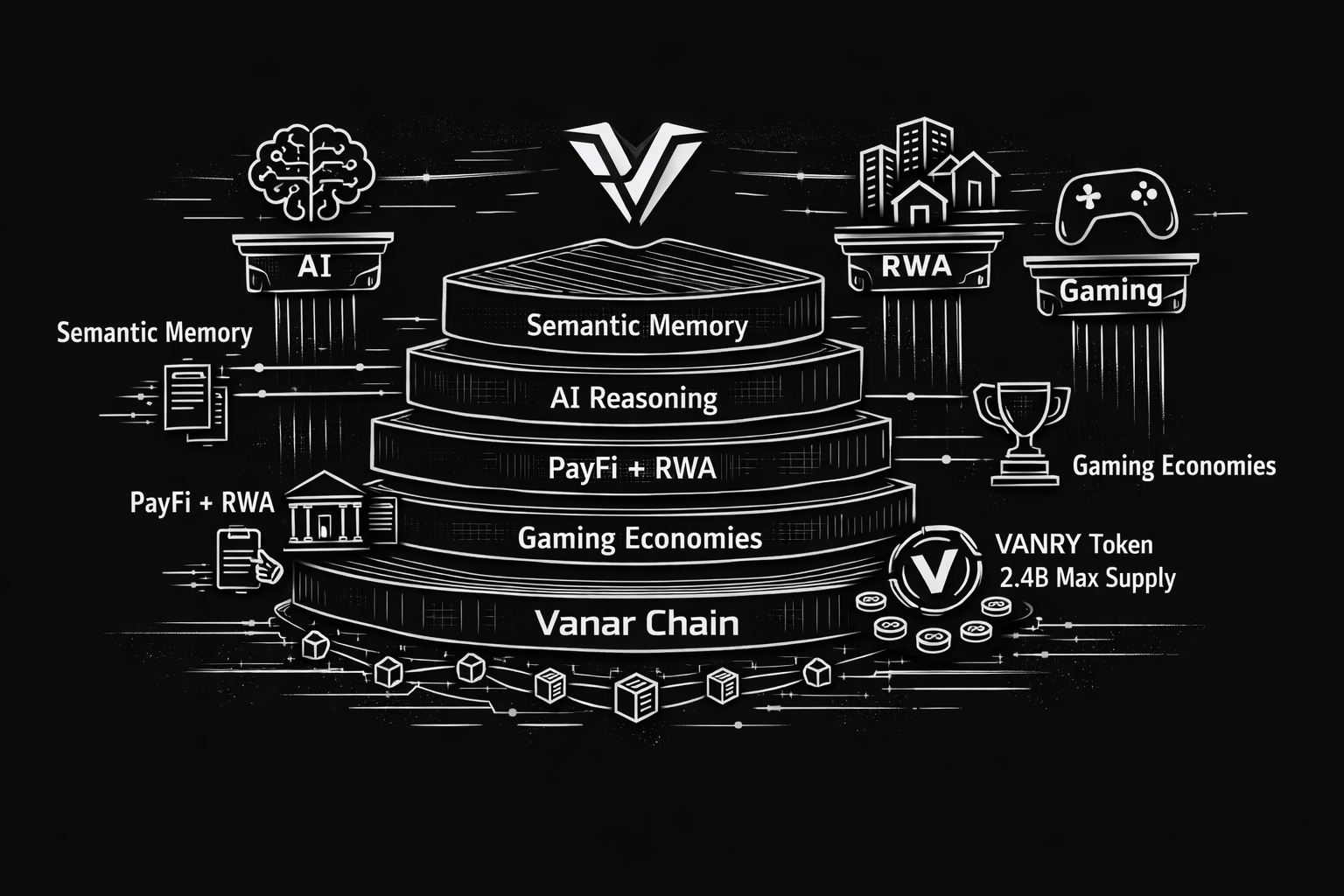
The part that matters most to me is how Vanar frames memory. If you want AI and RWAs to coexist without turning into a compliance nightmare, you need records that don’t rot. A tokenized deed isn’t just a token. It’s a bundle of context: jurisdiction, history, liens, signatures, and the boring but essential trail of how it came to exist. Vanar publicly describes a stack where raw files can be compressed into onchain “memory” that remains queryable and provable, and where reasoning can happen against that data inside the system. I read that as an attempt to make “what the asset is” inseparable from “why we believe it’s real.” That’s the only direction that reduces fear for institutions and everyday users at the same time, because trust stops being a social promise and becomes a repeatable habit.
Now zoom out to gaming, where the stakes are emotional before they’re financial. Gaming economies break when players sense the rules are negotiable. It doesn’t matter how elegant the code is—if the outcomes feel arbitrary, players leave, and the token follows them out the door. The reason Vanar’s gaming angle sits naturally beside RWAs, at least in my mind, is that both require the same kind of credibility under pressure. In RWAs, the pressure is legal and reputational. In gaming, it’s social and psychological. When Vanar talks about building a stack where data can be stored with meaning and used for logic, I immediately picture the moments that ruin games: disputes, chargebacks, item duplication accusations, tournament results contested after the fact.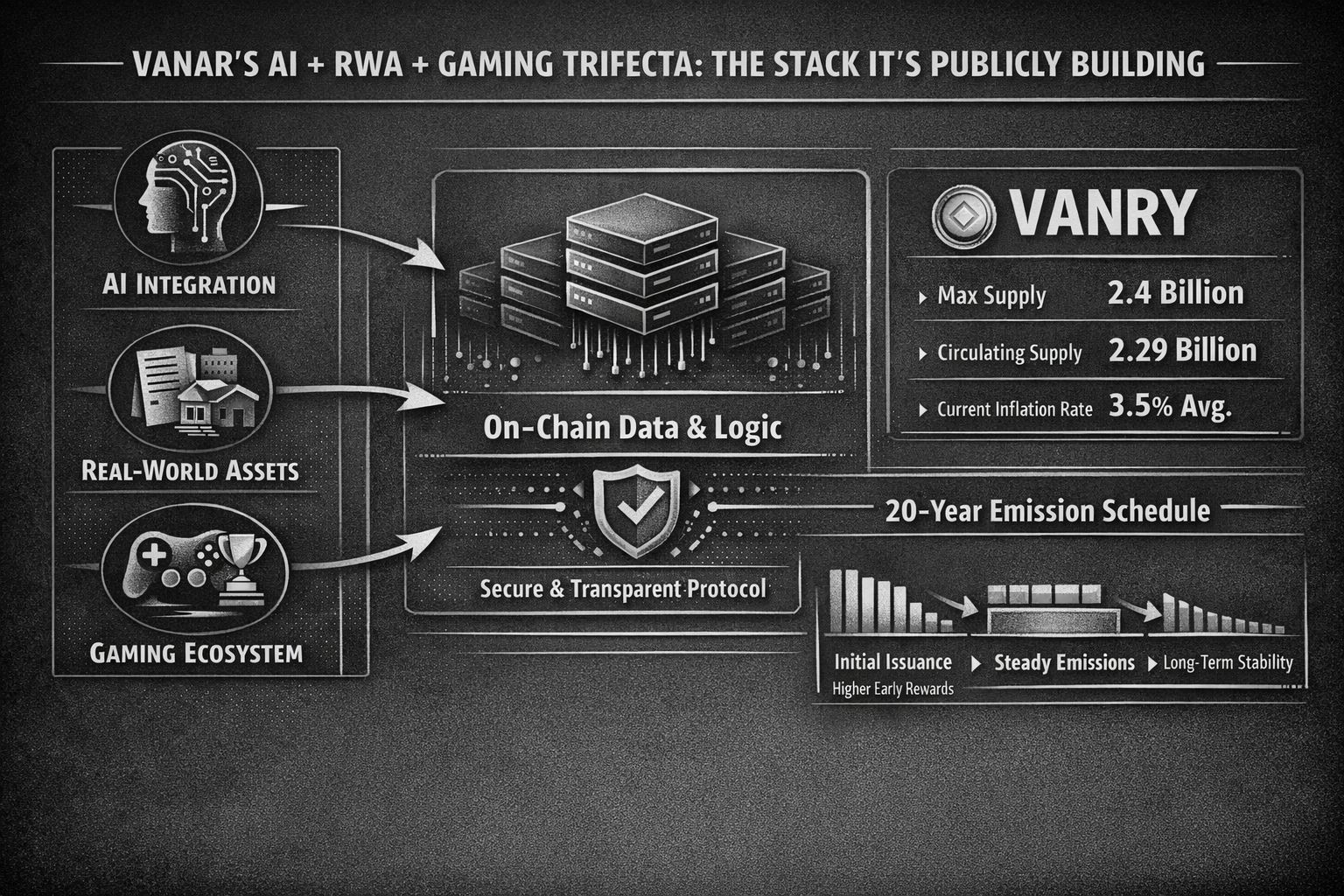 You don’t win those moments by being fast. You win them by being able to explain what happened in a way that feels fair and can be checked later.Vanar’s AI piece doesn’t feel like decoration because they’re pairing it with real integrations and distribution, not only internal prototypes. Their official site frames Vanar as infrastructure for PayFi and tokenized real-world assets, and it highlights familiar partners and ecosystem links that make it look like a product meant to ship into the real world, not stay stuck in a demo environment.That matters because AI without a path to real usage turns into a lab experiment, and RWAs without rails turn into a compliance memo. Vanar’s public framing is that the same onchain intelligence that reasons over records can also support payment flows where validation and rules aren’t an afterthought. When you’ve watched payment systems fail people—silent declines, frozen accounts, “support will get back to you”—you start to appreciate the quiet ambition of making reliability the product.
Token design is where the trifecta either becomes sustainable or becomes a seasonal storyline. Vanar’s documentation is unusually explicit about the long arc: a maximum supply of 2.4 billion VANRY, with issuance beyond genesis coming through block rewards over a 20-year schedule, and an average inflation rate described as 3.5% over that period (with higher early years to support ecosystem needs). I don’t treat those numbers as trivia. I treat them as the project admitting that incentives must be paced. AI development is not a one-quarter sprint. RWA onboarding is slow and full of paperwork. Gaming adoption is fickle and brutally honest. If the token emissions are chaotic, the ecosystem becomes chaotic. If the emissions are predictable, builders can plan, and users stop feeling like the floor is moving beneath them.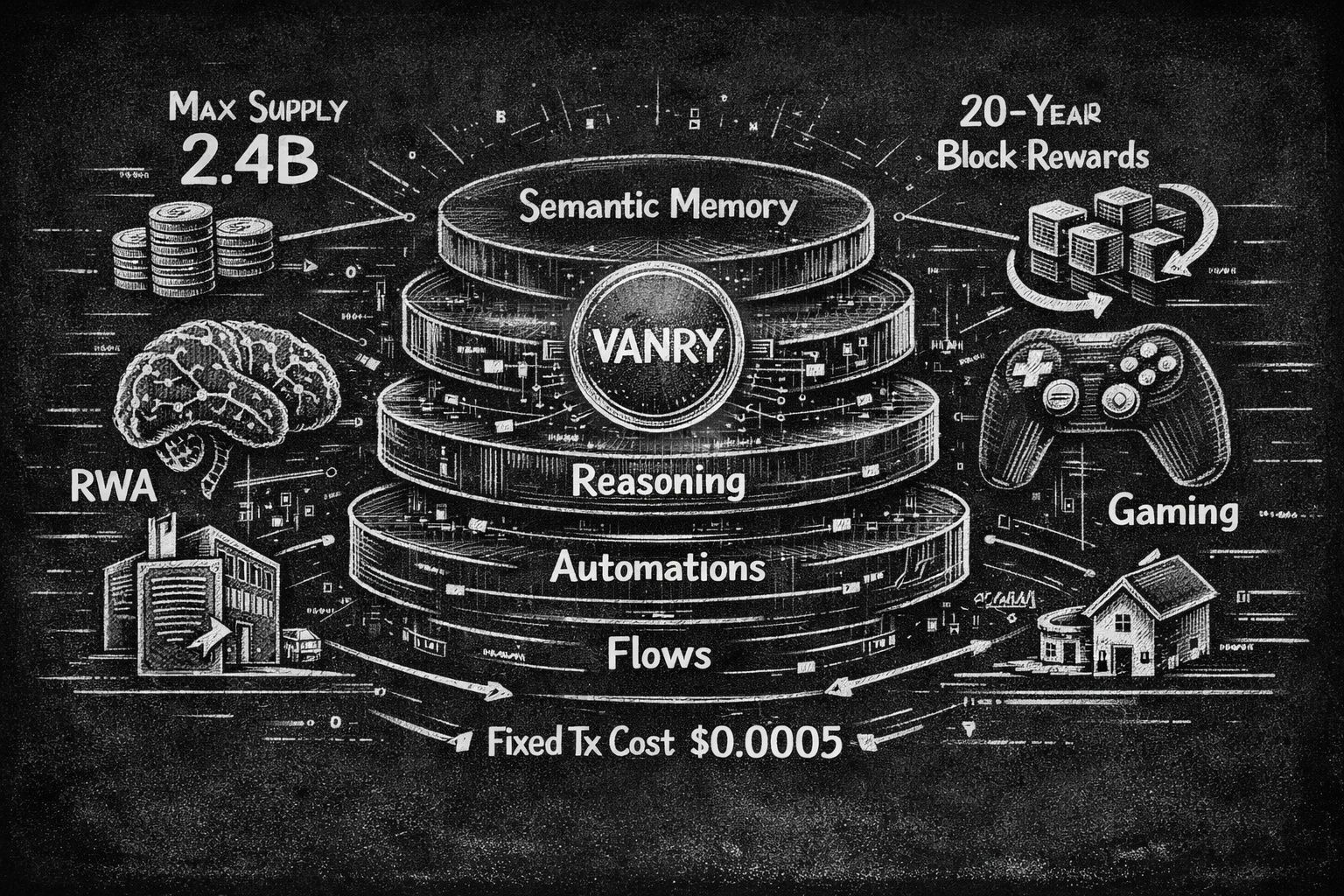
And then there’s the reality check that every serious community needs: what’s actually in circulation, and what does the market think right now? Public market trackers currently list VANRY with a circulating supply a little above 2.29 billion and the same 2.4 billion max supply, which implies the remaining headroom is not huge and makes the emission schedule and utility design even more consequential. I don’t cite this because price is destiny. I cite it because when supply is mostly out, narratives have less room to hide behind “future unlocks.” The token has to earn its place through usage and credibility, not promises.
What I keep coming back to is how the trifecta forces Vanar to confront disagreement. In RWAs, two “official” sources can conflict. In gaming, the community can disagree with the developers about what’s fair. In AI, the model can disagree with reality. A chain that claims to store meaningful data and support reasoning can’t pretend disagreement won’t happen. It has to turn disagreement into a process: preserve records, make claims inspectable, make outcomes reproducible, and make incentives favor honesty when nobody is watching. Vanar’s public descriptions point toward that kind of posture—data as something that stays alive, logic as something that can be traced, and decisions as something that should still make sense later, when emotions have cooled.
Even the “recent updates” that seem like simple ecosystem expansion matter more than people assume, because distribution is also part of reliability. Vanar’s own blog has been highlighting exchange and integration milestones tied to VANRY access and ecosystem growth, alongside explicit messaging about RWA focus and gaming expansions. I don’t read those as victory laps. I read them as plumbing work: widening the set of places where the token can move and the network can be tested by real users with real expectations. The hardest bugs don’t show up in controlled environments. They show up when the system meets human behavior. 
I also pay attention to what Vanar chooses to invest in locally, because that signals whether the AI story is meant to become talent and execution, not just marketing. Vanar’s own announcements around AI initiatives—like its AI Excellence Program messaging—suggest an effort to build a pipeline of people who can actually ship AI work aligned with the chain’s direction. That matters because “AI + chain” only becomes real when it’s maintained, tested, and improved by teams who understand both the messy edges and the boring discipline.
If I had to summarize what Vanar is publicly building with this AI + RWA + gaming trifecta, I’d say it’s a bet on invisible continuity. The chain is presenting itself as a place where data doesn’t die, where logic can be checked, and where tokens are issued on a schedule that tries to respect the pace of real adoption. The numbers matter—the 2.4 billion cap, the 20-year emissions, the stated inflation profile, the already-large circulating supply—because they set boundaries. But the deeper point is ethical: systems that touch people’s money, identity, and play need to behave like adults. Quiet responsibility is not glamorous. Invisible infrastructure doesn’t trend. Yet reliability is what users remember when volatility hits, when a dispute happens, when someone makes a mistake and needs the system to be consistent rather than clever. That’s the kind of attention I think Vanar is ultimately trying to earn—the kind that arrives late, after the noise, because the foundation didn’t crack when it mattered most.