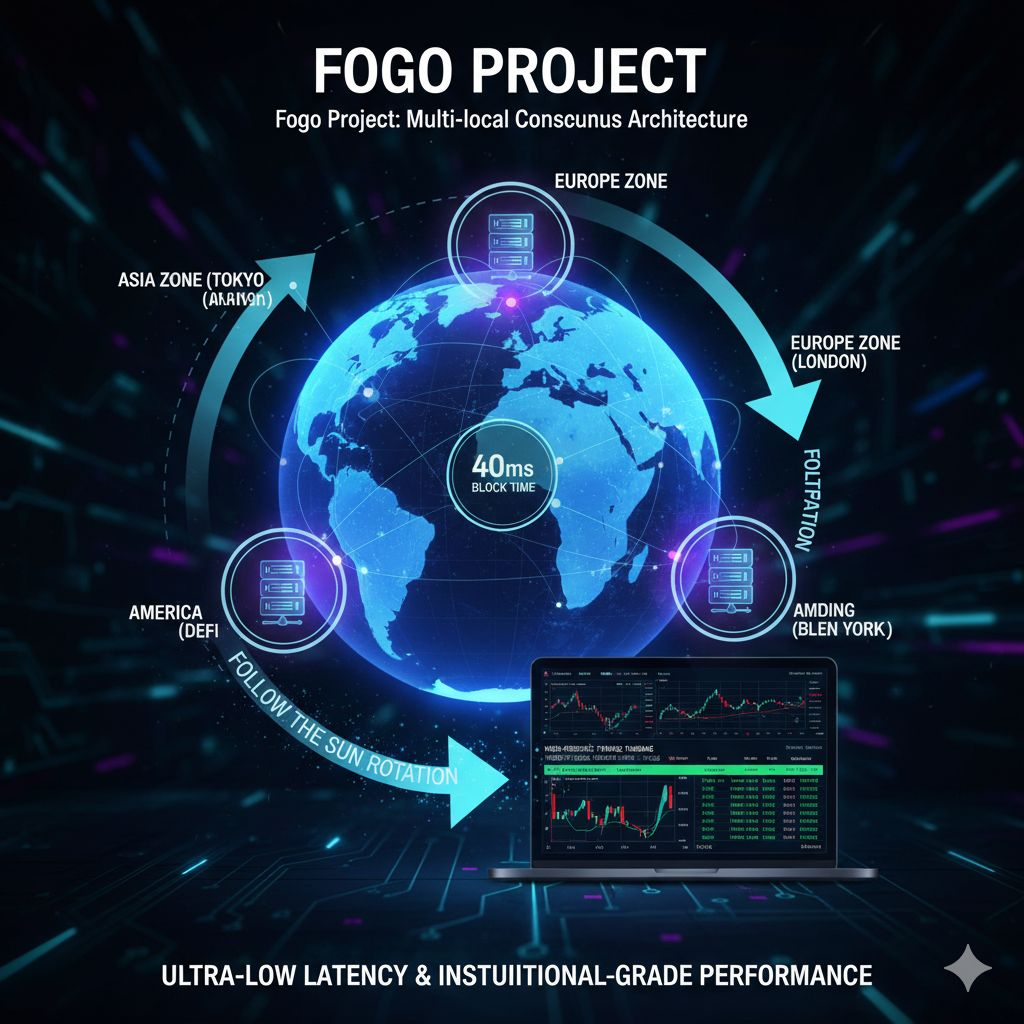
To understand Fogo’s Multi-local Consensus, you have to stop thinking about the internet as "instant" and start thinking about it like a physical highway.
In a normal blockchain, validators are scattered all over the world. When you send a transaction, the data has to travel from your house to a server in Germany, then to a server in Brazil, then to one in Singapore, just to "agree" that the transaction happened. This travel time is limited by the speed of light, which creates a natural lag (latency).
Fogo fixes this by clustering" the work
Geographic Zones:
Instead of asking every node on Earth to talk at once, Fogo groups validators into specific physical hubs—like a high-performance data center in Tokyo, London, or New York
Physical Proximity:
Because these computers are sitting in the same building or the same city, the "talk time" between them is almost zero. This is how they hit that crazy 40ms block timeFollow the Sun To keep things fair and decentralized, the network doesn't stay in one city forever. It uses a "Follow the Sun" rotation where the main consensus power moves across the globe as different financial markets wake up
The Safety Net If a local zone has an issue (like a power outage), the system instantly falls back to a global mode. It gets a bit slower, but it never stops working.
In simple terms It’s like having a relay race where the baton is always held by the fastest runners in the city where the sun is currently shining. This gives you the speed of a centralized exchange (like Binance or Coinbase) but keeps the security of a decentralized blockchain.