
I keep coming back to a mismatch I used to ignore: most legacy blockchains were built to be careful ledgers, and AI workloads behave more like ongoing conversations with data. In my head, an AI-powered product in the wild isn’t doing one big on-chain action every so often. It’s taking lots of little steps in a row—checking context, looking up what’s useful, producing an answer, updating memory—and repeating that cycle. The rhythm is quick and conversational, and it depends on fees and response times not swinging all over the place. Legacy chains struggle with that loop for reasons that are straightforward. They ration computation and storage on purpose so the network stays verifiable and hard to game, and the price of using shared resources is allowed to float with demand. For a contract that runs occasionally, that’s tolerable. For an agent taking many small steps, slow confirmations and fee swings quickly become design constraints.
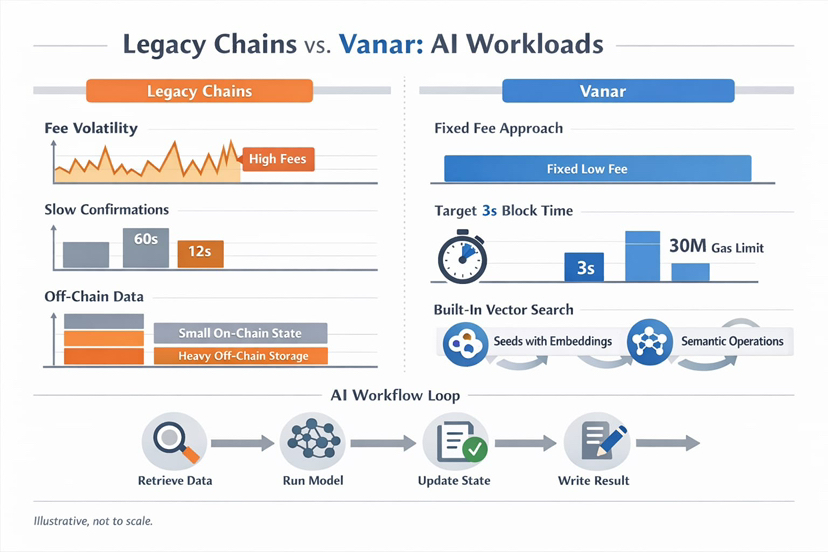
The data mismatch is hard to ignore once you look closely. Most blockchains assume state should be lightweight and orderly. AI context isn’t either of those things; it’s lots of text and history—docs, messages, logs—and then extra derived data like embeddings that help the system retrieve what it needs. Since modern AI leans so heavily on retrieval and memory, developers usually keep most of that context off-chain in databases and processing services, then anchor pieces of it back on-chain with signatures, proofs, or oracles. It works, but it also adds hidden complexity and more failure points than the “clean” architecture suggests at first glance.
What makes Vanar interesting to me is that it starts from the assumption that AI apps need memory and meaning, not just settlement. Vanar describes itself as built for AI workloads, including protocol-level support for AI inference and training, semantic operations, and built-in vector storage and similarity search. It also leans into predictability: its whitepaper describes a fixed-fee approach and a design target of a three-second block time with a 30 million gas limit. I don’t read that as a promise that every AI task belongs on-chain, but it’s a practical acknowledgement that iterative workflows hate latency and cost surprises. And instead of pretending every byte must be stored the same way, Vanar’s Neutron layer frames “Seeds” as searchable units enriched with embeddings, with off-chain storage by default and an optional on-chain layer for ownership, integrity verification, and audit trails when that trade-off is worth it.
I find it helpful to think of this as a choice about where “intelligence” lives. Legacy chains can anchor AI products, but they often force a split brain: the chain for finality, everything else somewhere else. Vanar’s pitch is that the “somewhere else” should be designed into the stack rather than bolted on later, while still staying compatible with familiar tooling through Ethereum-compatible smart contracts. Even if some details evolve, the direction tracks with what people are noticing right now: AI systems are becoming less like single calls to a model and more like persistent actors, and infrastructure either makes that normal—or makes it painful enough that developers give up.
@Vanarchain #vanar #Vanar $VANRY
