
Fogo and the Physics of On-Chain Speed
There’s a moment every builder eventually runs into.
Everything works fine when it’s quiet. The charts are calm. The mempool isn’t screaming. Transactions land. People tweet about “scaling.
Then volatility hits.
Liquidations start stacking. Everyone tries to move at once. And suddenly the chain that felt fast yesterday feels heavy. Orders slip. Blocks wobble. Execution feels… uneven.
That’s when you realize the real problem isn’t just throughput. It’s timing.
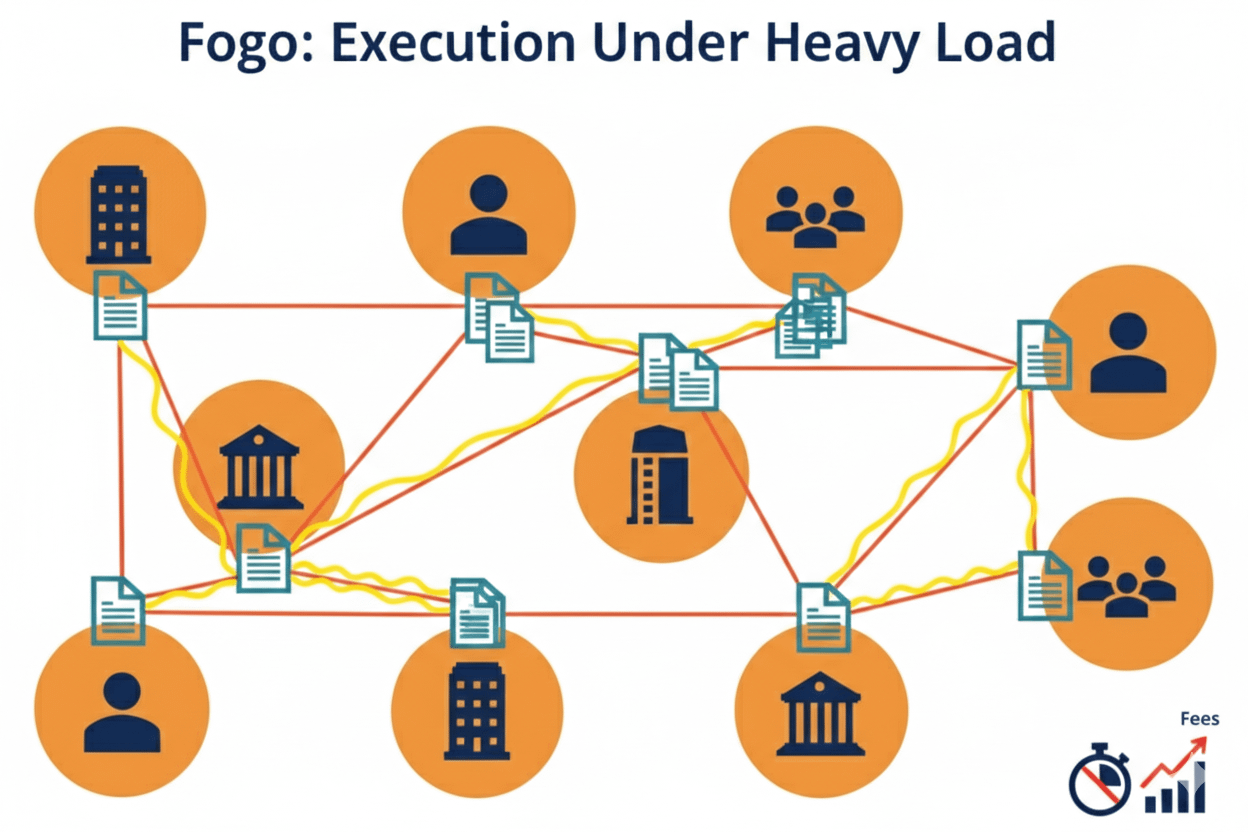
It’s the tiny delays between nodes. The jitter in how information moves. The unpredictable gap between “market moved” and “chain reacted.” In calm conditions, you barely notice it. In chaos, it’s everything.
Fogo feels like it was designed by people who are tired of pretending those gaps don’t matter.
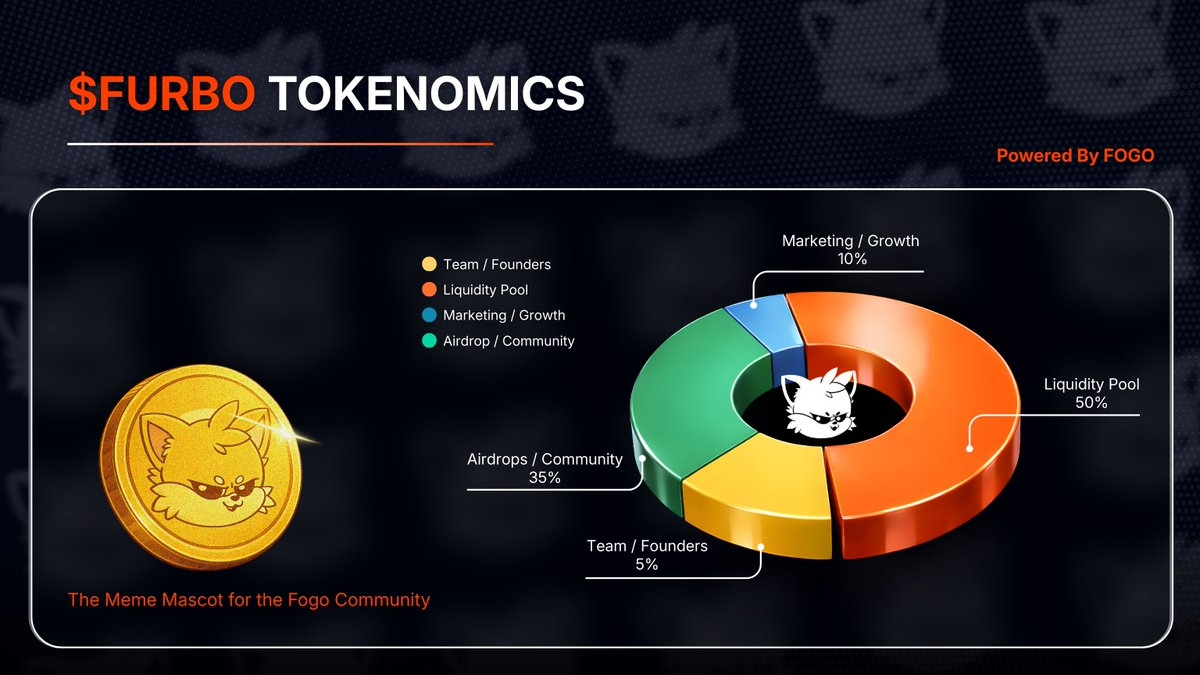
Instead of assuming the internet is magically equal everywhere, it starts with something simple: distance is real. Signals take time. The farther validators are from each other, the more randomness seeps into consensus. And traders don’t feel average speed they feel inconsistency.
So when Fogo talks about colocated validators, it doesn’t read like a gimmick. It reads like a venue mindset.
If you’ve ever looked at how traditional exchanges operate, they don’t scatter their matching engines across the globe for philosophical reasons. They cluster tightly because consistency matters more than ideology when money is moving fast.
Fogo’s zone rotation idea follows that logic. Keep the active validators physically close so consensus settles quickly and predictably then rotate regions over time so no single geography becomes permanent.
It’s not pretending to eliminate trade-offs. It’s choosing them openly.
And that honesty matters.
The same thing shows up in how it approaches the stack itself. Most networks accept a mix of validator clients, different performance levels, different setups. It’s decentralized in spirit but it often means the chain inherits the slowest common denominator.
Fogo instead leans into a high-performance client path, closer to a tightly engineered pipeline than a loose collection of implementations. The goal isn’t just speed. It’s reducing variance.
Because traders can adapt to “slow but steady.” What breaks trust is “fast until it isn’t.”
The worst damage always happens in the tails when the market is stressed, when liquidations cascade, when liquidity thins. That’s when consistency becomes survival
Validator curation is probably the most uncomfortable part of the design. But it’s also one of the most practical.
A single underperforming validator in a high-speed environment isn’t just inefficient it drags everyone. Many permissionless systems quietly rely on informal curation anyway. The strongest operators dominate. The weakest still exist. And the chain absorbs the cost during stress.
Fogo makes that tension explicit.
Of course, that shifts responsibility toward governance. Who decides quality? How transparent is the filter? Can it be captured? These aren’t small questions. They’re central. Because in markets, legitimacy is infrastructure.
Then there’s price.
People talk about oracles like they’re background plumbing. But in trading systems, price is the heartbeat. If price updates lag or behave inconsistently, everything else breaks liquidations misfire, arbitrage widens, users feel like the chain is reacting to yesterday’s reality.
Fogo’s push toward tighter price feed integration feels less like a feature and more like an admission: information speed is market speed.
Even the “enshrined exchange” idea fits that pattern. Fragmented liquidity across dozens of contracts sounds open, but it often creates hidden friction. Different congestion patterns. Different latency profiles. Uneven execution.
There’s a difference between letting markets emerge and engineering them to behave consistently under stress.
Fogo seems to prefer the second option.
And honestly, that might be the real dividing line. Some chains want to be general-purpose platforms where trading happens. Fogo seems to be betting that serious on-chain trading needs a chain that treats market structure as a first-class responsibility.
Not just TPS.
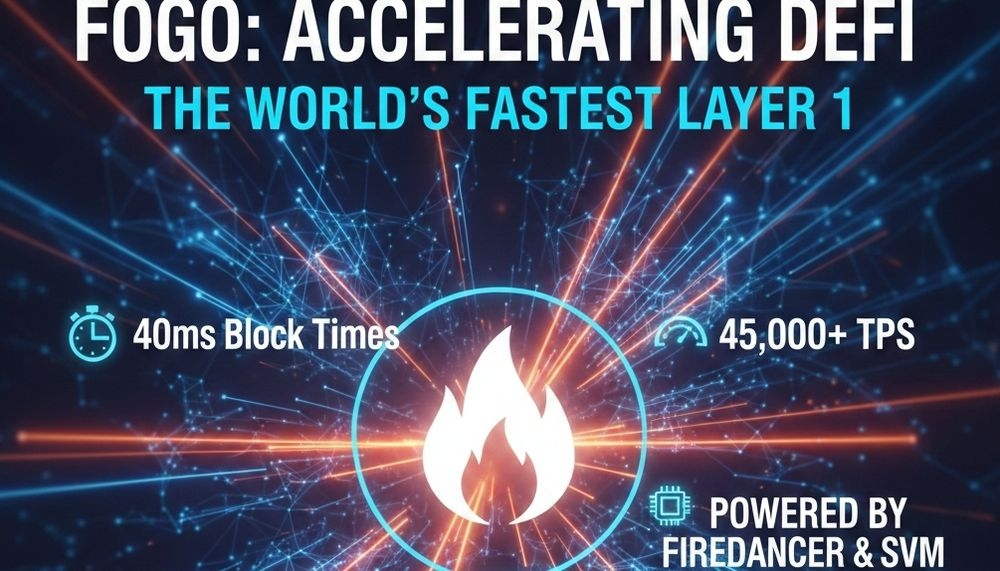
Not just block time.
But the entire pipeline validator placement, execution consistency, price timing, congestion control, even UX friction like signature fatigue.
It’s a big bet.
If it works, Fogo won’t feel flashy. It’ll feel boring in the best possible way. Stable when things are unstable. Predictable when markets aren’t.
And in trading, boring speed is the only speed people actually trust.