
Crypto infrastructure has been evolving rapidly, but one of the most persistent gaps in the space has been real-time execution and responsiveness. As decentralized finance (DeFi) grows more complex and competitive, users and builders want latency and execution quality that begin to rival traditional markets — not just high throughput in abstract benchmarks. After researching this project properly, I can say Fogo is one of the clearest attempts yet to address this need by building a purpose-optimized Layer-1 blockchain with ultra-low latency and Solana compatibility at its core.
From a timing perspective, Fogo matters now because the crypto ecosystem is increasingly focused on execution quality, user experience, and meaningful performance rather than just raw numbers. We read the documentation and looked closely at how they explain their vision: Fogo’s founding thesis is that on-chain trading and finance infrastructure should feel as responsive and predictable as centralized systems — something that existing blockchains, even high-throughput ones, haven’t fully delivered.
At its heart, Fogo is a high-performance Layer-1 built on the Solana Virtual Machine (SVM), meaning it runs the same or compatible virtual machine that Solana uses and can therefore support existing Solana tooling, applications, and developer workflows without requiring substantial rewrites. The network has been developed with a specific emphasis on speed and predictability: it claims block times as low as 40 milliseconds and transaction finality around 1.3 seconds, a level of rapidity that is engineered to support demanding use cases like decentralized on-chain order books, high-frequency trading strategies, liquidations, and real-time auctions. 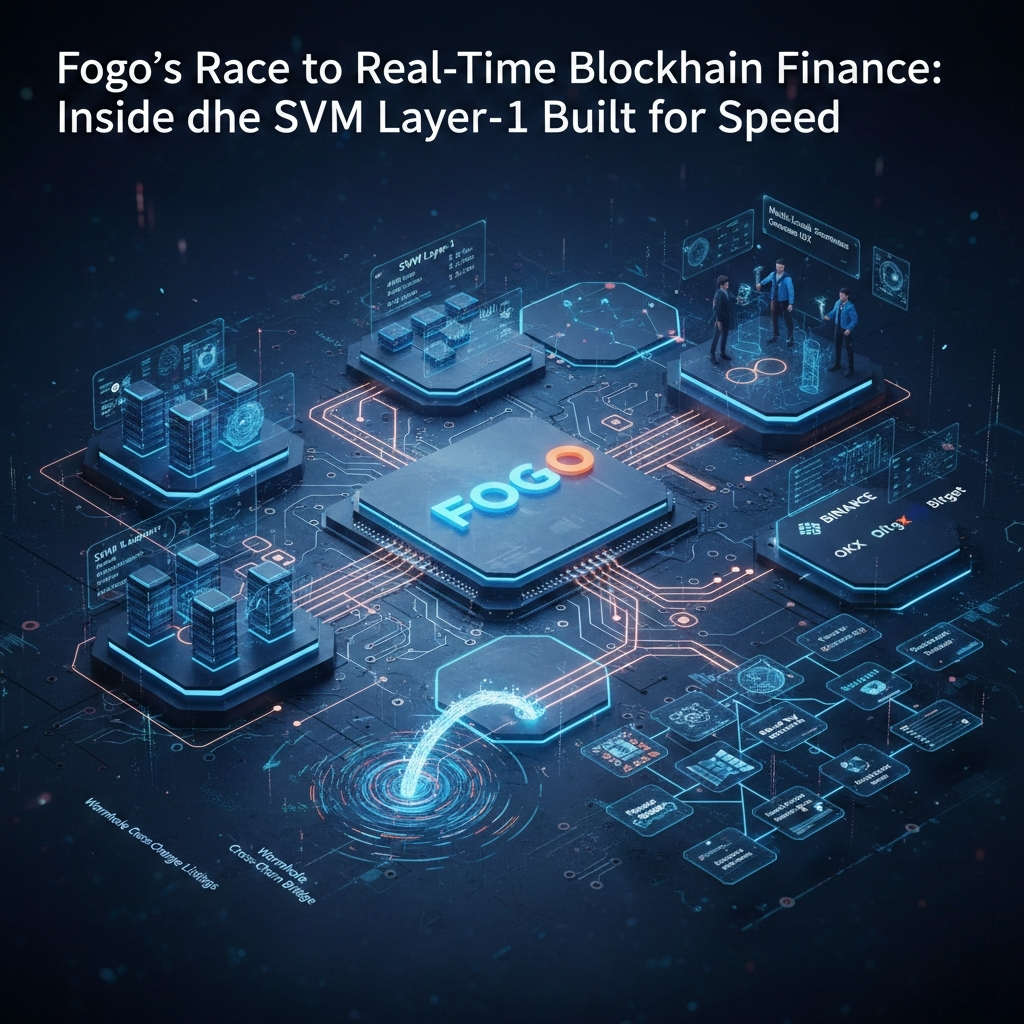
How exactly Fogo achieves this involves a few key architectural choices. The network uses a custom validator client based on Firedancer, a high-performance implementation originally developed to optimize Solana validator operations, which is designed to eliminate unnecessary overhead and push performance to its limits. Beyond that, Fogo’s consensus model incorporates mechanisms — including multi-local consensus zones and dynamic validator colocation — to minimize latency and keep nodes operating with optimal proximity and synchronization. On the user side, innovations like Fogo Sessions — a session-based key scheme that lets users interact with many decentralized applications without repeated wallet signatures — are built to make on-chain experiences smoother and faster, more akin to familiar Web2 interactions.
Interpreting real ecosystem signals tells a story that goes beyond performance claims. Fogo’s public mainnet launched in January 2026, and within a short time the network saw its native FOGO token listed on major exchanges including Binance, OKX, Bitget, and others — an indication of institutional and market interest. Trading campaigns, incentives, and exchange promotions aimed at generating liquidity show that the ecosystem is actively trying to bootstrap real engagement and attract both traders and builders. The involvement of established exchange ecosystems and the early presence of decentralized applications (spot and perpetual trading platforms, liquid staking, lending markets, and analytics tools) also suggest that adoption isn’t purely theoretical — it’s already unfolding in concrete deployments.
In the broader crypto landscape, Fogo stands at an intersection of performance-centric infrastructure and specialized financial utility. While many Layer-1 projects prioritize broad general-purpose programmability, Fogo’s narrative is narrower and more focused: delivering real-time, high responsiveness for trading and financial primitives on chain. This focus situates it in a growing niche of infrastructure that tries to bridge the gap between traditional finance expectations and decentralized execution realities.
That said, a balanced view must acknowledge the challenges and limitations. From a professional point of view, the very design choices that prioritize speed — such as validator colocation and curated, performance-oriented nodes — raise questions about how decentralization and resilience will evolve over time as the network scales. True decentralization typically involves wide geographic diversity of participants, and maintaining that while keeping sub-second performance is an ongoing tension in blockchain design. Also, claims about throughput and block times, while impressive on testnets and theoretical benchmarks, require real-world stress testing with diverse traffic and adversarial conditions to fully validate.
Moreover, early token listings and exchange incentives can generate initial liquidity, but sustained ecosystem growth depends on continuous developer interest, deep liquidity, and real user activity — factors that take time to mature beyond launch hype.
Looking forward, Fogo’s potential hinges on how effectively it can translate its performance infrastructure into lasting adoption by DeFi builders, trading protocols, and users. The project’s integration with cross-chain bridges like Wormhole — which connects Fogo’s environment to broader liquidity and assets — and its early suite of decentralized applications indicate a strategy to foster composability and ecosystem expansion. Whether these early signals evolve into a durable network with active liquidity and developer gravity remains the central question for long-term sustainability.
After researching this project properly, I can say that Fogo appears intentionally designed with a clear purpose: to redefine how real-time finance operates on blockchain by leveraging high-speed execution and familiar programming flows from the Solana ecosystem. While the technical innovation is compelling and the timing aligns with broader industry demands for responsiveness and performance, its long-term success will be shaped by real adoption beyond benchmarks, broad participation in governance and decentralization, and sustained liquidity growth across its token and applications.