Defining Moment for Crypto Regulation in the United States
For over a decade, the digital asset industry in the United States has expanded at extraordinary speed. Protocols launched. Billions flowed into tokens. Institutions tested the waters. Yet one persistent question hovered over every innovation: which regulator holds authority, and what rules actually apply?
The proposed Digital Asset Market Clarity Act of 2025, commonly referred to as the CLARITY Act, is designed to resolve that uncertainty. It is not merely another policy draft. It represents a structural attempt to define oversight, jurisdiction, and compliance pathways for a market that has outgrown informal interpretation.
Understanding its trajectory requires examining political timing, agency boundaries, and economic interests—not just headlines
What the CLARITY Framework Seeks to Fix
For years, digital asset firms have operated between overlapping authority claims from the U.S. Securities and Exchange Commission and the Commodity Futures Trading Commission. Enforcement actions have often arrived before comprehensive rulemaking, leaving companies uncertain whether tokens qualify as securities, commodities, or something new entirely.
The CLARITY Act attempts to:
Define clearer jurisdictional lines between agencies
Establish registration pathways for trading platforms
Introduce disclosure standards comparable to traditional financial markets
Provide a structured framework for digital asset issuance
At its core, the bill seeks to replace regulatory ambiguity with durable architecture.
Why It Hasn’t Passed Yet
Major financial legislation rarely moves quickly. Committee review, bipartisan negotiation, floor scheduling, and executive approval all require alignment.
Stakeholders—including crypto firms, banks, regulators, and the U.S. Department of the Treasury—have weighed in heavily. That alone signals the scale of what is at stake. Digital assets are no longer peripheral. They intersect with payments, capital markets, and financial stability.
But progress has slowed due to structural debates rather than ideological opposition.
The Stablecoin Question
One of the most sensitive discussions involves stablecoins and whether issuers should be permitted to offer yield-based features.
Traditional banking institutions argue that yield-bearing stablecoins could divert deposits from regulated banks, potentially shifting liquidity dynamics. Crypto advocates counter that restricting yield mechanisms limits innovation and undermines competitive parity.
This is not simply a technical dispute. Stablecoins operate at the intersection of payments infrastructure, consumer savings behavior, and systemic risk considerations. Lawmakers must balance innovation with financial stability—a calculation that demands precision.
The Regulatory Balance Problem
Another hurdle lies in writing legislation that is clear yet adaptable.
If the CLARITY Act grants too much flexibility, ambiguity could persist. If it becomes overly rigid, regulators may struggle to address emerging risks. Lawmakers must reconcile predictability for markets with discretion for oversight bodies.
That balance is difficult—but achievable.
Political Timing Matters
Legislation is shaped by electoral cycles. As campaign seasons intensify, bipartisan cooperation narrows and controversial votes are often delayed.
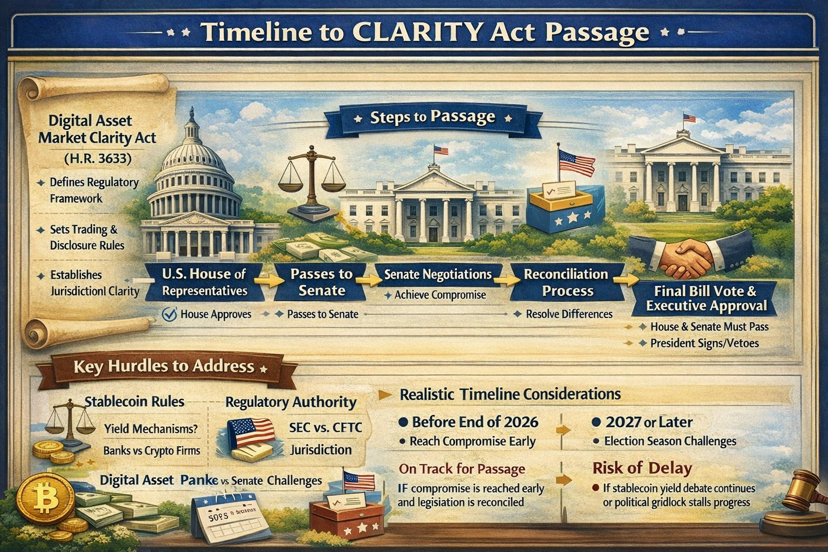
If negotiations reach compromise before political pressures peak, the bill could move within the current legislative window. If talks extend deeper into campaign season, timing may stretch significantly.
Signals from Treasury leadership indicate policymakers view regulatory clarity as strategically important for competitiveness and global positioning.
What Must Align Before Passage
For the CLARITY Act to become law:
Senate committees must finalize compromise language
Sufficient bipartisan support must hold
House and Senate versions must be reconciled
Executive approval must follow without veto risk
When these pieces align, movement can accelerate quickly.
A Realistic Outlook
The debate surrounding the CLARITY Act reflects technical design choices—not rejection of digital assets themselves. Most lawmakers agree that regulatory clarity is necessary. The disagreement lies in how that clarity should be structured.
In legislative history, technical disputes often lead to negotiated compromise rather than permanent gridlock.
If stablecoin provisions and agency boundaries reach agreement in the near term, passage could occur within months. If not, the timeline may extend into a later session.
What is clear is this: the era of regulatory ambiguity is narrowing. The only remaining question is how—and when—that clarity becomes law.