
I’m paying attention to FOGO because it’s one of the few projects that treats latency as the product itself, not just something to show off in benchmark screenshots. Most chains talk about speed like it’s a marketing stat. This one is clearly trying to build around where delay actually shows up in real trading, which is what makes it worth watching.
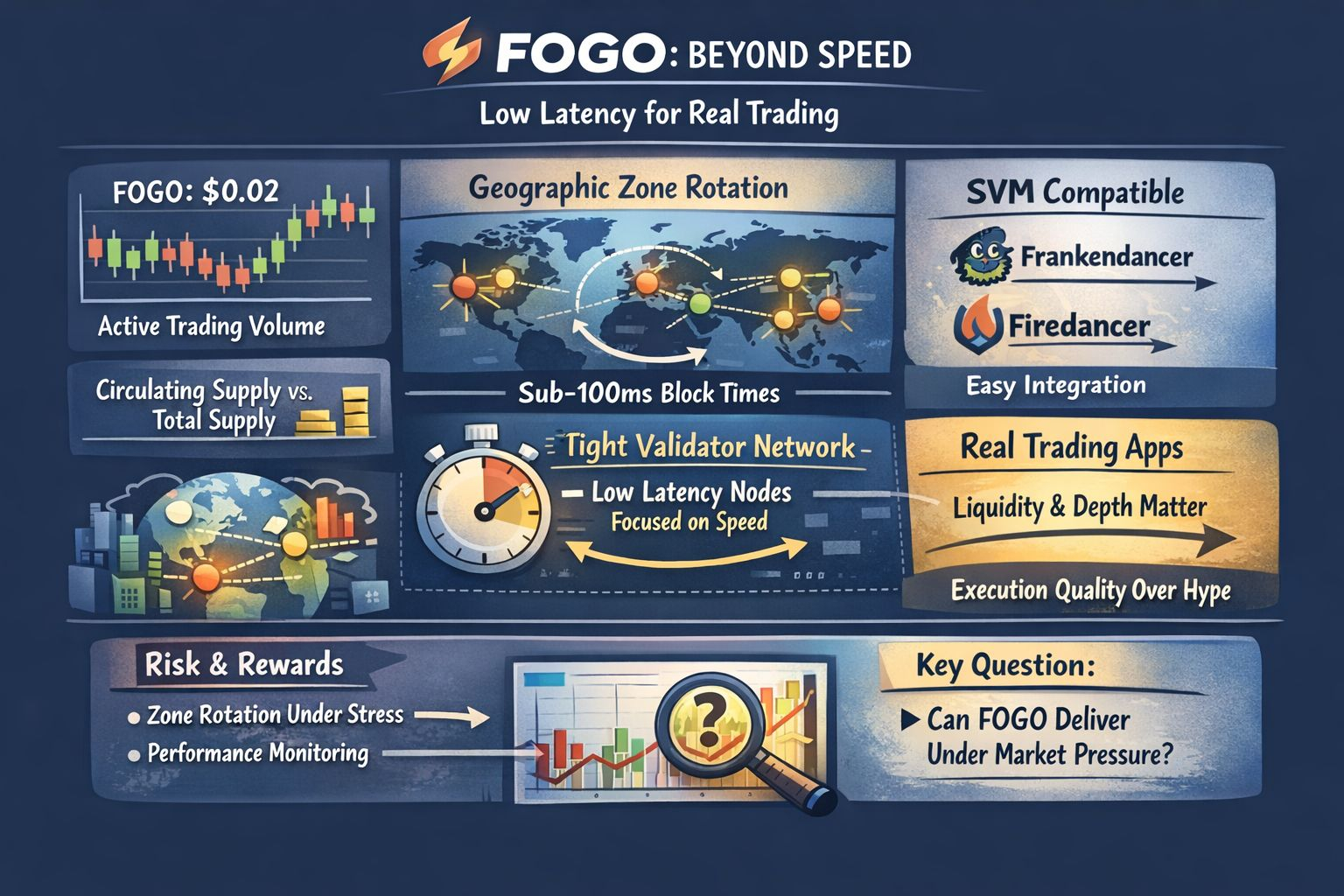
If you’re looking at this from a trading perspective, start with what’s actually happening on the tape. FOGO has been sitting around the low two-cent range, with real daily volume relative to its market cap. That matters because it tells you the token is being traded, not just held in cold wallets waiting for a story to save it. The circulating and total supply numbers also frame how far narratives can realistically stretch before dilution starts to matter.
I don’t think the edge here is “fast chain” in the abstract. Every new network leads with that. What stands out is how Fogo is trying to control latency at the architecture level. Validators are grouped by geography, and the active set is kept physically close to tighten network delay, with sub-100ms block times as the target in ideal conditions. Traders don’t get punished by average speed. They get punished by timing variance, missed windows, and jitter when markets move fast.
The zone rotation idea is the part that makes this more than a single-region design. Keep the critical path tight, but rotate zones over epochs so the system doesn’t ossify into one favored cluster forever. Call it “Tokyo Consensus” if you want, but the real point is a core that stays awake and predictable when order flow spikes, without locking the network into one geographic center.
On execution, Fogo leans into SVM compatibility and a Firedancer-based validator path, with Frankendancer as the stepping stone. That’s not flashy, but it lowers friction for teams and helps real applications and liquidity show up faster than if everyone had to rewrite their stack from scratch.
The tradeoff is obvious. Validator curation and performance standards improve timing consistency, but they narrow openness and introduce social coordination into who stays on the critical path. From a trader’s view, that makes sense. From a network view, it’s a risk to monitor.
What would make this thesis stronger is seeing zone rotation work cleanly under live stress, and seeing apps that actually benefit from lower latency build real liquidity. What would weaken it is volume without better execution quality, sticky users, or depth, or a validator model that gets too narrow or political over time.
This isn’t a moonshot framework. A move into the mid hundreds of millions in market cap is already meaningful from here if conditions line up. The downside is the usual one: narratives get crowded, usage doesn’t follow, and the token trades the story instead of the product.
If you’re watching Fogo, don’t just watch the candles. Watch whether the network keeps delivering tight execution when markets are messy, whether zones rotate without breaking performance, and whether real trading flow sticks. If those improve together, the market will notice. If they don’t, price will tell you before the narrative does.$FOGO @Fogo Official #fogo