
When I hear “globally distributed nodes,” my first reaction isn’t admiration. It’s skepticism. Not because geographic spread isn’t valuable but because in many networks it’s treated as a map statistic rather than an operational guarantee. A pin on a continent doesn’t mean resilience. It means someone deployed a server there.
So yes, global distribution sounds like decentralization. But what really matters is how that distribution behaves under stress, latency, regulation, and uneven infrastructure. Geography is not the goal. Fault tolerance is.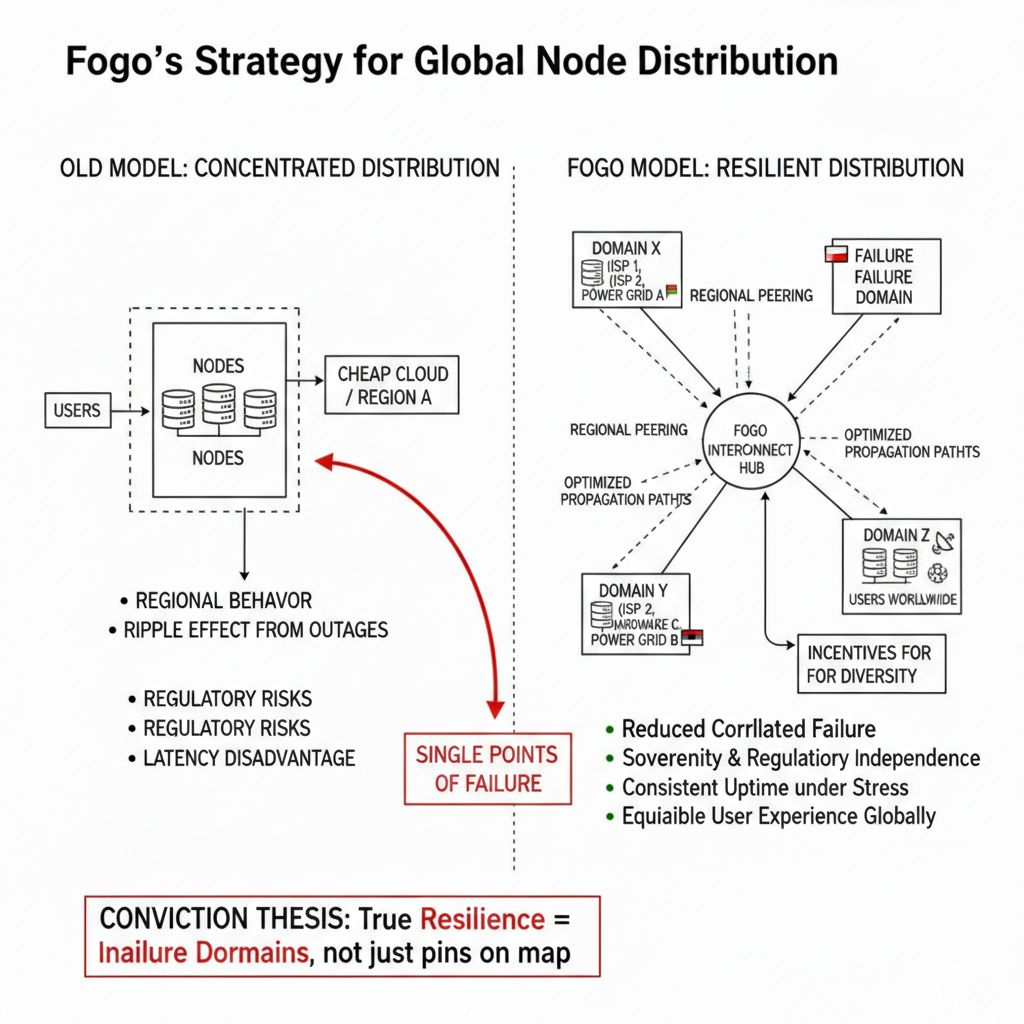
In the old model, node distribution often follows convenience rather than necessity. Operators cluster in regions with cheap cloud pricing, stable power, and predictable connectivity. The result is a network that looks global on paper but behaves regionally in practice. A routing issue in one major data center provider can ripple across half the validator set. A regulatory action in a single jurisdiction can suddenly silence a disproportionate share of block production. The map suggests diversity; the topology reveals concentration.
Fogo’s approach to global node distribution shifts the question from “where are nodes located?” to “how independent are their failure domains?” True resilience isn’t achieved by sprinkling nodes across continents. It comes from separating dependencies: different ISPs, power grids, legal regimes, hardware supply chains, and peering routes. Two validators in different countries but on the same cloud backbone are closer to each other, in risk terms, than two validators in the same city running on independent infrastructure.
This is where latency enters the conversation — not as a performance metric alone, but as a design constraint. Ultra-fast block times and parallel execution demand tight coordination, which can quietly incentivize geographic clustering. If propagation windows are too narrow, operators farther from network hubs face a structural disadvantage. Over time, this can create a gravity well that pulls validators toward a few connectivity epicenters. The network remains permissionless, but physics and economics shape participation.
Fogo’s strategy appears to acknowledge this tension rather than ignore it. Instead of pretending latency doesn’t matter, it becomes a parameter to engineer around: optimizing propagation paths, encouraging regional peering, and designing incentives that reward uptime and independence rather than raw proximity. The goal isn’t to eliminate latency — an impossible task — but to prevent it from centralizing power.
Because geography is also politics. Nodes exist within legal systems and legal systems exerts pressure. A globally distributed network must assume that some jurisdictions will impose restrictions, demand compliance, or create uncertainty for operators. If too much stake or block production accumulates in a small set of regulatory environments, the network inherits their policy risks. Distribution, in this sense, is not just about uptime. It’s about sovereignty.
That’s why operator diversity matters as much as geographic diversity. A network dominated by a handful of professional hosting providers may achieve impressive uptime, but it also creates correlated risk. When infrastructure becomes standardized, failure becomes synchronized. Fogo’s challenge is to encourage a heterogeneous validator ecosystem — from independent operators to institutional participants — without sacrificing performance guarantees that real-world applications depend on.
And things do fail, just not always where you expect. Submarine cable disruptions, regional power shortages, BGP misconfigurations, cloud outages, sanctions regimes, and hardware embargoes — these are not hypothetical edge cases. They are recurring events in global infrastructure. A resilient node distribution strategy assumes partial network partitions are normal, not exceptional. The measure of success is not whether partitions occur, but whether the network continues to function coherently when they do.
There’s also an economic layer to distribution that’s easy to overlook. Running a validator in regions with higher bandwidth costs or less reliable power is more expensive. Without thoughtful incentive design, operators will rationally concentrate in low-cost regions. If Fogo wants genuine global participation, it must align rewards with resilience — compensating operators who contribute to failure-domain diversity, not just throughput.
Once you frame node distribution as infrastructure rather than optics, responsibility shifts. It’s no longer enough for the protocol to be technically decentralized; it must be operationally resilient. If an outage in one region degrades the experience for users worldwide, the network’s topology becomes part of product reliability. End users won’t analyze routing paths or validator maps. They will notice that transactions slowed, confirmations stalled, or applications became unreliable.
This reframes global distribution as a competitive factor. Networks won’t just compete on speed or fees; they’ll compete on consistency under imperfect conditions. How well does the system perform during regional outages? How gracefully does it handle partial partitions? Do users in emerging markets experience the same reliability as those near major internet exchanges? These questions turn geography into user experience.
The most interesting long-term outcome of Fogo’s strategy may not be the number of countries represented in its validator set, but the emergence of operational standards for resilience. If independent operators, regional infrastructure providers, and institutional validators converge on best practices for failure isolation and peering diversity, the network’s topology itself becomes a form of shared defense.
So the real question isn’t “are Fogo’s nodes globally distributed?” It’s “does that distribution reduce correlated failure, regulatory capture, and latency-driven centralization when the network is under pressure?”
Because in calm conditions, any network can look decentralized on a map. In turbulent conditions, only those designed for independence behave that way.
