
When I hear people ask where Fogo stands in 2026, my first instinct isn’t to list milestones. It’s to ask which of those milestones actually changed behavior. Roadmaps are full of shipped features; ecosystems are defined by what people stop noticing because it simply works.
For most users, the meaningful shift hasn’t been throughput numbers or validator counts. It’s the gradual disappearance of friction that once made on-chain activity feel like a sequence of chores. Wallet approvals, fee preparation, unpredictable confirmation times — these were never core to the product experience. They were logistics. And 2026 is the first year those logistics started fading into the background for a meaningful slice of users.
That shift didn’t happen because one feature landed. It happened because the stack matured. Execution became more predictable. Fee abstraction reduce dead ends. Tooling standardized patterns developers no longer had to reinvent. None of this is glamorous, but together it changes who the platform feels built for. Instead of catering primarily to crypto-native users willing to tolerate friction, the network began accommodating users who expect software to behave like software.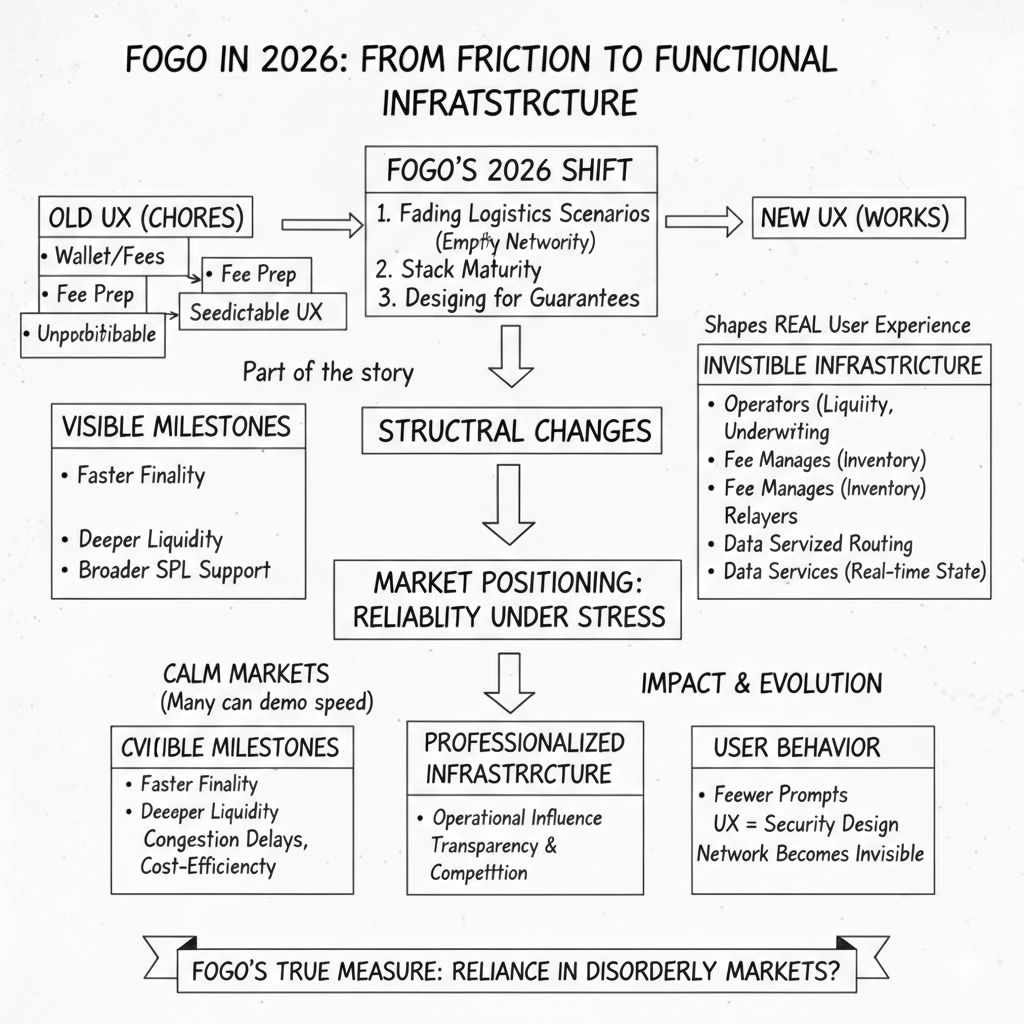
The visible milestones faster finality, deeper liquidity integrations, broader SPL asset support tell only part of the story. The structural change is that applications stopped designing around constraints and started designing around guarantees. When builders trust execution to be fast and costs to be bounded, they design flows that assume continuity rather than interruption. That alone shifts the category of apps that can exist.
Of course, guarantees are never absolute. Underneath the smoother experience sits a growing layer of operators managing liquidity, underwriting fees, routing transactions, and smoothing volatility. These actors don’t appear in product demos, but they shape the real user experience. Their pricing, uptime, and risk management determine whether a “one-click” action remains one click when markets are chaotic.
This is where market positioning becomes less about raw performance and more about reliability under stress. Many networks can demonstrate speed in calm conditions. Far fewer maintain predictable execution when volatility spikes, spreads widen and demand surges unevenly across applications. In 2026 the competitive line is drawn not between fast and slow chains but between those that degrade gracefully and those that fragment under pressure.
The professionalization of infrastructure around the network reinforces this positioning. Fee managers hold inventory instead of forcing users to top up balances. Relayers optimize routing instead of leaving users to guess priority fees. Indexing and data services deliver near-real-time state instead of forcing developers to build brittle workarounds. Each layer removes a decision from the end user and transfers it to a specialized operator.
That transfer isn’t neutral. It concentrates operational influence in fewer hands, raising the importance of transparency and competition among providers. If spreads widen silently or limits tighten without clear communication, users experience it as product failure. Trust, once anchored primarily in protocol rules, now extends to the behavior of infrastructure intermediaries.
Security posture evolves alongside convenience. Fewer prompts and longer lived sessions enable smoother interaction but they also raise the stakes of permission boundaries and session management. The average user no longer signs every action which means safeguard must shift from repetitive confirmation to well designed constraints. In 2026, good UX is inseparable from good security design.
From a market perspective, the network’s position is increasingly defined by execution quality rather than narrative cycles. Applications compete on success rates, cost predictability, and resilience. Infrastructure providers compete on spreads, uptime, and risk controls. Users, most of whom will never read a whitepaper, simply gravitate toward flows that feel dependable.
That’s why the most telling milestone isn’t a specific upgrade or partnership. It’s the point at which users stop asking which chain they’re on and start evaluating whether the product works. When the underlying network becomes invisible, it has effectively succeeded in positioning itself as infrastructure rather than novelty.
The open question for the years beyond 2026 is not whether the system can perform in ideal conditions. It’s whether the underwriting layers, liquidity routes, and execution guarantees hold steady when markets turn disorderly. Because in calm periods, almost any architecture appears robust. In stressed markets, only disciplined systems preserve trust without quietly taxing users through spreads, restrictions, or unreliable execution.
So the real measure of Fogo’s position in 2026 isn’t how fast it claims to be. It’s who relies on it when conditions are worst — and whether their users ever notice the strain.
