

I. Project Overview
Mira Network is a decentralized infrastructure protocol focused on verifiable artificial intelligence designed to bring transparency, traceability, and trust to AI-generated outputs. The network establishes an on-chain verification layer that validates AI reasoning and responses, addressing key challenges such as hallucinations, bias, and unverifiable outputs.
Unlike traditional centralized AI systems, Mira introduces a trustless verification architecture where AI outputs are decomposed into multiple claims and independently validated across distributed verifier nodes. Verified results are then aggregated through consensus mechanisms, producing reliable and auditable AI outputs.
Built on Base (Ethereum Layer-2), Mira is interoperable with major blockchain ecosystems including Bitcoin, Ethereum, and Solana. The protocol supports smart contracts, decentralized applications (DApps), and DAO-based governance, positioning itself as a foundational trust layer for AI applications across Web3.
Core verification process: AI outputs are split into smaller verifiable components, distributed to independent verifier nodes for evaluation, and aggregated through consensus into a final trusted result. Mira has already deployed products within the Base ecosystem, emphasizing real-world integration and developer accessibility.
II. Key Highlights
Mira Network reports millions of users and processes tens of millions of AI queries weekly, demonstrating strong early adoption. Its verification layer improves AI accuracy to approximately 96 percent while reducing hallucination rates by up to 90 percent. Flagship applications such as Klok (AI chatbot) and Astro (AI search) have collectively attracted hundreds of thousands of users, validating Mira’s practical approach to trustworthy AI.
Mira operates a distributed verification network integrating over 100 AI models under a multi-model consensus framework. By decentralizing validation across independent nodes, the system reduces single-point failure risks and improves output reliability, analogous to decentralized auditing of AI reasoning. This architecture provides a scalable trust layer for AI-powered applications and agents.
Mira has secured funding from leading venture investors across the AI and Web3 sectors, reflecting market confidence in its AI and blockchain infrastructure model. The team brings experience in AI systems, blockchain protocols, and global product development. The protocol has raised approximately 9.85 million dollars across seed funding and node sales to support ecosystem growth and infrastructure expansion.
The MIRA token functions as the economic backbone of the network enabling AI verification payments, node staking and rewards, governance participation, and developer incentives. The project has also established an independent foundation and a 10 million dollar builder fund to accelerate ecosystem expansion and partnerships.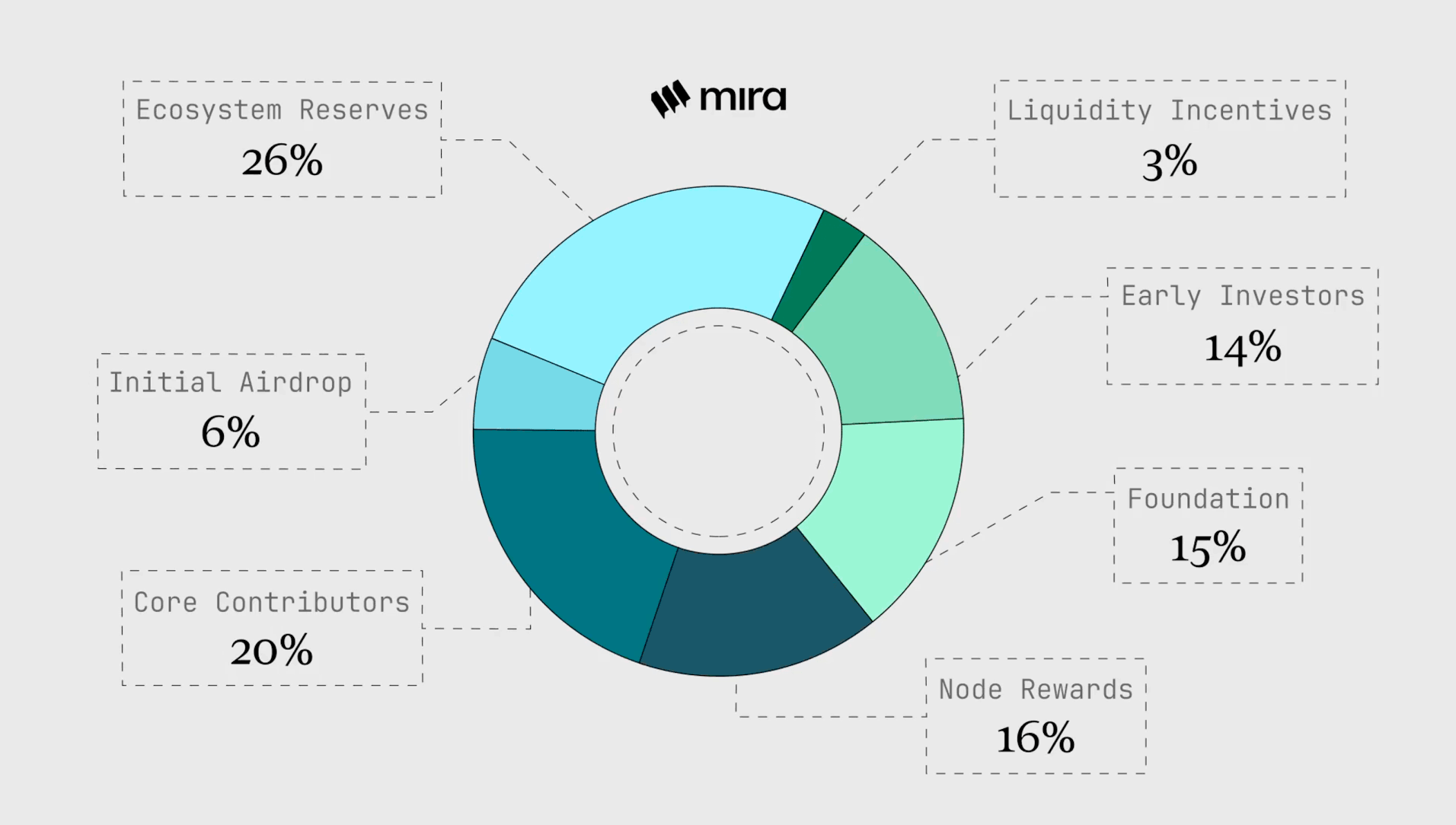
III. Tokenomics
Token name: MIRA
Total supply: 1,000,000,000
Initial circulating supply: 191,200,000 (19.12%)
Allocation structure consists of 26 percent ecosystem and growth, 20 percent core contributors, 16 percent validator rewards, 15 percent foundation treasury, 14 percent early investors, 6 percent community airdrop, and 3 percent liquidity programs.
MIRA utility includes payment for AI verification services and APIs, staking collateral for verifier nodes, governance participation in protocol upgrades and fund allocation, and ecosystem incentives for developers and contributors. Additional use cases include content incentives and emerging AI-driven applications.
IV. Team and Funding
The core team includes CEO Karan Sirdesai with experience at Accel and BCG and early investment exposure to Polygon and Nansen, CTO Siddhartha Doddipalli formerly architect at FreeWheel and CTO of Stader Labs, and COO Ninad Naik formerly general manager at Amazon Alexa and product leader at Uber. The leadership combines expertise in AI engineering, blockchain infrastructure, and global product scaling.
Funding includes approximately 9 million dollars from a 2024 seed round and about 0.85 million dollars from community node sales between 2024 and 2025, bringing total funding to around 9.85 million dollars. Funds support protocol development, ecosystem applications, and adoption.
V. Risk Considerations
Decentralized AI infrastructure remains an early-stage sector without established long-term business models. Market sentiment shifts or slower adoption could impact ecosystem growth and token demand.
With 19.12 percent circulating at launch, token supply will expand progressively to about 33 percent by year one, 61 percent by year two, 83 percent by year three, and full supply by year seven. Short-term sell pressure may arise from airdrop and ecosystem unlocks, mid-term volatility may increase from contributor and investor vesting, and long-term risks will depend on adoption and fundamentals.
Conclusion
Mira Network introduces a verifiable AI infrastructure layer combining decentralized consensus with multi-model validation to improve AI trustworthiness. With growing adoption, scalable architecture, and a tokenized verification economy, Mira aims to become foundational middleware for trustworthy AI in Web3. As an early-stage decentralized AI protocol, long-term value will depend on sustained ecosystem growth, real-world adoption, and effective management of token supply expansions.