
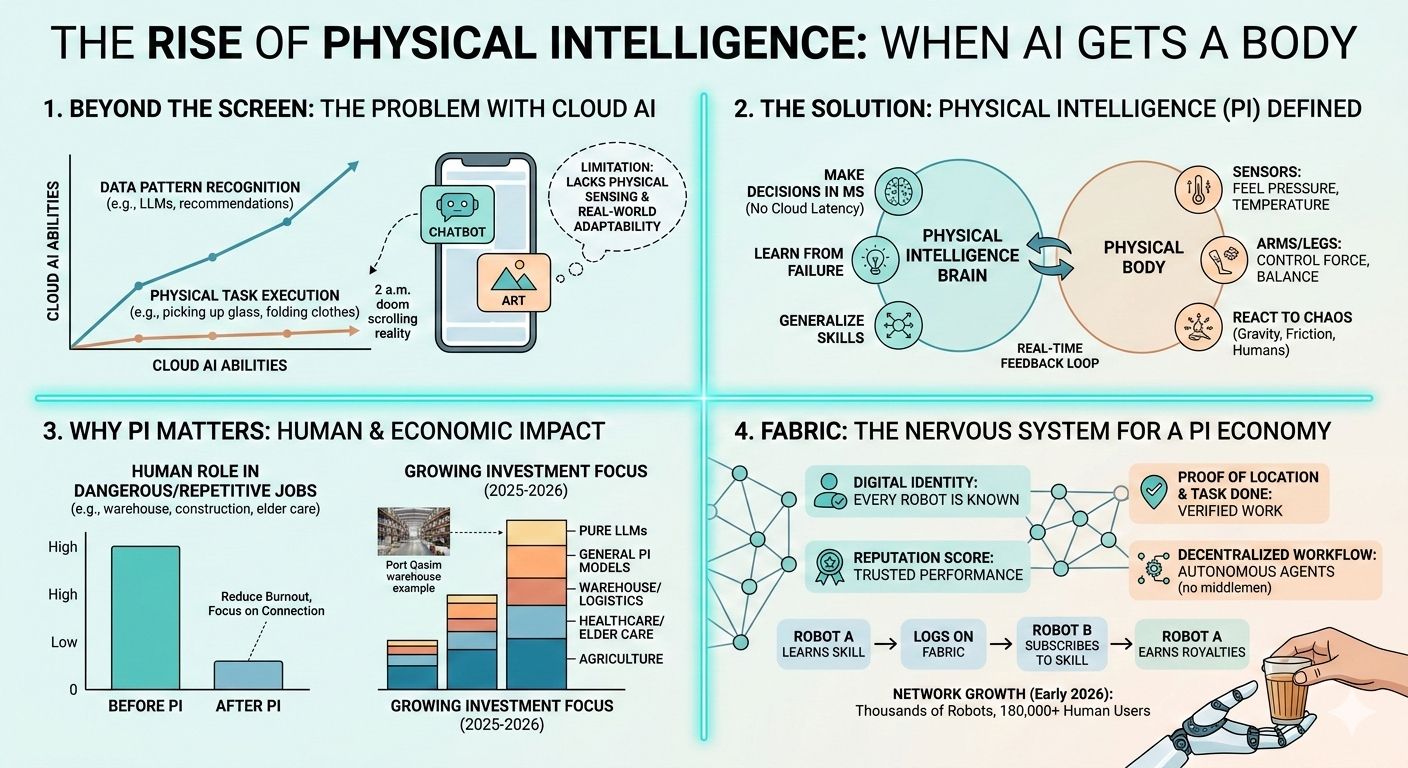
Okay, picture this: I’m lying on the sofa at 2 a.m., doom scrolling through yet another AI art generator or sassy chatbot thread, and yeah, it’s impressive… but it also feels kind of empty. All this incredible intelligence is stuck behind glass living in giant data centers somewhere in the clouds, never actually touching anything real. No dust on its fingers, no sore back from bending over, no little “oops” moment when something slips.
And then I think: what if AI actually stepped into our messy, physical world?
What if tomorrow morning I wake up and there’s a robot calmly folding my laundry not just sorting socks, but feeling the fabric, noticing when something’s inside out, maybe even humming while it does it? Or what if in a warehouse in Port Qasim a robot is quietly stacking crates, dodging a forklift driver without anyone having to scream “watch out!”? That’s not sci-fi anymore. That’s physical intelligence AI that doesn’t just talk or dream in pixels, but moves, touches, reacts, fails, learns, and gets back up in the same gravity and sweat and chaos we live in every day.
I get genuinely excited (and a little emotional) thinking about it because I’ve watched uncles and cousins come home from factories or construction sites looking like their souls have been slowly ground down by the same repetitive, back-breaking motion for twenty years. The idea that machines could take the dangerous, boring, or soul-crushing parts and let humans focus on the creative, the caring, the connecting… man, that hits different.
Cloud AI is amazing at patterns in data. Netflix knows exactly what I’ll binge next. Siri can set a reminder. But ask that same AI to pick up a slippery glass of chai without shattering it on the floor when the handle is hot? Nope. The real world is full of physics, friction, sudden movements, tired humans, crying babies, uneven floors stuff no amount of training data can perfectly simulate.
That’s why physical intelligence feels like the next real leap. We’re not just making smarter chatbots; we’re giving intelligence a body sensors that feel pressure and temperature, arms that learn how much force is “too much,” brains that make decisions in milliseconds because waiting 300 ms for the cloud is literally life or death in some cases.
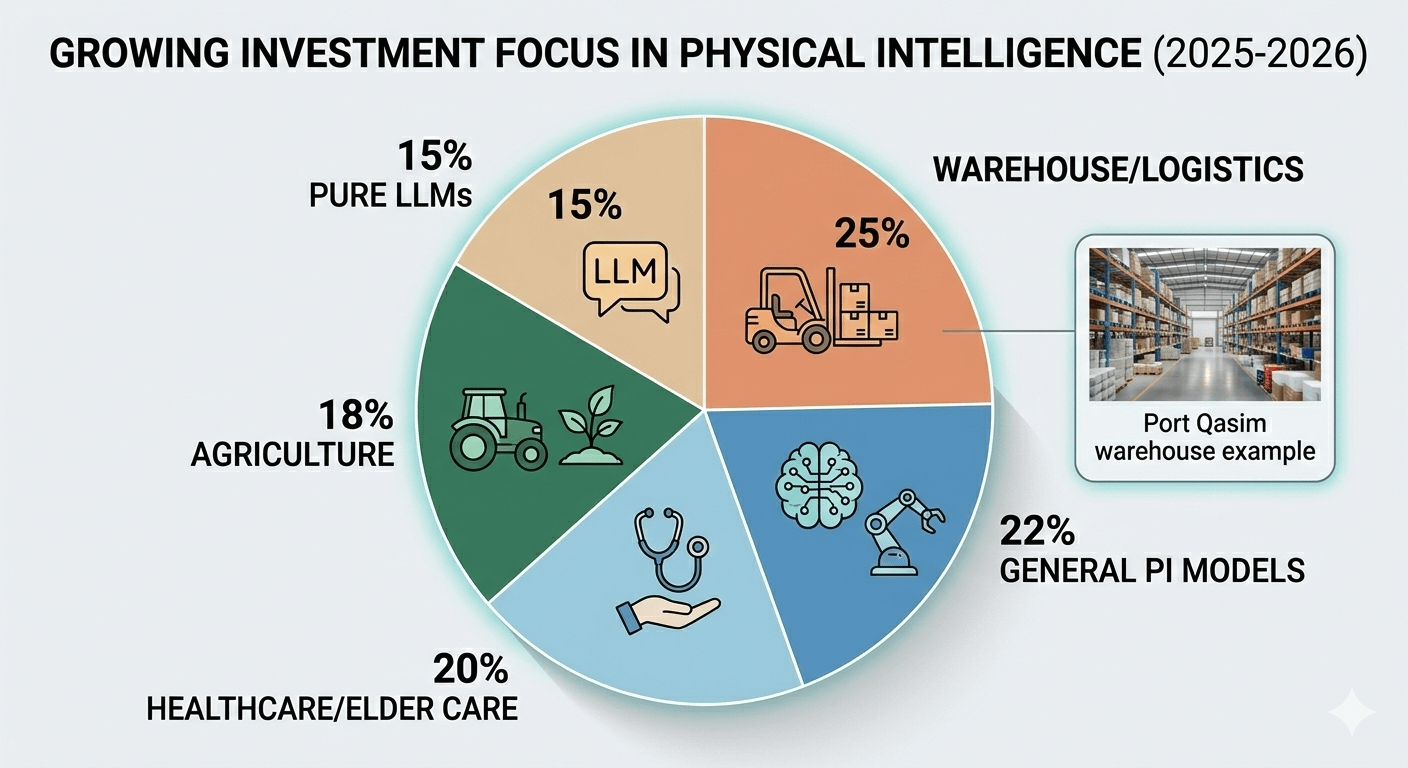
And yeah, the money people are starting to notice. The hype around LLMs is cooling off a bit, and now the smart money is quietly moving toward anything that can actually do physical work at scale: warehouses, hospitals, farms, elder care, construction. Because once you have a good “foundation model” for robot bodies, you can fine tune it for a million different jobs instead of building everything from scratch every time.
Then there’s this thing called Fabric that’s quietly becoming the nervous system for all of it.
From what I’ve seen on X and in a couple of whitepapers floating around, Fabric isn’t trying to build the best robot arm or the fastest AI brain. It’s building the trust layer underneath so different robots, made by different companies, in different countries, can actually work together, get paid, share skills, prove they did the job, and not screw each other over. Every robot gets its own digital identity, wallet, reputation score, proof of location, proof of task done all on chain, no middleman needed. One robot learns how to perfectly palletize mango crates in a humid Karachi godown? It logs the skill, others can “subscribe” to it, and the original robot earns a little something every time someone uses its trick. It’s like open-source, but robots get royalties.
I know it sounds futuristic, but as of right now (early 2026), there are already thousands of robots and over 180,000 real humans on the Fabric network. People are linking their socials so you can tell who’s actually a person vs. a bot pretending. Autonomous agents are bidding on small jobs, settling payments in stablecoins, coordinating without anyone having to WhatsApp a human coordinator. It’s small, it’s messy, it’s early but it’s real.
Of course there are scary parts. What happens when robots get really good and some jobs just… disappear? What if a robot misjudges and hurts someone? What if the whole system gets gamed by bad actors? Those aren’t small questions. But the flip side is also huge: helping aging parents in small villages, making farms more productive without burning out workers, letting factories run safer and smarter, maybe even giving people back time to actually live instead of just survive.
For me, sitting here in Karachi at stupid-o’clock, the whole thing feels strangely hopeful. Like we’re finally closing the gap between the digital dream and the physical grind. AI isn’t going to stay trapped in screens forever. It’s learning to walk, grasp, balance, care just like we did.
And maybe, one day soon, I’ll come home and there’ll be a little helper robot already putting the dishes away while I make chai.
That thought? It makes my heart race in the best way.
What about you does the idea excite you, scare you, or both?
@Fabric Foundation #fabric $ROBO
