At first glance I assumed Fabric Protocol was just another entry in the crowded AI crypto hype cycle, but the deeper you look the more you realize it is not actually about building robots, it is about a much more urgent question who owns the value of machine labor when machines eventually outperform humans in almost every physical task.
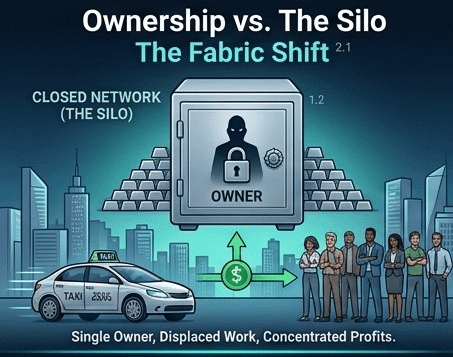
Everything is of this change we are aware of what happens when the intelligence is able to grow fast everything was different by software physical intelligence is finally following robots are no longer experiments. But they are becoming cost effective workers when a machine can perform a job receive a payment and improve its own skills the debate is not about, if they can work it is about whose pocket the profit lands in.
➡️ The Real Issue Ownership Not Automation:
One of the first serious projects which attempts to answer such a question in a definitive manner is Fabric Protocol it develops infrastructure rather than hype Fabric in its minimal form is a global open network where a public system can make maintain and enhance robots the thing is that it indeed transforms robots into economic actors not the instruments that companies possess but the participants in an open market.
As one studied this one thing became evident the issue is not the emergence of robots the issue is the way they will be owned nowadays each robot system is independent a firm constructs it educates it owns and retains all the revenues it generates people work with it however they do not share the gains.
➡️ The Fragmented World of Machines:
Fragmentation is a large unnoticed issue in robotics various robots implement various hardware software and control systems it is highly challenging to cultivate innovation that way Fabric addresses this by OM1 a robot operating system which is universal in a nutshell OM1 is Android to phones.
The OM1 system allows developers to write code once and run it everywhere in case it succeeds it prevents one of the largest blockers of robotics the impossibility to transfer skills between machines one robot can be made to possess a skill on another robot that reduces expenses accelerates development and creates a common innovation layer add to that an open network such as Fabric and you have a powerful worldwide source of machine intelligence.
➡️ Evidence of Robotic Work Purchase to Real Productions:
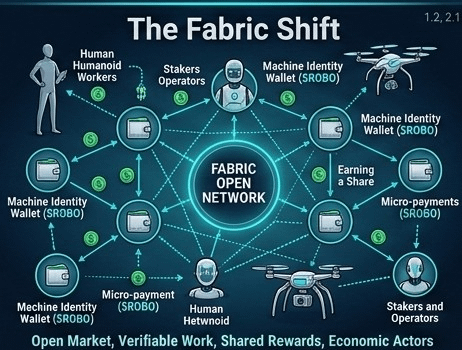
The way Fabric treats incentives is also one of the most interesting things about it it is not about doing well on fabric it applies Proof of Robotic Work (PoRW) and therefore you only earn when you have actual machine work which has been verified.
Fabric does not concentrate on staking or holding tokens or speculating it dwells on actual machine performance it is a massive switch compared to the conventional crypto systems rewards come from real work whenever a robot completes a task that has been approved money is generated and distributed it is more of a machine job market that is where it gets exciting.
➡️ Agent Native Infrastructure Built for Machines:
Another concept that transformed my perception is the concept of agent-native infrastructure in the modern world nearly all systems around the world are designed to suit individuals banking IDs contracts all presuppose a human user robots do not belong to such a system.
Robots are not able to open bank accounts they do not have passports they are unable to make legal contracts in a regular manner fixes made to fabric which provide machines with own infrastructure layer allow robots to have wallets hold assets do transactions and pay for services this is a very crucial thing since it will make robots not merely a tool but a participant with money to earn to spend and to economically interact.
➡️ $ROBO — Token A Layer of Pricing Labor:
The initial appearance of the token might seem like any other token however I find on closer examination that it is not so it is not only used to purchase and sell it coordinates economics. ROBO is used in all the actions within the network including payments fees staking and governance.
More importantly it makes machine labor priced that way when a robot performs an activity then it will earn $ROBO and it spends money on things in case it requires them this forms a closed economic cycle the token is one method of establishing a standard price of machine work which is quite unlike the normal crypto tokens.
➡️ Verifiable Computing Enhancing Credibility:
One of the main concepts that I have acquired is verifiable computing it is in simple terms anything that a robot does be it delivery of goods construction of parts or even visualizing data can be checked and verified by someone.
This fixes a real problem artificial intelligence nowadays is capable of being mistaken of faking or behaving in an unpredictable manner in software that is okay but in real life it is hazardous Fabric addresses this by breaking down results and having them verified by a large number of systems so instead of submitting to a single machine numerous individuals confirm the findings which is unlike being able to trust the machine to examine the result.
➡️ The Future of Work and Ownership:
I ceased to view Fabric as a crypto project after having done some research it should be considered more like an economic system of a post-human labor market that can be considered radical but the point is obvious machines are getting better costs are going down and adoption is speeding up.
One day machine labor will take over some industries when that occurs the query is straightforward is it concentrated in the hands of some central groups or does it exist in a network Fabric is betting on the second response it is not going to jump at the fleeting hype but instead focus on putting the infrastructure in place on the thing that is not entirely present but definitely will be.
@Fabric Foundation #ROBO $ROBO