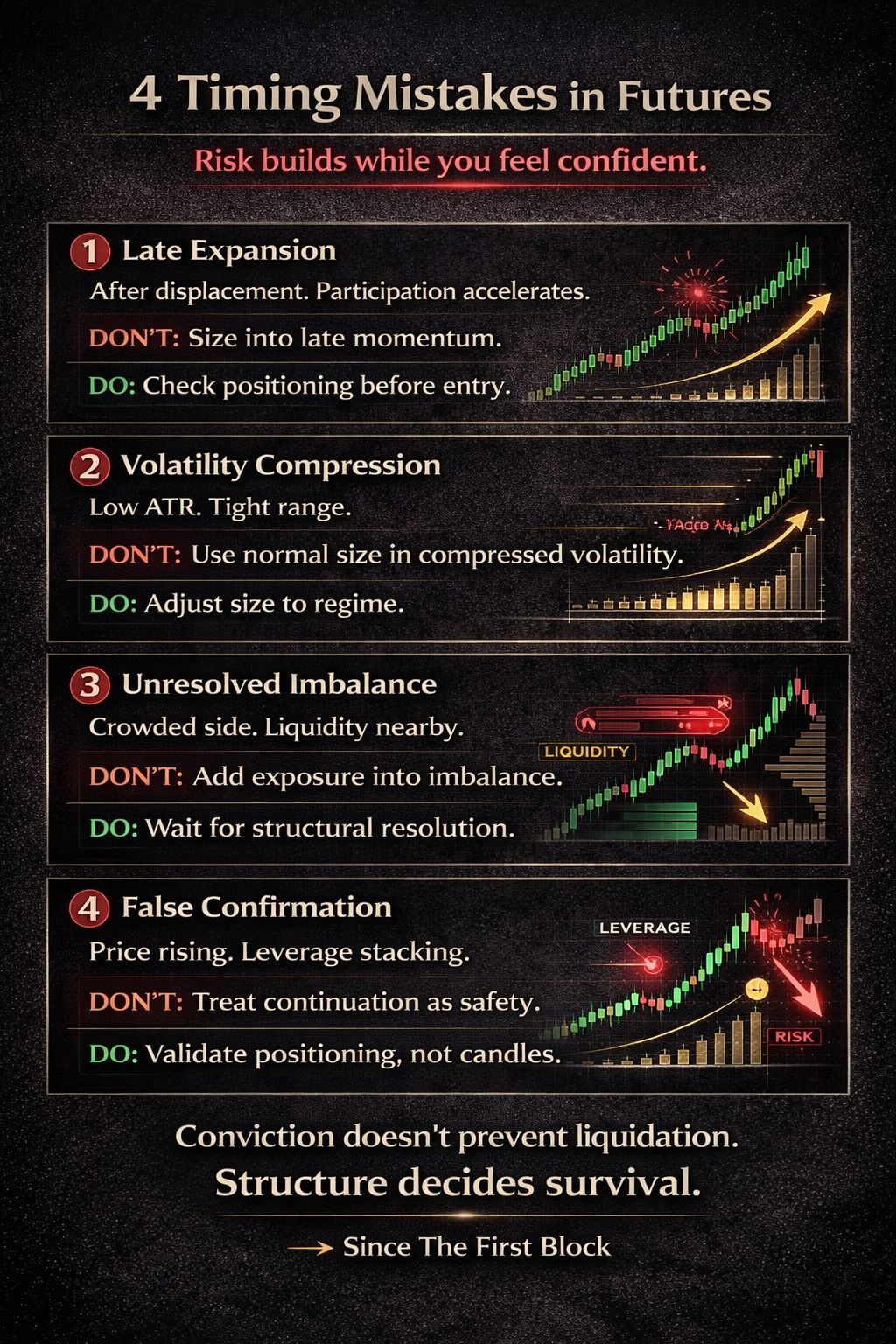
Risk builds while you feel confident.
Most traders evaluate entry. Few evaluate the risk phase.
The market doesn’t suddenly become dangerous.
Risk builds. Then it resolves.
Here are four structural timing mistakes that quietly destroy accounts:
1️⃣ Expanding participation late in a move
Price displaces. Momentum looks strong.
Participation accelerates.
But when positioning increases after displacement, you’re not early.
You’re joining pressure.
Late expansion isn’t confirmation. It’s crowd density.
And density attracts clearing.
2️⃣ Trading compressed volatility without adjusting size
Low ATR feels safe. Tight ranges feel controlled.
But compressed volatility increases sensitivity.
When range expands, moves travel further than your sizing assumes.
Small structural shifts become forced exits.
Not because of direction — but because of magnitude relative to exposure.
3️⃣ Increasing exposure while imbalance is unresolved
If one side of the market is dominant and liquidity rests nearby, resolution becomes mechanical.
When imbalance clears, the last entrants become the first liquidity source.
Timing matters more than conviction.
4️⃣ Confusing continuation with structural confirmation
Price rising doesn’t mean risk is decreasing.
Continuation can coexist with leverage stacking.
Strength can mask fragility.
Structural confirmation is not price alone —
it’s how positioning behaves while price moves.
When that relationship distorts, risk concentrates.
And concentrated risk eventually resolves.
Conviction doesn’t prevent liquidation.
Structure decides survival.
Since The First Block.