
I used to believe AI reliability would automatically get better with time. Make the model bigger. Feed it more data. Train it longer. And slowly, hallucinations would fade away.
But that is not how it works. Models become more fluent, yes. They sound more confident and more human. But sounding right is not the same as being true. That is exactly why Mira Network grabbed my attention.
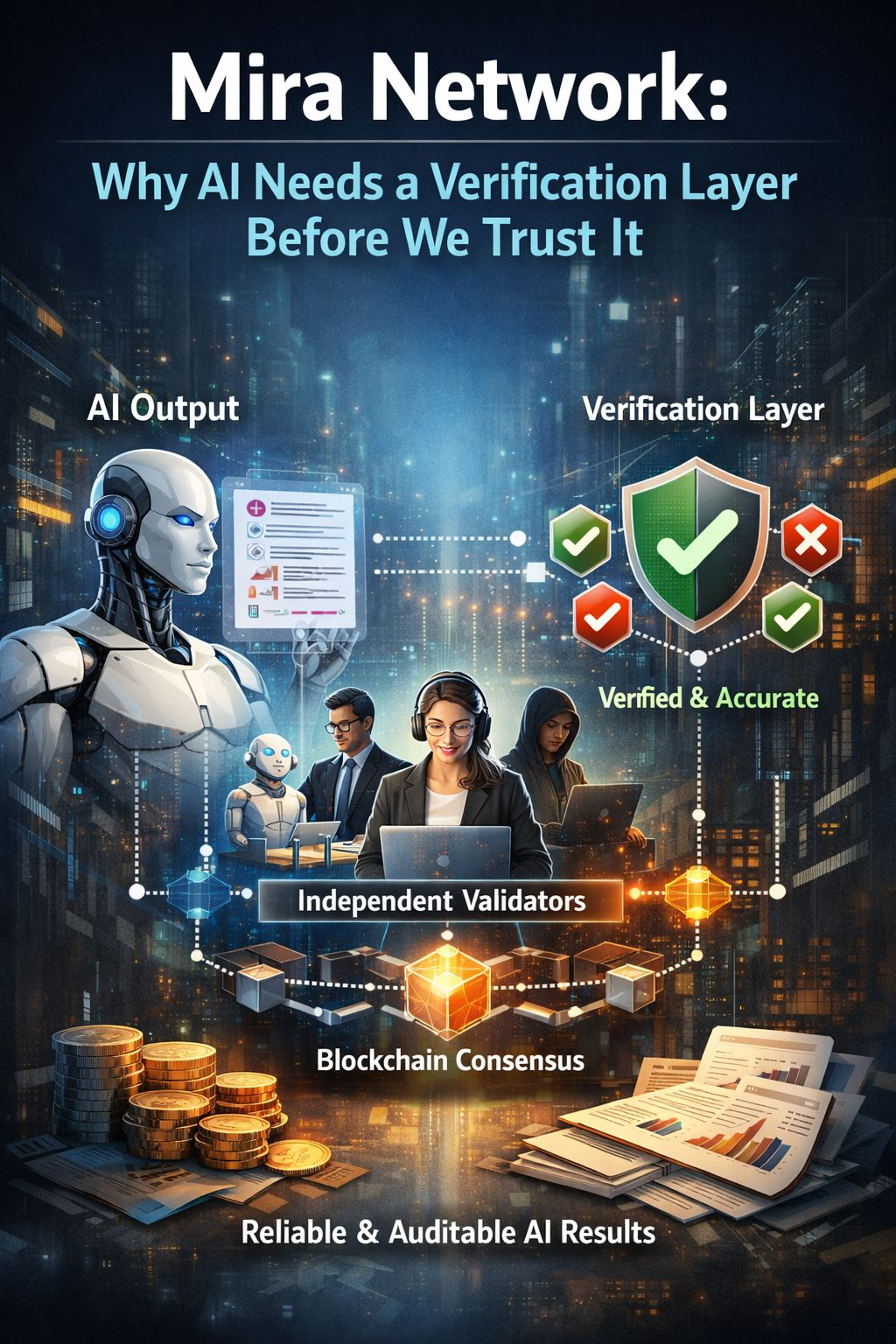
Mira is not trying to beat the big AI labs. It is not another model promising “fewer mistakes.” Instead, Mira works like a verification layer that comes after an AI gives an answer, and before we decide to trust it. That position is important.
Here is the idea in simple terms: instead of trusting one AI output as a whole, Mira breaks that output into smaller claims. Then those claims are checked by independent validators. These validators can be different AI systems, not just one model. They review each claim and come to an agreement through coordination on a blockchain, supported by economic incentives.
So you are not trusting one confident voice. You are trusting distributed agreement.
The blockchain records what validators decided, which makes the process auditable. And because validators stake value in the system, they have a reason to be careful. If they validate bad information too easily, there are consequences. In this setup, “truth” is pushed by incentives, not just reputation.
This matters even more now because autonomous AI agents are growing fast. When humans are always checking AI outputs, hallucinations can be annoying but manageable. But once AI starts doing real actions like sending money, approving business workflows, or producing research that influences serious decisions, the cost of mistakes becomes huge.
At that stage, we need outputs that are verifiable and traceable, not just persuasive.
What I like about Mira is that it does not pretend hallucinations will disappear. It assumes they will happen and builds around that reality. That feels honest. Of course, there are still hard questions: scalability, speed, validator diversity, and the risk of collusion. Also, breaking complex reasoning into small “atomic” claims is not easy.
But the bigger direction feels clear: intelligence without verification does not scale safely.
Mira is positioning itself as trust infrastructure for AI, turning probabilistic answers into information backed by consensus. It may not look flashy, but if AI keeps entering critical systems, layers like this will move from “nice to have” to “must have.”