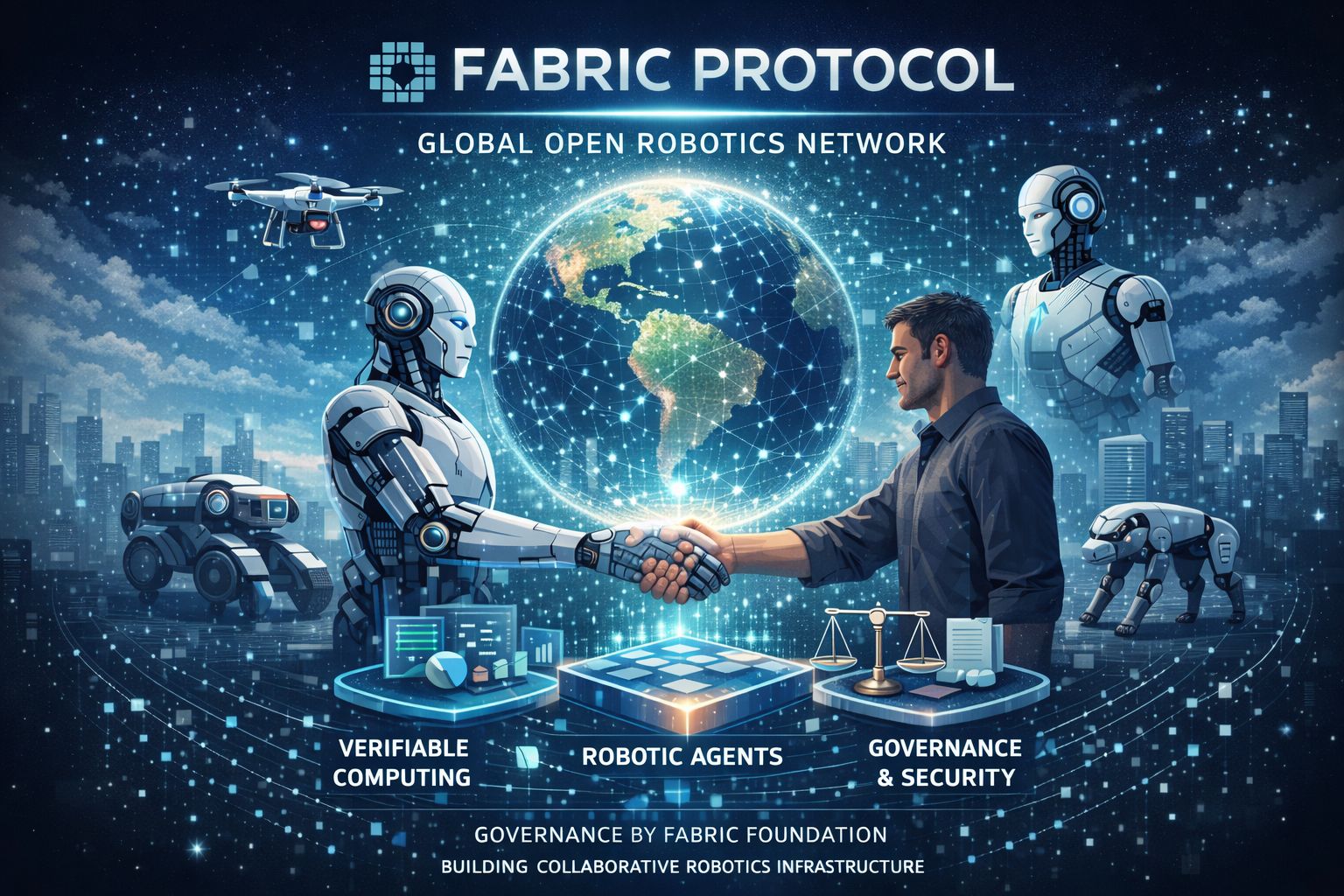
Fabric Protocol is a global open network supported by the non-profit Fabric Foundation, enabling the construction, governance, and collaborative evolution of general-purpose robots through verifiable computing and agent-native infrastructure. The protocol coordinates data, computation, and regulation via a public ledger, combining modular infrastructure to facilitate safe human-machine collaboration.
The Undefined Variable in Autonomous Systems
When robots begin transacting with one another, settling payments for completed tasks, and coordinating physical operations without human intervention, a fundamental question emerges that few robotics companies have bothered to ask: who validates that the work was actually done?
This is not a theoretical concern. It is the central economic friction preventing autonomous machine networks from scaling beyond controlled demonstrations. The robotics industry has spent decades perfecting perception, manipulation, and locomotion. It has devoted enormous resources to making robots see, grasp, and move. But it has invested almost nothing in making them trust one another.
The Fabric Protocol enters this void with a proposition that flips the conventional robotics narrative on its head. Before robots can collaborate at scale, they need something more fundamental than better grippers or more sophisticated computer vision. They need an economic consensus mechanism that aligns the incentives of machines, their owners, and the validators who certify that work occurred as claimed.
This is where the market model reveals its first structural weakness. Existing robotics deployments operate within closed gardens. A warehouse robot from one manufacturer cannot verify the work of a delivery robot from another. There is no shared ledger of reputation, no mechanism for dispute resolution, and crucially, no economic penalty for bad actors. The result is fragmentation that prevents the emergence of true machine-to-machine commerce.
Why Traditional Approaches Fail the Coordination Test
The incumbent solutions to machine coordination are architectural fossils from an era when robots were isolated from networks. Industrial robotics relied on centralized supervisory systems where a single controller directed all activity. This approach scales linearly with complexity, which is to say it does not scale at all. More robots require more supervisors, more proprietary interfaces, and more integration middleware that collapses under its own weight.
Cloud robotics attempted to solve this by offloading computation to centralized servers. But this reintroduces the trust problem in a different form. Who operates the servers? What prevents them from manipulating task records to favor certain participants? The cloud robotics model assumes benevolent centralized coordination, an assumption that becomes untenable when real economic value moves through the system.
Blockchain-based machine coordination projects have attempted to address the trust gap, but most have failed to understand the unique demands of robotic verification. They treat robots as passive IoT devices that simply report their status to the chain. This ignores the reality that robots are active agents capable of generating verifiable proof of their own work through computational attestations.
The Fabric Protocol recognizes that verification cannot be outsourced entirely to human validators or simple oracle mechanisms. The volume of machine transactions will dwarf human-scale economic activity. A single autonomous fleet could generate millions of microtransactions daily. Manual verification is economically impossible. Oracle-based verification introduces latency and centralization risks that defeat the purpose of decentralized coordination.
The Validator as Economic Arbiter
This brings us to the core mechanism that will determine whether Fabric succeeds or joins the graveyard of ambitious infrastructure projects: validator incentives. The protocol's design acknowledges that validators are not merely technical participants maintaining network consensus. They are economic arbiters whose decisions allocate value between competing machines.
When Robot A claims it completed a delivery task for Robot B's owner, and Robot B's sensors confirm receipt, who gets paid? The answer depends entirely on validator behavior. Validators must weigh cryptographic proofs from both parties, assess reputation scores, and render judgments that cannot be economically gamed. This is not typical blockchain validation where transaction ordering is the primary concern. This is computational dispute resolution at machine speeds.
The validator incentive structure must therefore accomplish something that no existing proof-of-stake system has fully addressed: it must align validator rewards with accurate assessment of physical-world events. A validator who consistently rules incorrectly—whether through malice, incompetence, or capture—must face economic consequences that exceed any potential gains from manipulation.
Fabric approaches this through a slashing mechanism tied to dispute outcomes. Validators stake ROBO tokens to participate in consensus. When disputes arise, a subset of validators is randomly selected to adjudicate based on cryptographic proofs submitted by the involved machines. If their ruling is later overturned through protocol-level appeals, their staked tokens are partially slashed and redistributed to the wronged party.
This creates a powerful economic constraint. Validators cannot simply collude to favor certain machines because they never know which disputes they will be assigned to adjudicate. They cannot predict which machines will appear before them, preventing the formation of stable corruption pacts. The random assignment, combined with financial penalties for incorrect rulings, pushes validators toward honest verification as the dominant strategy.
The Token Design Tension
The ROBO token sits at the center of this incentive architecture, and its design reveals the trade-offs the protocol team has navigated. With a fixed supply of 10 billion tokens, the system must generate sufficient fee volume to reward validators for their work while maintaining affordable transaction costs for machine participants. This is the classic blockchain trilemma applied to machine economics.
Transaction fees in the Fabric network are paid in ROBO and distributed to validators based on their participation and accuracy metrics. But here the design introduces a subtle feedback loop that bears watching. Validators with higher historical accuracy receive proportionally more fee allocations. This creates a reputation premium within the validator set itself. Accurate validators earn more, allowing them to compound their staking positions and gain greater influence over future consensus.
The risk embedded in this design is the potential for a permanent validator class to emerge. If accuracy correlates perfectly with wealth, and wealth enables larger stakes that capture more fees, the network could drift toward concentration. The countervailing force is the random dispute assignment mechanism, which prevents any validator from developing specialized expertise that would give them systematic advantage. Every validator faces the same probability distribution of dispute types, commoditizing the verification function.
What on-chain metrics would validate whether this design is working? The critical indicators would center on validator turnover and dispute resolution patterns. A healthy network would show consistent entry and exit of validators at various stake sizes, indicating that barriers to participation remain low. Dispute resolution times would compress as validators develop efficiency in processing machine proofs. Most importantly, the correlation between validator stake size and accuracy would remain weak, suggesting that verification quality depends on technical competence rather than economic muscle.
Governance Risk in Machine Systems
The governance layer of Fabric introduces complications that human-centered protocols never encounter. When human stakeholders vote on parameter changes, they weigh trade-offs based on their economic interests. When machines gain governance rights through staked ROBO, the calculus shifts. Machines operate according to programmed objectives that may not align with human welfare.
This is not science fiction. The protocol explicitly contemplates machine participation in governance through staked identities. A robot fleet operator could delegate voting power to the machines themselves, allowing them to vote on fee structures or validation parameters that affect their operations. The machines would vote based on their programmed utility functions, optimizing for lower costs and faster settlements.
The governance risk here is profound. Machines optimizing locally for their own operational efficiency could vote to reduce validator rewards below the level necessary to attract high-quality participants. They could vote to lower slashing penalties, reducing the deterrent effect that keeps validators honest. They would do this not out of malice but out of faithful execution of their programmed objectives.
The protocol's defense against this outcome is the non-profit Fabric Foundation's retained governance authority during early stages, combined with human stakers who maintain voting power through their ROBO holdings. But as the network matures and machine participation grows, this tension will intensify. The on-chain governance data will tell the story. If proposals that benefit machines at the expense of validators begin passing with overwhelming margins, the network will face a reckoning. Validators will exit if rewards fall below their opportunity cost, triggering a security spiral that undermines the entire verification apparatus.
Adoption Friction and the Cold Start Problem
The most elegant validator incentive design means nothing if robots never join the network. Fabric faces the classic cold start problem amplified by physical-world complexity. Robot manufacturers must integrate the OM1 operating system. Fleet operators must stake ROBO to register their machines. Validators must commit capital to infrastructure with uncertain short-term returns.
The protocol's approach to this friction reveals its understanding of network effects. By open-sourcing OM1 under the MIT license, Fabric removes the primary barrier to developer adoption. Robot builders can integrate the operating system without licensing negotiations or upfront payments. They can experiment, contribute improvements, and build compatible tools without committing to the economic layer.
This strategy mirrors successful protocol launches in other domains. Give away the infrastructure, build a developer ecosystem, and let organic demand for coordination drive economic participation. The risk is that developers adopt OM1 but never connect to the Fabric settlement layer, using it instead as a standalone robotics framework. The on-chain metrics that would validate the strategy's success are not transaction volumes but identity registrations and cross-fleet coordination events.
When multiple independent robot operators begin using Fabric to coordinate shared tasks, the network achieves its first economic density. A delivery robot from one company hands off a package to a security robot from another, and the transaction settles automatically through the protocol. This is the moment when validator incentives matter, when the fees generated justify the capital committed, when the machine economy transitions from concept to reality.
The Forward-Looking Thesis
The current market conditions favor infrastructure that bridges digital and physical value creation. Capital has rotated toward projects with clear revenue models and real-world utility. Fabric occupies an unusual position at this intersection, offering exposure to robotics adoption through a tokenized incentive layer rather than hardware manufacturing.
The capital flow thesis depends on two concurrent developments. First, the continued maturation of AI enables robots to perform increasingly complex tasks, expanding the addressable market for machine services. Second, the validator network achieves sufficient geographic and technical distribution to provide reliable verification at scale. When these converge, the fees generated by machine-to-machine transactions could create sustainable demand for ROBO that transcends speculative trading.
What would validate this thesis on-chain? Volume trends would show increasing transaction counts from diverse machine identities, not concentrated in a few large operators. Fee accruals would demonstrate that economic activity generates validator rewards competitive with other staking opportunities. Validator composition would reflect genuine geographic and technical diversity rather than domination by a few large staking pools.
The machine economy will not arrive all at once. It will emerge gradually as individual fleets connect, as standards solidify, as the economic benefits of coordination outweigh the costs of integration. Fabric's validator incentive design recognizes this gradual emergence and builds mechanisms that can scale from dozens of robots to millions. Whether those mechanisms prove robust enough to withstand the governance tensions and adoption frictions ahead will determine whether the protocol becomes the settlement layer for autonomous systems or merely a footnote in robotics history.
The question for participants watching this space is straightforward: can economic consensus scale to machine speeds without collapsing under its own complexity? The answer will be written in validator behavior, dispute outcomes, and the quiet accumulation of on-chain proofs that robots are finally learning to trust one another.