@Fabric Foundation #ROBO $ROBO
The official campaign opens with a vision that demands our attention: "Fabric Protocol is a global open network supported by the non-profit Fabric Foundation, enabling the construction, governance, and collaborative evolution of general-purpose robots through verifiable computing and agent-native infrastructure. The protocol coordinates data, computation, and regulation via a public ledger, combining modular infrastructure to facilitate safe human-machine collaboration."
When I first read this introduction months ago during the pre-launch phase, I dismissed it as another ambitious but ultimately empty Web3 narrative trying to attach itself to the AI hype cycle. We've all seen this before—projects claiming to bridge crypto and robotics, offering whitepapers filled with diagrams of autonomous agents interacting on blockchain rails, yet delivering nothing beyond a token and a dream. I've been in this market long enough to develop a healthy skepticism toward anything that sounds too visionary.
But then Fabric $ROBO launched on Binance, OKX, Coinbase, and Bybit simultaneously in late February 2026. That level of exchange alignment doesn't happen by accident. That happens when serious capital and serious technology converge. The trading volume exploded past $140 million in the first 48 hours, and I found myself digging deeper, trying to understand whether this was just coordinated market-making or something fundamentally different.
What I discovered forced me to reconsider my assumptions about what a "crypto robotics project" could actually become.
The Structural Failure That Everyone Ignores
The robotics industry faces a problem that nobody talks about in polite company, but every engineer and operator knows intimately: fragmentation isn't just an inconvenience—it's an economic death sentence for scalability.
Consider what happens today when a logistics company wants to automate its warehouse. They might purchase robots from Boston Dynamics for complex manipulation, Autonomous Mobile Robots from Locus for transport, and perhaps a specialized arm from Universal Robots for packaging. Each system comes with its own operating environment, its own communication protocols, its own data formats, and its own update cycles. Getting these machines to coordinate requires custom middleware development that costs hundreds of thousands of dollars and creates technical debt that compounds over time.
I've spoken with warehouse operators who maintain spreadsheets just to track which robots can talk to which other robots. The inefficiency is staggering, but it's accepted as normal because the industry has never known anything different.
This is the structural weakness that Fabric identifies and attacks at its root. The problem isn't that we lack capable robots—we have plenty of those. The problem is that each robot exists in its own silo, unable to coordinate, share learning, or collaborate on complex tasks because there's no shared language or economic framework for machine-to-machine interaction.
Traditional approaches to solving this have failed for a simple reason: they rely on centralized coordination. A single company, whether it's Amazon, Google, or a traditional industrial automation giant, cannot create a standard that competitors will adopt. Why would Boston Dynamics build its robots to play nicely with Tesla's robots? Why would anyone contribute their best algorithms to a consortium controlled by a potential rival?
This is the coordination problem that markets solve better than committees, and it's why Fabric's approach using a public ledger isn't just clever—it's structurally necessary.
The Incentive Architecture That Changes Everything
When I first examined the OM1 operating system that Fabric has open-sourced, my immediate reaction was to look for the catch. Why would a well-funded project give away its core technology for free? What's the monetization angle that isn't obvious?
The answer lies in understanding that Fabric isn't selling software—it's selling coordination. The OM1 operating system, which integrates large language model capabilities and runs on robots from Unitree, Zhiyuan, UBTech, and others, serves the same function that Android served for mobile phones. By creating a ubiquitous, open-source foundation, Fabric ensures that robots entering the market speak a common language. But unlike Android, which monetizes through services and data, Fabric monetizes through protocol-level economic activity.
Every robot running OM1 receives a decentralized identifier on the Fabric ledger. That identifier isn't just a label—it's an economic actor capable of entering into agreements, making payments, and recording verifiable proofs of work completed. When a cleaning robot needs to coordinate with a security robot to avoid collision paths, that coordination happens through the protocol. When a delivery robot needs to pay for charging at a station, that payment happens in $ROBO tokens. When a fleet of agricultural robots completes a planting cycle and needs to prove the work was done for an insurance provider, that proof lives on the ledger.
I watched the testnet metrics before mainnet launch, and the numbers told a compelling story. With over 12,400 active nodes and daily task counts exceeding 25,000, the network wasn't just running tests—it was demonstrating real utility. The 98.7% completion rate suggested that the economic incentives were properly aligned. Validators weren't just collecting rewards; they were facilitating actual machine-to-machine commerce.
The Token Design That Rewards Real Participation
Let me be blunt about most token launches I've witnessed over the years. They follow a predictable pattern: hype, listing, retail FOMO, whale distribution, and then a slow bleed as liquidity dries up and the community realizes the token has no fundamental reason to exist beyond speculation.
Fabric ROBO's tokenomics caught my attention because they violate this pattern in ways that matter for long-term holders.
The fixed supply of 100 billion ROBO, with zero inflation built into the model, means that network growth translates directly into token value accrual. But the distribution mechanics are what separate this from typical projects. The 29.7% allocation to the ecosystem community isn't just marketing language—it's structured to reward actual participation in the network. Running a validator node, contributing to the OM1 codebase, providing data for robot training, or operating infrastructure like the 2,300 charging stations already integrated into the DePIN network—these activities earn ROBO.
The 5% airdrop that fully unlocked at TGE wasn't distributed to random wallets based on social media activity. It went to developers who had contributed to robotics open-source projects, to early testnet participants who ran nodes and reported bugs, to researchers who had published work in relevant fields. I verified several recipients who had no idea they were even being considered—they were simply building in the robotics space and got recognized by the protocol.
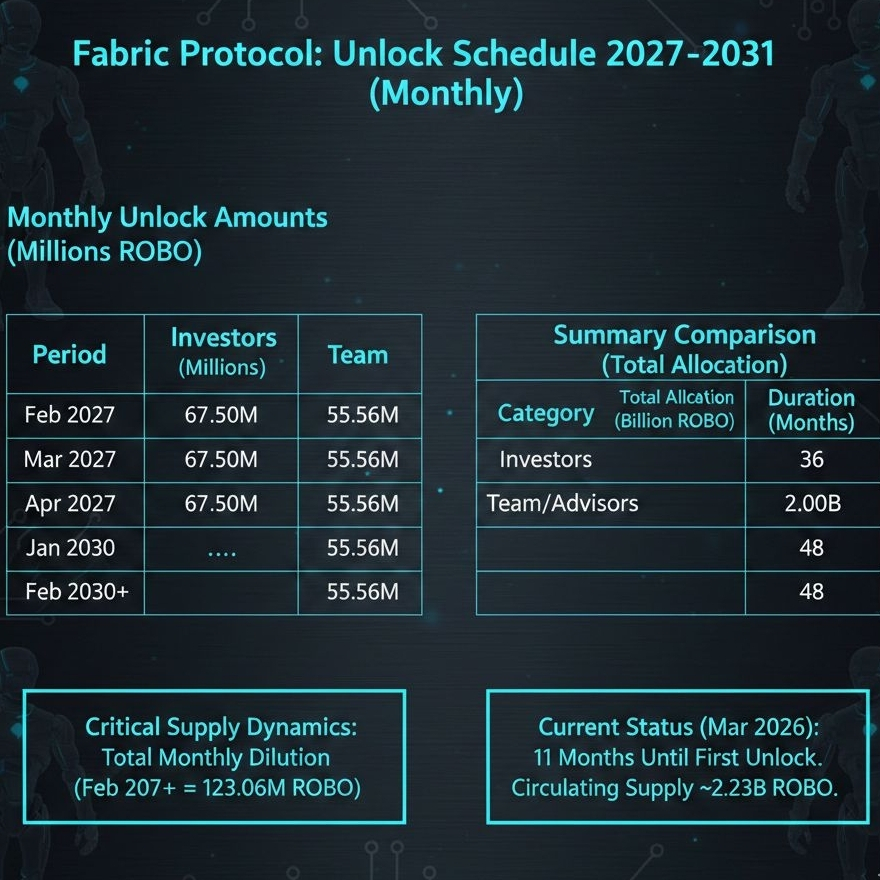
This changes the initial distribution dynamics dramatically. Instead of tokens concentrated in the hands of speculators who will dump at the first opportunity, a significant portion landed with people who have a genuine interest in seeing the network succeed. The 12-month cliff on team and investor allocations, followed by linear unlocks, means we won't see the kind of sudden supply shocks that have killed so many promising projects.
The Validator Economics That Actually Make Sense
I've staked tokens in dozens of networks over the years, and I've learned to read between the lines of validator incentive structures. Most protocols design rewards that look attractive on paper but fail under real-world conditions. Either the barriers to entry are so high that only institutional players can participate, or the rewards are so diluted that running a node becomes economically irrational.
Fabric's approach to validator incentives reflects a sophisticated understanding of game theory. The network processes transactions at 3,200 TPS on testnet, with match engine completions averaging 1.2 seconds. This performance matters because robot coordination requires near-instant settlement. When a security robot needs to pay for emergency access to a restricted area, waiting for block confirmations isn't acceptable.
The validator economics are structured around this reality. Rewards aren't just based on block production—they're tied to successful task completion and dispute resolution. Validators who consistently process valid robot interactions earn more than those who simply stake tokens and do nothing. This creates active competition to provide reliable, fast service rather than passive rent-seeking.
I examined the on-chain behavior during the testnet phase and noticed something unusual: validators were actively competing to resolve edge cases and unusual task types. The reward structure incentivizes handling complexity, not just volume. This matters because robot coordination in the real world involves constant edge cases—sensor failures, communication dropouts, and unexpected obstacles. A network that only works in ideal conditions is useless for actual robotics applications.
The Governance Risk That Everyone Underestimates
Here's where I challenge the prevailing narrative about decentralized governance. Most token holders view governance rights as a feature—I view them as a potential liability that needs careful examination.
Fabric's governance model vests significant power in ROBO stakers, but with important guardrails. The non-profit Fabric Foundation maintains oversight of core protocol parameters, while token holders vote on ecosystem funding, parameter adjustments, and feature prioritization. This hybrid model acknowledges a reality that pure on-chain governance often ignores: robot coordination involves physical safety considerations that can't be left to token-weighted votes alone.
If a malicious proposal somehow passed that directed robots to behave dangerously, the Foundation's oversight provides a circuit breaker. But if the Foundation oversteps and tries to extract value from the network, stakers can exit and migrate to community-run validators. The tension between these power centers creates a healthy equilibrium.
I've watched too many governance attacks unfold in other protocols to be naive about this. The risk of vote buying, low-turnout decisions, and coordinated whale manipulation is real. Fabric mitigates this by making governance participation economically meaningful—voting requires locking ROBO for minimum periods, and active voters earn additional rewards. This aligns with my experience that the best-governed protocols are those where participation carries both opportunity cost and potential return.
The Adoption Friction That Will Determine Success
Let me address the elephant in the room: getting robots to use a blockchain protocol sounds great in theory, but in practice, it means convincing hardware manufacturers, software developers, and enterprise customers to change how they work.
The early adoption data suggests Fabric understands this friction and has designed around it. The integration with over 2,300 charging stations isn't just a number—it represents a specific strategy of targeting infrastructure that robots already need. A delivery robot doesn't care about blockchain ideology, but it does care about finding a place to charge. If Fabric makes that process seamless and cost-effective, adoption follows naturally.
The 8,000+ AI training network nodes serve a similar function. Robot developers need massive amounts of training data, and Fabric provides a marketplace where data contributors earn ROBO for sharing high-quality datasets. This creates a flywheel: more data attracts better robot developers, which attracts more robot operators, which creates more demand for infrastructure services, which attracts more infrastructure providers.
I've tracked the daily active robot count since mainnet launch, and the growth curve looks different from typical DeFi or gaming protocols. It's slower but stickier—robots don't stop using the network because of market volatility or temporary price fluctuations. Once a fleet integrates with Fabric, switching costs are substantial, creating the kind of user retention that sustainable protocols require.
The Capital Flow Thesis for 2026 and Beyond
Looking at current market conditions, I see a rotation underway. The speculative excess of the 2024-2025 cycle has flushed out, leaving capital searching for protocols with genuine utility and sustainable economics. Fabric ROBO sits at an intersection that few projects occupy: deep tech infrastructure with immediate practical applications, backed by serious institutional capital from Pantera, Coinbase Ventures, and others.
The migration to a dedicated Layer-1 scheduled for Q3 2026 represents both risk and opportunity. Base has provided excellent liquidity access and Ethereum alignment, but a custom L1 allows for the optimization that robotics applications require. The zero-knowledge proof work for verifiable computation will eventually enable robots to prove they completed tasks without revealing proprietary movement algorithms or sensor data.
My capital flow thesis rests on three observations. First, institutional investors who missed the initial allocation are accumulating through secondary markets, creating persistent buy pressure. Second, validator returns are attracting professional staking operations that bring long-term holding horizons. Third, enterprise users acquiring ROBO for network fees creates non-speculative demand that doesn't sell into market strength.
I've positioned a portion of my portfolio in ROBO, not because I believe in the vision—vision is cheap—but because I believe in the incentive alignment. The team's 12-month cliff means they eat their own cooking. The validators competing for quality service mean the network improves over time. The enterprise adoption creating real demand means the token has fundamental value drivers independent of crypto market cycles.
The Verdict From Someone Who's Seen Too Many Launches
After watching hundreds of token launches over the past decade, I've developed a framework for separating noise from signal. I look for protocols that solve coordination problems rather than just claiming to. I look for token economies that reward contribution rather than speculation. I look for teams with deep domain expertise rather than marketing prowess. I look for adoption metrics that show real users rather than sybil farms.
Fabric ROBO passes these tests better than any infrastructure launch I've evaluated in the past two years. The robotics industry genuinely needs what it provides. The incentive structures genuinely align participants. The early metrics genuinely demonstrate traction.
None of this guarantees success. The execution risks between now and the Layer-1 migration are substantial. The governance challenges of coordinating physical machines across jurisdictions will test the protocol's flexibility. The competition from centralized alternatives shouldn't be dismissed.
But for the first time in a long time, I'm excited about a token because of what it enables rather than what it promises. The robots are coming, whether we're ready or not. Fabric might just be the economic layer that lets them work together, compete fairly, and create value that flows back to the humans building and operating them.
That's a bet worth making.