
When people hear about rising tensions involving Iran and the United States, the first assumption is usually the same: oil prices will spike. That is true, but it is also far too narrow. The real danger of a disruption in the Strait of Hormuz is not just the loss of oil as fuel. It is the breakdown of what oil and gas enable across the modern global economy.
The Strait of Hormuz is one of the most critical chokepoints in the world. Roughly 20 million barrels of oil pass through it every day, accounting for around one-fifth of global petroleum consumption. That alone makes it central to the global energy system. But crude oil is only the beginning of the story. What matters even more is what comes next in the chain of industrial transformation.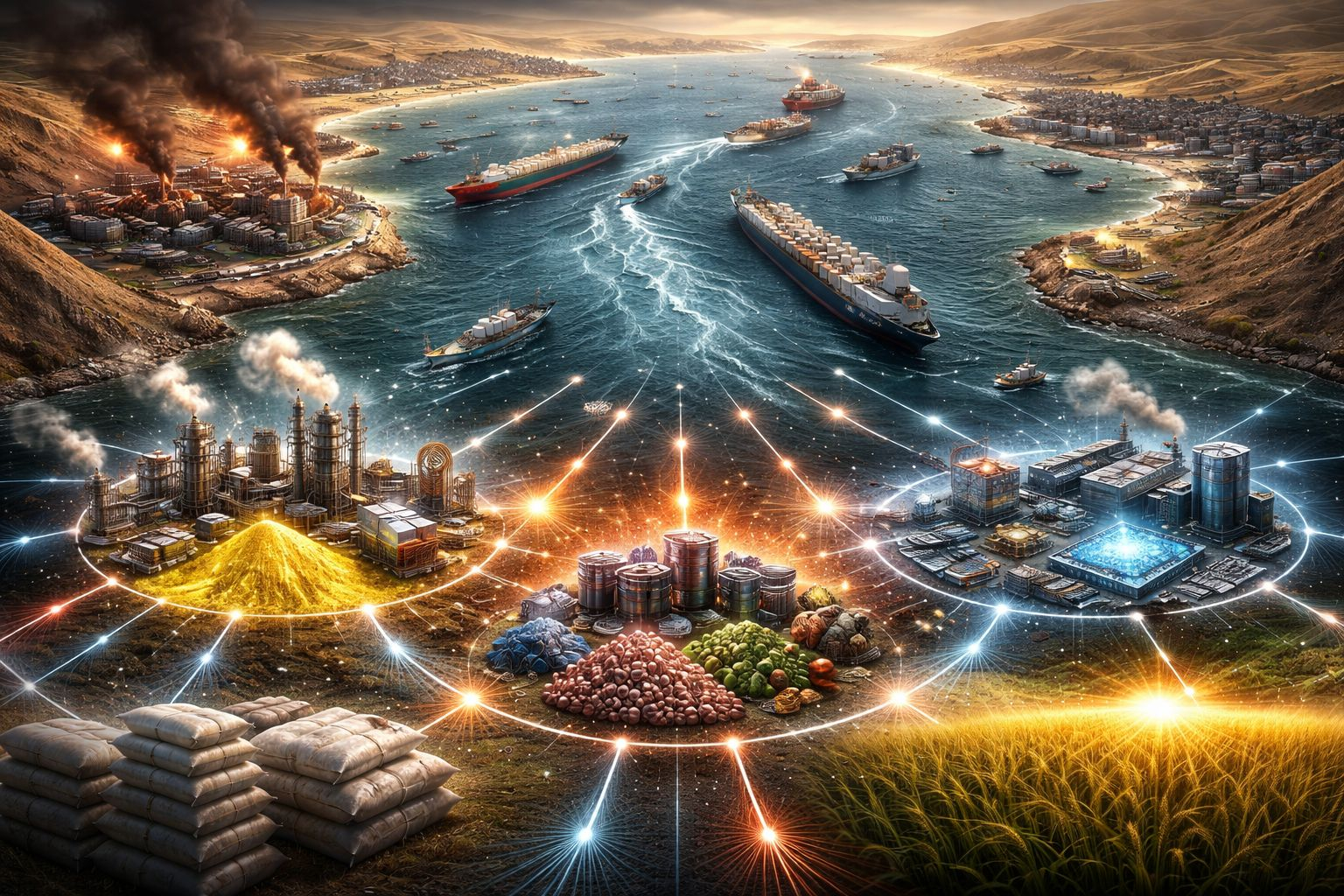
A large share of the world’s sulfur is derived from oil and gas refining. Sulfur, in turn, is the essential feedstock for sulfuric acid, one of the most heavily produced industrial chemicals on Earth. Sulfuric acid is indispensable in metal processing, especially in the extraction and refinement of copper, cobalt, and nickel. These are not marginal commodities. They are foundational materials for transformers, electric vehicle batteries, electronics, grid infrastructure, and the substrates that support data centers and advanced computing systems. If refining flows are severely disrupted, the impact would not stop at fuel markets. It would extend into industrial chemistry, metals, electrification, and digital infrastructure.
The second layer of vulnerability is natural gas. Qatar, one of the world’s leading exporters of liquefied natural gas, ships much of its LNG through the Strait of Hormuz. That gas is vital for electricity generation across Asia. Taiwan is particularly exposed because it depends heavily on imported LNG and has limited storage capacity. A disruption in LNG shipments could translate quickly into electricity shortages.
That matters because Taiwan is home to TSMC, the most important advanced semiconductor manufacturer in the world. TSMC produces the overwhelming majority of the world’s leading-edge chips, the processors that power AI systems, advanced electronics, cloud infrastructure, and military technologies. Semiconductor fabrication is highly energy-intensive and cannot tolerate major power instability. If LNG disruptions were to undermine Taiwan’s electricity supply, the consequences would move rapidly through the global technology sector.
The risks do not end with energy and chips. Fertilizer is another major point of dependence. A significant share of the feedstocks tied to nitrogen fertilizer production also moves through or depends on energy systems linked to the Gulf. Synthetic fertilizers are one of the pillars of modern agriculture. They sustain crop yields at a scale necessary to feed billions of people. If those supplies are disrupted long enough, the effects would move from industry and technology into food production and, eventually, political stability.
This is why the Strait of Hormuz should not be viewed simply as an oil transit route. It is better understood as a pressure point in an interconnected system. Energy supports chemical production. Chemical production supports metals. Metals support batteries, grids, and electronics. Gas supports power systems. Power systems support semiconductor fabrication. Fertilizer supports agriculture. A shock in one narrow waterway can therefore spread through multiple layers of the world economy at once.
The real story is not just higher gasoline prices. It is systemic fragility. A serious disruption in Hormuz would threaten industrial inputs, electricity security, chip manufacturing, and food systems in parallel. That is what makes the crisis so dangerous. It is not only an energy story. It is a story about how tightly modern civilization is bound to a few critical flows—and what happens when one of them breaks.