
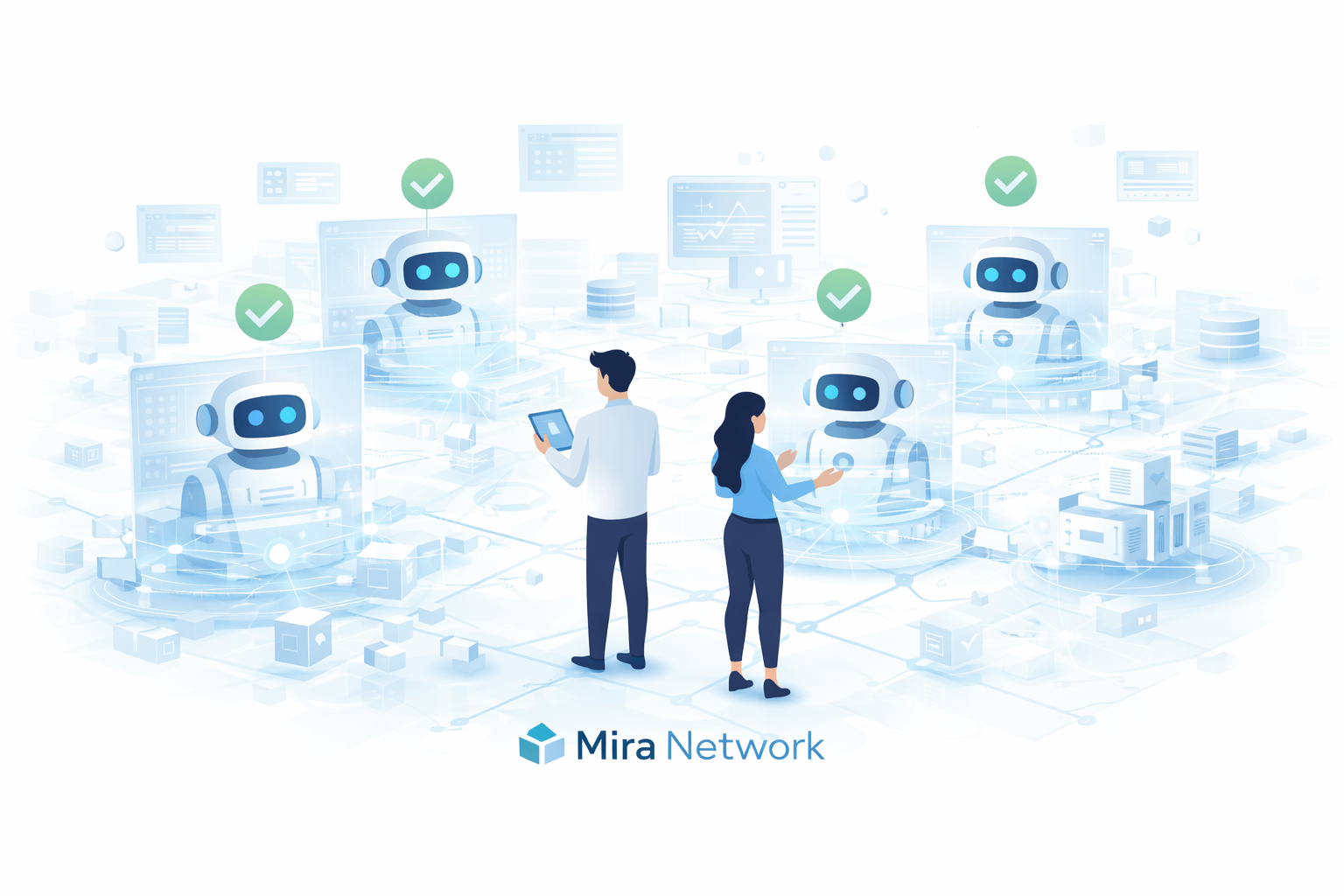
 Artificial intelligence is growing fast. Today AI helps people write content, analyze markets, detect diseases, and even support legal research. But one big problem still exists: Can we really trust AI answers?
Sometimes AI gives very confident responses that look correct but actually contain wrong or misleading information. This problem is often called AI hallucination. As AI becomes more involved in real-world decisions, the need to verify its outputs becomes more important than ever.
This is where Mira Network and the $MIRA ecosystem introduces an interesting concept.
Instead of trusting a single AI model, Mira Network treats every AI response like a claim that needs verification. Think of it like a research process. One AI provides an answer, but multiple independent systems review and check that answer before it can be considered reliable.
The idea is simple but powerful.
First, a complex AI response is broken into smaller statements. These statements are then checked by different participants and verification models inside the network. Each participant reviews the claim and provides validation. Through a consensus mechanism supported by blockchain, the system decides whether the information is trustworthy.
This creates something similar to a “trust layer” for artificial intelligence.
One major benefit of this approach is diversity of verification. When multiple AI systems evaluate a response, the risk of a single model’s bias or mistake becomes smaller. In simple words, many perspectives lead to stronger accuracy.
Another important advantage is transparency. Because the verification process can be recorded on blockchain, it becomes possible to track how a piece of information was validated. For industries like finance, healthcare, and legal services, this kind of traceability can be extremely valuable.
But like any emerging infrastructure, there are challenges too.
For a decentralized verification network to work well, participants must be properly incentivized. Validators and reviewers need clear motivation to contribute honest evaluations. At the same time, the system must remain efficient. Too much complexity in verification could slow down the process.
Finding the right balance between decentralization, speed, and accuracy will be one of the key factors that determine the success of networks like Mira.
Still, the concept itself is very promising.
Instead of focusing only on making AI smarter, projects like Mira Network focus on making AI more accountable and trustworthy. In the long run, this kind of infrastructure could become just as important as the AI models themselves.
As AI continues to expand across industries, verification layers may become the missing piece that allows people and organizations to trust AI outputs with greater confidence.
And if that happens, the future of AI may not just be about intelligence — but also about verified intelligence. 🚀