Most people do not think about data ownership when they open an app.
You send a message.
You upload a photo.
You connect a wallet.
You sign in to a service.
Everything feels simple. Smooth. Instant.
But behind that smooth experience there is a complicated reality that very few people ever see.
Your data is almost never really yours.
It sits inside servers owned by companies. It moves through systems you cannot inspect. It is analyzed, copied, stored, and sometimes even sold. In many cases, the user who generated the data has the least control over it.
For years this model worked because people accepted convenience over control. But the digital world is changing. People are becoming more aware of privacy risks, data leaks, and the invisible value their information creates.
This is where the idea behind Midnight starts to feel important.
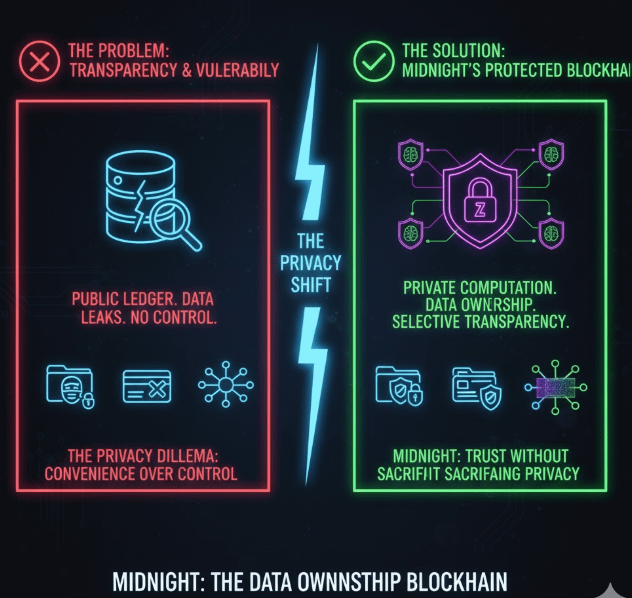
Midnight is not trying to build just another blockchain. It is trying to solve something deeper, how information can exist on a blockchain without exposing everything to the world.
Most traditional blockchains are transparent by design. Every transaction, every interaction, every piece of activity is visible to anyone who looks at the chain. Transparency helped build trust in decentralized systems, but it also created a new problem.
Not every piece of information should be public.
Businesses cannot expose confidential data.
Developers cannot always publish sensitive application logic.
Users may not want every action permanently visible.
So the question becomes simple but difficult:
How do you build decentralized systems while still protecting privacy?
Midnight approaches this problem with a different philosophy. Instead of forcing developers to choose between transparency and privacy, it attempts to make privacy something that can exist naturally inside blockchain applications.
In other words, developers should not have to redesign their entire application architecture just to protect user data.
The Midnight network introduces a framework where sensitive information can stay protected while still benefiting from decentralized infrastructure. That idea alone could change how companies think about using blockchain technology.
Right now many businesses avoid blockchain because of privacy limitations. Financial systems, healthcare platforms, enterprise tools, these sectors handle sensitive information that cannot simply be placed on a public ledger.
Midnight creates the possibility that blockchain could finally work in those environments.
But technology alone is never enough to build a network. Incentives matter. Participation matters. And this is where the role of the NIGHT token becomes interesting.
Instead of acting only as a speculative asset, the token is designed to support the functioning of the network itself.
The Midnight system uses a resource model where network operations require computational resources represented through a mechanism connected to the token economy. Transactions and application interactions consume network capacity, and that resource model helps regulate how the system grows and operates.
This design is subtle but important.
It means the network economy is not just about trading tokens. It is about maintaining the infrastructure that allows privacy-focused applications to exist.
When people talk about blockchain adoption, they often focus on price charts and market cycles. But real adoption usually comes from infrastructure that quietly solves real problems for developers.
If Midnight succeeds, its biggest impact might not even be visible to the average user.
Imagine a future where:
A financial application can process sensitive transactions without revealing client information.
A supply chain platform can verify data authenticity without exposing proprietary details.
A digital identity system can confirm credentials without broadcasting personal information across a public ledger.
These kinds of systems require both decentralization and privacy, and that combination has historically been difficult to achieve.
Midnight is attempting to bridge that gap.
Another interesting part of the project is how it positions itself within a broader multi chain ecosystem. The blockchain world is no longer a place where one chain tries to replace all others. Instead, different networks specialize in different capabilities.
Some chains focus on speed.
Some focus on smart contracts.
Some focus on scalability.
Midnight’s focus appears to be privacy-preserving computation and protected data interactions. That specialization could allow it to work alongside other networks rather than compete directly with them.
For developers, this could open a new design space.
Instead of asking whether an application should be public or private, they can begin asking which parts of the system require protection and which parts benefit from transparency.
That flexibility matters more than people realize.
Innovation rarely happens when developers are forced into strict limitations. It happens when tools expand what developers can build.
In many ways, Midnight feels less like a typical blockchain project and more like an infrastructure layer that quietly enables new kinds of applications.
Of course, every emerging network faces the same challenge: building a real ecosystem.
Technology alone does not guarantee adoption. Developers need tools. Operators need incentives. Communities need reasons to participate.
This is why early networks often focus heavily on developer accessibility and ecosystem growth. When builders feel empowered to experiment, unexpected use cases start appearing.
The most interesting applications are often the ones nobody predicted at the beginning.
Maybe the future killer app of privacy-enabled blockchain infrastructure does not exist yet.
Maybe a developer somewhere is still thinking about the problem Midnight will eventually help them solve.
That is the strange beauty of early infrastructure projects. Their value often becomes visible only years later when the systems they enabled begin shaping everyday digital life.
For now, Midnight represents an idea that feels increasingly relevant in a world where data is both valuable and vulnerable.
The internet created an era where information moves freely but ownership is blurry. Blockchain promised a new model of trust, but transparency sometimes went too far.
The next stage of digital infrastructure may need something in between.
A system where trust exists without sacrificing privacy.
A system where applications can operate securely without exposing everything.
A system where users do not have to choose between convenience and control.
Midnight is exploring that possibility.
And whether people realize it yet or not, solving the privacy layer of blockchain could become one of the most important pieces of the entire decentralized future.
@MidnightNetwork #night $NIGHT