
I have learned the hard way that when a token consolidates sideways after volatility, the market is asking a question it has not settled yet. ROBO closed today at 0.04196 USDT, up 2.67 percent in the last 24 hours, trading in a tight range between 0.03924 and 0.04202. Volume came in at 277.99 million tokens, translating to roughly 11.19 million USDT. That volume number is down from the 17 million we saw yesterday and well below the 23 million peak we hit a few days ago. Volume decay is normal after sharp moves, but it also tells me the market is waiting for something. Either waiting for price to prove it can hold this level, or waiting for Fabric Foundation to publish the kind of onchain activity data that would justify renewed conviction. What kept me watching ROBO today was not the modest bounce. It was thinking through what validator economics actually mean for a protocol trying to price accountability in autonomous systems, and why that matters more than whether the token finishes green or red on any given session.
The technical picture is neutral, which is fine. ROBO is sitting just above the EMA 20 at 0.04151, which tells me short term momentum has stabilized but not accelerated. The RSI at 50.60589 is dead neutral, not overbought and not oversold, which means the chart is not giving strong directional signals either way. The MACD is slightly negative at minus 0.00020, but the slope is flat, which suggests momentum has stalled rather than collapsed. The moving averages are compressed with the MA 5 at 46.47 million and MA 10 at 57.17 million tokens, which usually precedes either a breakout or a breakdown depending on which way volume tips the scale next. Right now, volume is contracting, which tells me participants are stepping back and reassessing rather than aggressively positioning. That is healthy price discovery behavior after a volatile run, and it creates space to think about the fundamentals without the noise of constant price moves demanding attention.
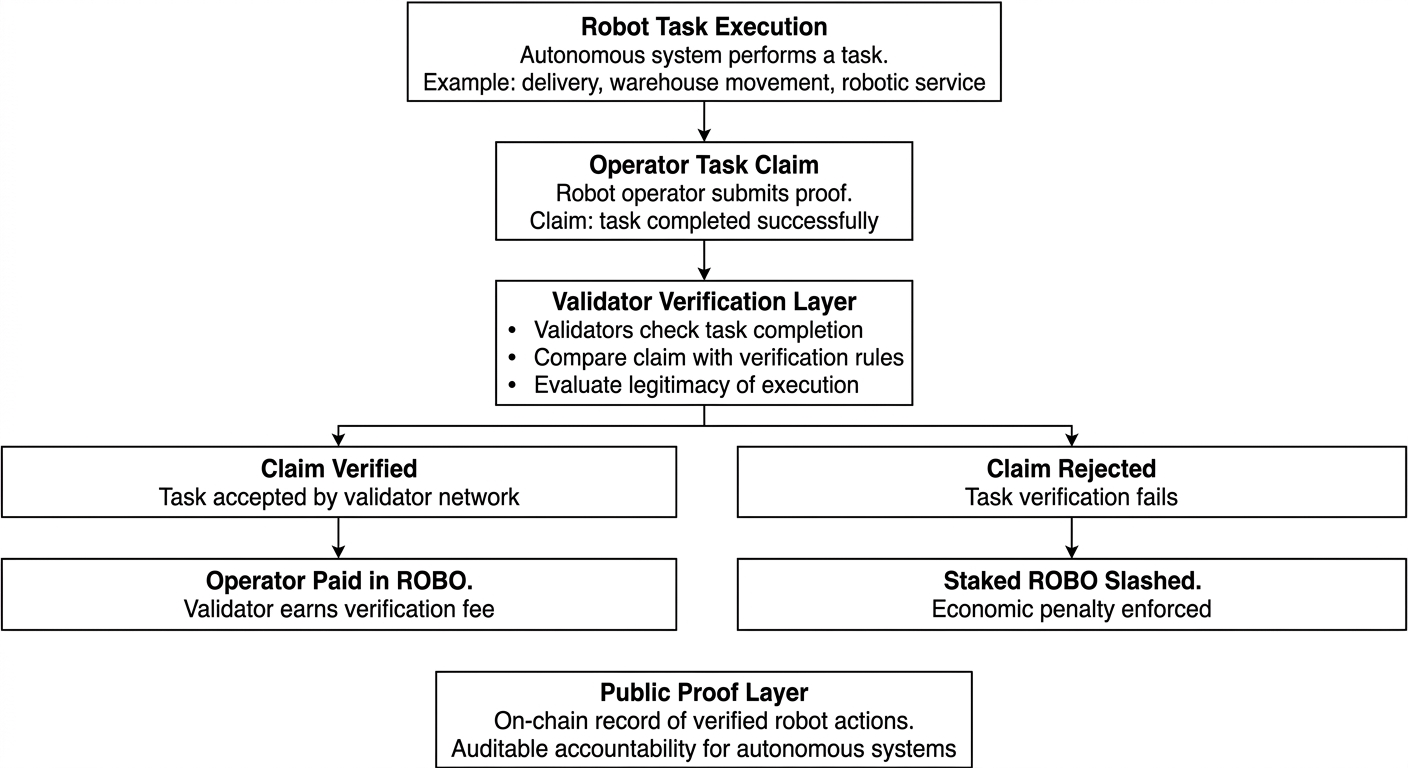
Here is what I keep circling back to. Fabric Protocol is not trying to be a Layer 1 competing on transaction speed or gas fees. It is not a DeFi protocol competing on yield or TVL. Fabric Foundation describes the network as infrastructure designed to coordinate data, computation, and oversight through public ledgers rather than closed corporate stacks, with ROBO functioning as the token used for network fees, identity verification, staking, and governance. What that means in practice is that validators are not just block producers. They are quality enforcers. When a robot operator submits a claim that a task was completed correctly, validators check that claim against whatever verification criteria the network has defined. If the claim passes, the operator gets paid in ROBO. If the claim fails, the staked ROBO gets slashed. Validators earn fees for checking claims, but they also risk their own reputation if they consistently approve bad work or reject good work. That creates an economic game where validators have to balance leniency against strictness, speed against thoroughness, and participation against selectivity.
That validator role is critical because it determines whether Fabric Protocol becomes useful infrastructure or just another coordination experiment that sounds good on paper but fails in practice. If validators are too lenient, the network fills up with low quality task completions, operators game the system, and reputation degrades until nobody trusts the proof layer anymore. If validators are too strict, legitimate operators get discouraged, participation drops, and the network becomes too expensive or too slow to be competitive with centralized alternatives. If validator rewards are too low, nobody bothers to participate and verification becomes a bottleneck. If validator rewards are too high, the network bleeds value to rent-seekers rather than directing it toward productive activity. Getting that balance right is not a one-time design decision. It is an ongoing governance problem that has to adapt as the network scales, as task complexity increases, and as adversarial participants probe for weaknesses.
Here is where I still have friction with the Fabric story. The whitepaper admits that several design parameters are still open, including what metrics should count as non-gameable success, whether the initial validator set starts permissioned or permissionless, and how sub-economies get defined. Those are not minor details. They are the structural choices that determine whether the validator economics actually work or whether they collapse under adversarial pressure. The document also says that revenue can be faked through self dealing among robots, which is the kind of honest admission I appreciate because at least it shows the team is thinking about attack vectors rather than just writing aspirational marketing copy. But it also means this is unproven. If the verification layer is weak, if quality thresholds get politically softened to chase growth, or if early validators capture governance and optimize for their own interests rather than network health, then the entire accountability thesis breaks down. I have watched enough DeFi protocols struggle with governance capture, incentive misalignment, and validator centralization to know this is not a hypothetical concern. It is the central execution risk.
The other thing I keep thinking about is what retention actually looks like for validators. In Proof of Stake networks, retention shows up as staking participation rates and validator uptime. In DeFi protocols, retention shows up as liquidity depth and active user counts. For Fabric Protocol, validator retention should show up as consistent participation in task verification, growing stake amounts as validators commit more capital to the network, and evidence that validation quality is improving over time rather than degrading. Those are the metrics that would tell me the validator economics are sustainable, that participants are not just showing up for launch incentives and then leaving, and that the network is building the kind of institutional memory that makes accountability actually enforceable. Right now, I do not have those numbers. Fabric Foundation has announced partnerships with hardware manufacturers like UBTech, AgiBot, Fourier Intelligence, and Unitree. They launched the x402 protocol with Circle to enable autonomous USDC payments for robot services. Those are real developments, but they are inputs, not outcomes. I want to see validator participation data, I want to see task settlement volume growing, I want to see evidence that the verification layer is being used repeatedly rather than just tested once during setup.
The allocation structure also keeps me cautious about long term value capture. Fabric allocated 29.7 percent of ROBO to ecosystem and community, 24.3 percent to investors, 20 percent to team and advisors, and 18 percent to foundation reserve, with much of that supply locked under cliff and vesting schedules. Circulating supply is around 2.23 billion tokens out of a 10 billion maximum, which means roughly 78 percent of total supply is still locked. That creates short term price stability, but it also means that as vesting unlocks start hitting in late 2026 and 2027, ROBO will need genuine demand from validator participation and network usage to absorb supply without collapsing. Today's modest bounce on declining volume does not tell me much about whether that demand is building. It tells me the market is consolidating and waiting for more information before committing capital in either direction.
The governance question is also unresolved, and I think it matters more than most traders are pricing in. Fabric's whitepaper says token holders can signal on network upgrades and protocol parameters, but it also says governance rights do not extend broadly beyond protocol operations, and that early stage decision making may involve a limited set of stakeholders. That language tells me that in practice, governance over validator rules, quality thresholds, and verification criteria is likely centralized for now, with the foundation or a small coalition making the decisions that actually shape how the network operates. I am not saying that is wrong. Early stage protocols often need tighter control to avoid governance gridlock or adversarial capture. But if you are buying ROBO thinking you are getting meaningful governance power over how validators operate, you should read the fine print carefully, because the token may not give you the influence you think it does. What ROBO does give you is exposure to network growth if Fabric Foundation executes on validator economics successfully, and exposure to dilution if they do not. That is the trade.
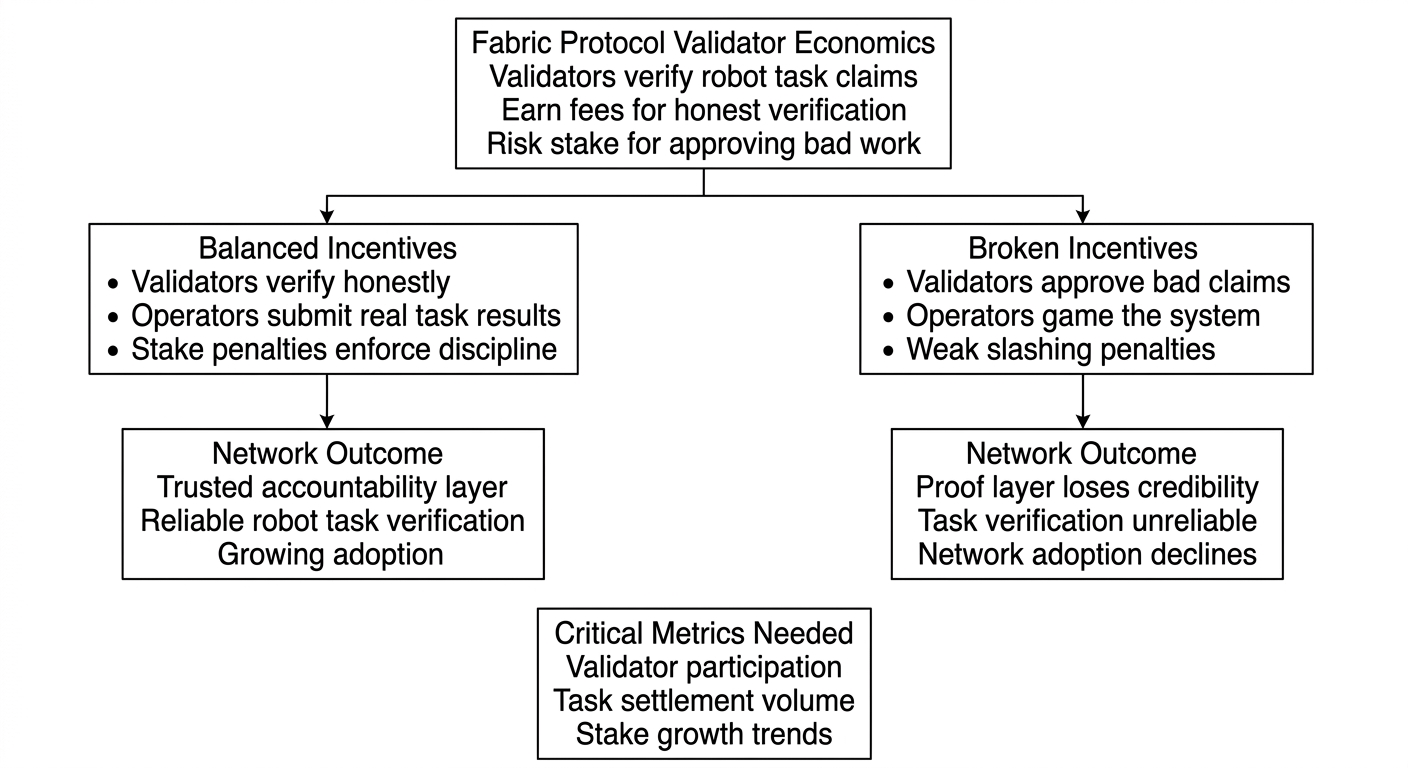
So what would change my mind in either direction? If Fabric Foundation publishes transparent data on validator participation, showing how many validators are active, how many tasks are being verified daily, what percentage of claims are passing versus failing, and how validator stake amounts are trending over time, then the accountability thesis starts to validate and I get more interested in ROBO as infrastructure rather than just narrative. If volume stabilizes above 10 million USDT daily without needing constant new catalysts, that tells me there is genuine two-sided interest beyond launch speculation. If governance decisions around validator rules start happening onchain in ways token holders can track and verify, that tells me decentralization is real rather than cosmetic. On the other hand, if metrics stay opaque, if volume continues to decay toward single digit millions, or if validator economics remain undefined while the team focuses on partnership announcements instead of operational transparency, then I start worrying that ROBO is branding without substance, and that the real value is accruing to the foundation and early validators rather than flowing to token holders.
For now, I am watching ROBO with cautious interest. The token bounced modestly today, the chart is neutral, and the project is early enough that most of the thesis remains unproven. But the question Fabric Foundation is asking, how do you create economic incentives for honest verification in autonomous systems, is the right question. The answer they are building, a validator network with stake-based accountability and governance over quality thresholds, is architecturally sound. Whether they can execute it before vesting pressure hits and before competitors with deeper pockets build alternative solutions, that is the open question. Track whether validator participation actually grows, whether task verification becomes routine rather than exceptional, and whether the economic penalties for dishonest reporting are severe enough to matter. That is where the signal lives, not in today's two percent bounce or yesterday's volume drop. Validator economics are the structural foundation underneath everything else Fabric Protocol is trying to build, and if those economics do not work, nothing else matters.
#ROBO $ROBO @Fabric Foundation
