
#night $NIGHT @MidnightNetwork
The easy version of privacy is the one crypto likes to sell.
You prove something, reveal less, move on. Cleaner UX. Better dignity. Fewer things living forever on a public chain. Sounds good. Usually is good.
That version holds up right until somebody serious asks a second question.
Not did the proof verify?
More like... what actually happened here?
Thats where Midnight gets interesting to me. Not because the zero-knowledge part is fake. I think the core proposition is real. Public ledgers are bad at handling things that should not sit exposed forever... commercial terms, treasury activity, user-linked financial data, regulated workflows, any of that. @MidnightNetwork sees that clearly. Selective disclosure, private smart contracts, proofs instead of exposure. On paper that is one of the more coherent directions in crypto right now.
But normal operation is not where this gets tested.
It gets tested when somebody with authority asks for context.
Say a firm builds on Midnight. Nothing dramatic. Not an exploit. Not a scandal. Just ordinary institutional use. Payroll logic. Supplier finance. A credit workflow where a counterparty proves they satisfy a requirement without dumping the whole balance sheet on-chain. Fine. That's exactly the kind of thing Midnight should make possible.
Then quarter close happens.
An auditor wants the sequence of approvals. A bank partner wants to know why one exception was accepted and another wasn’t. Internal risk asks why disclosure happened at that stage of the workflow and not earlier. Nobody is asking to break privacy for fun. They’re asking because somebody has to sign their name under the decision later.
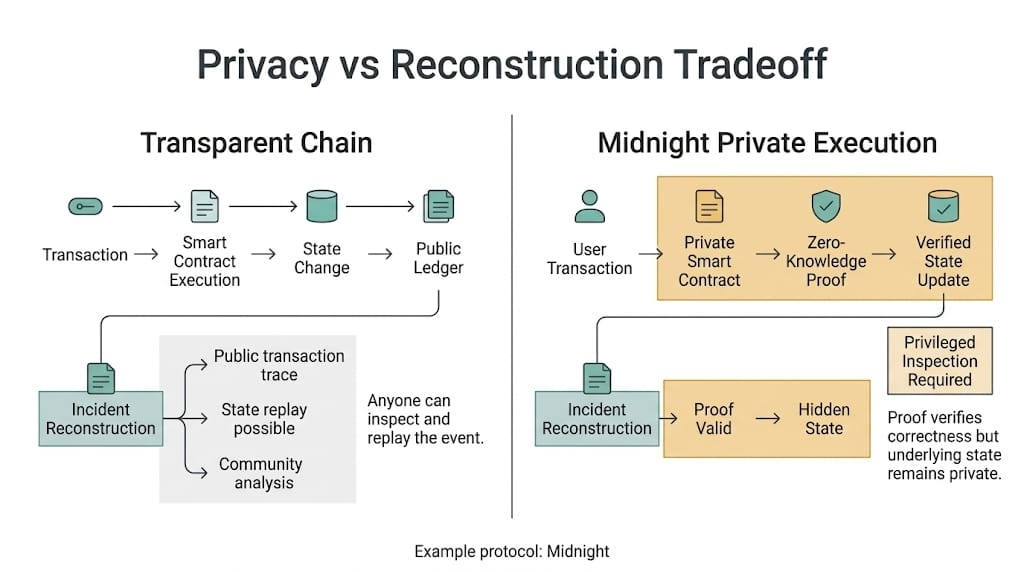
Exact moment where a technically valid proof stops being the whole answer.
Compliance people do not always want validity. They want chronology. They want who approved what. They want to know what changed, when it changed, and whether the explanation still holds up once there is liability attached to it.
They want, basically, a transcript.
That part gets skipped all the time.
Proofs are good at narrowing what has to be revealed. Midnight is built around that. But reveal less and explain enough are not the same threshold, and the second one moves around depending on who is asking and what they’re responsible for defending.
If a contract on Midnight proves a compliance condition without exposing the underlying private data, then technically the system worked. Fine. But then the counterparty says: I accept that the proof validated. Now explain the path that led there. Not the raw records maybe. But the decision path. The exception logic. The order of events. Why this outcome was allowed at all.
By then nobody wants the raw data. They want enough evidence to sign off without owning the whole mess.
Who decides what gets opened at that point?
The protocol?
The app developer?
The enterprise running the workflow?
The examiner who does not care how elegant the cryptography is and just wants enough to clear the file?
At that point, it's barely a cryptography problem anymore.
That’s governance, whether anyone wants to call it that or not.
Midnight network's harder problem isnot private proving. It is making disclosure legible enough for real oversight without sliding back into the same trust dependence crypto claimed it was removing.
This doesn’t make Midnight weaker. It just moves the hard part somewhere less comfortable. This is what real adoption pressure looks like. Not do people say they want privacy? Everyone says yes to that. The harder test is what happens when privacy has to survive contact with institutions that still need an explainable record of why a decision was acceptable.
Because at that point Midnight is not just proving things.
It is deciding how much of the story gets to exist outside the proof.
Real liability is where that boundary stops looking clean.