When people first enter crypto, they often hear one sentence again and again: “Blockchain is transparent.”
Every transaction can be seen, every wallet can be tracked, and every movement is recorded forever.
At the beginning this sounded like the perfect system. Transparency creates trust. No one can secretly change the records. Everything stays open.
But as blockchain grows, another question slowly appears.
Do we really want every piece of information to be public forever?
Imagine a future where companies use blockchain for payments, identity systems, contracts, or supply chains. In many of those situations, full transparency can become a problem instead of a benefit. Businesses may need confidentiality. Users may want their financial activity protected. Developers may want to build applications that handle sensitive information.
This is where Midnight Network begins to look interesting.
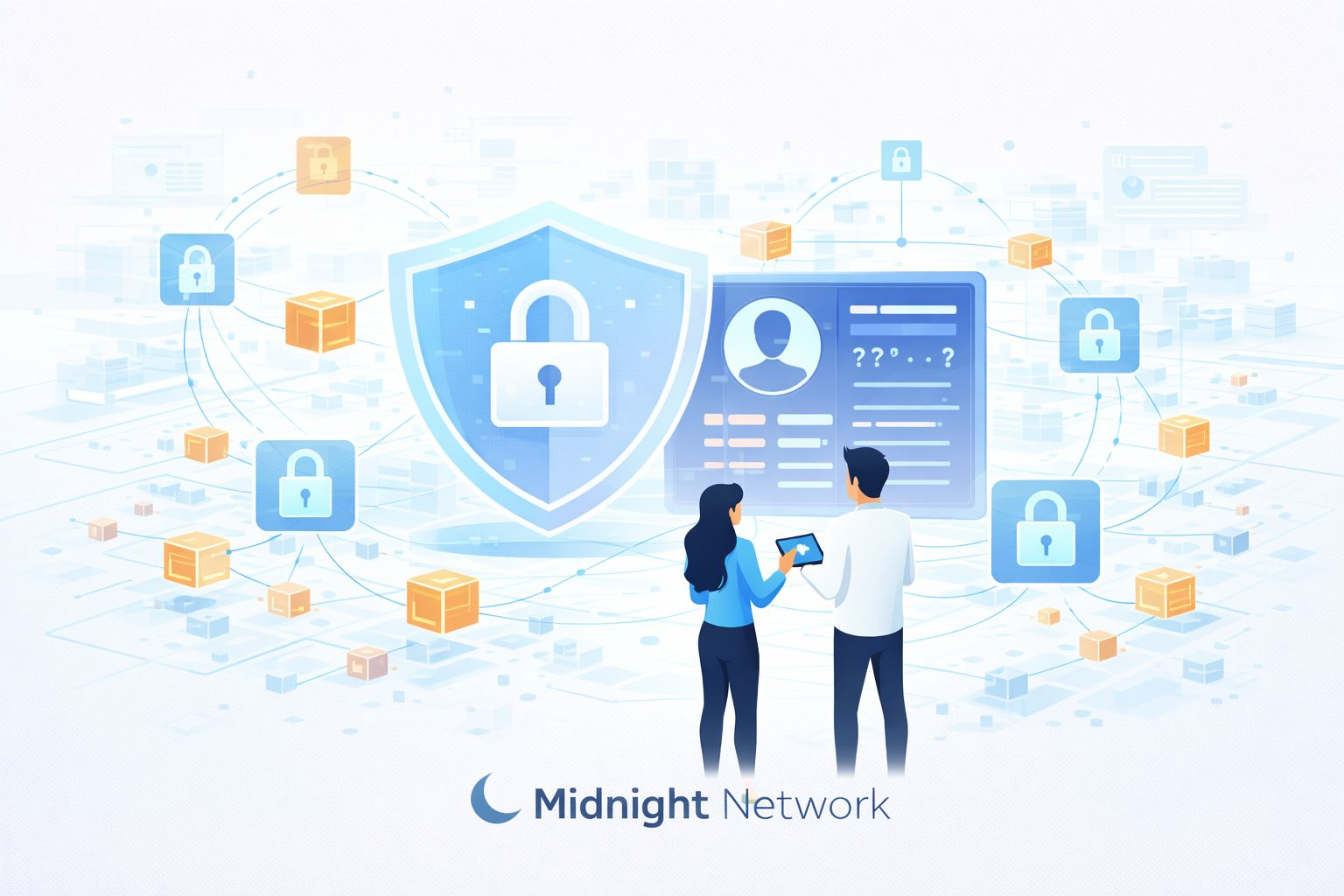
Midnight is a blockchain designed around a simple idea: people should be able to prove something without revealing everything.
Instead of forcing users to expose all data, the network uses zero-knowledge (ZK) proof technology. This technology allows a system to confirm that a statement is true without revealing the private information behind it.
In simple words, you can prove validity without exposing the details.
For example, an application could confirm that a user meets certain conditions or owns specific assets without revealing the exact data publicly on-chain. That changes how privacy works inside Web3.
Many privacy projects focus only on hiding transactions. Midnight takes a slightly different direction. It tries to build a system where privacy and verification exist together. Information can stay protected, but the network can still confirm that rules were followed correctly.
This idea is important for the future of blockchain applications.
Think about industries like finance, healthcare, digital identity, or enterprise software. These environments cannot operate in a system where every detail becomes public. At the same time, they still need the security and trust that blockchain provides.
Midnight tries to balance these two needs.
Another interesting design choice is how the network separates different roles inside its ecosystem. Instead of making everything dependent on one token function, the architecture focuses on supporting private computation and application execution while maintaining a broader network economy.
For developers, this can open the door to new kinds of applications. Smart contracts may handle sensitive logic, identity verification, or confidential data without exposing those details to the entire world.
In many ways, Midnight feels like an experiment in making blockchain more practical for real-world use.
Of course, like any new infrastructure project, success will depend on adoption. The technology may be powerful, but the real test will be whether developers build applications and whether users begin interacting with the ecosystem.
Still, the direction itself reflects an important shift happening in Web3.
Early blockchain focused mostly on transparency and financial transactions. The next stage may focus more on data control, digital identity, and privacy-aware systems.
Midnight Network is exploring that direction by asking a simple question:
What if blockchain could protect your information
while still proving that everything works correctly?
If that balance can be achieved, privacy may not just be a feature in the future of Web3.
It may become one of its most important foundations.