Lately I’ve been thinking a lot about how artificial intelligence is entering the crypto space. Every cycle brings a new narrative. A few years ago it was DeFi, then NFTs, then GameFi. Now the big conversation seems to be around AI.
Many projects today focus on what AI can do — analyzing blockchain data, predicting market movements, or helping automate strategies. And honestly, those tools can be useful. AI can process huge amounts of data faster than any human trader.
But after thinking about it for a while, I realized something interesting.
Analysis alone doesn’t change a decentralized system.
The real question is what happens after the AI finishes analyzing the data.
Let’s imagine an AI model finds an opportunity somewhere in DeFi. Maybe it identifies a better liquidity strategy or a more efficient way to route trades. That’s great. But the system still needs a way to turn that insight into real action on-chain.
Without structure, AI decisions could easily create confusion instead of efficiency.
For example, imagine hundreds of automated agents interacting with multiple protocols at the same time. If there is no coordination layer, these systems might conflict with each other. Governance proposals could overlap, strategies might compete, and networks could become unstable.
This is where infrastructure starts becoming important.
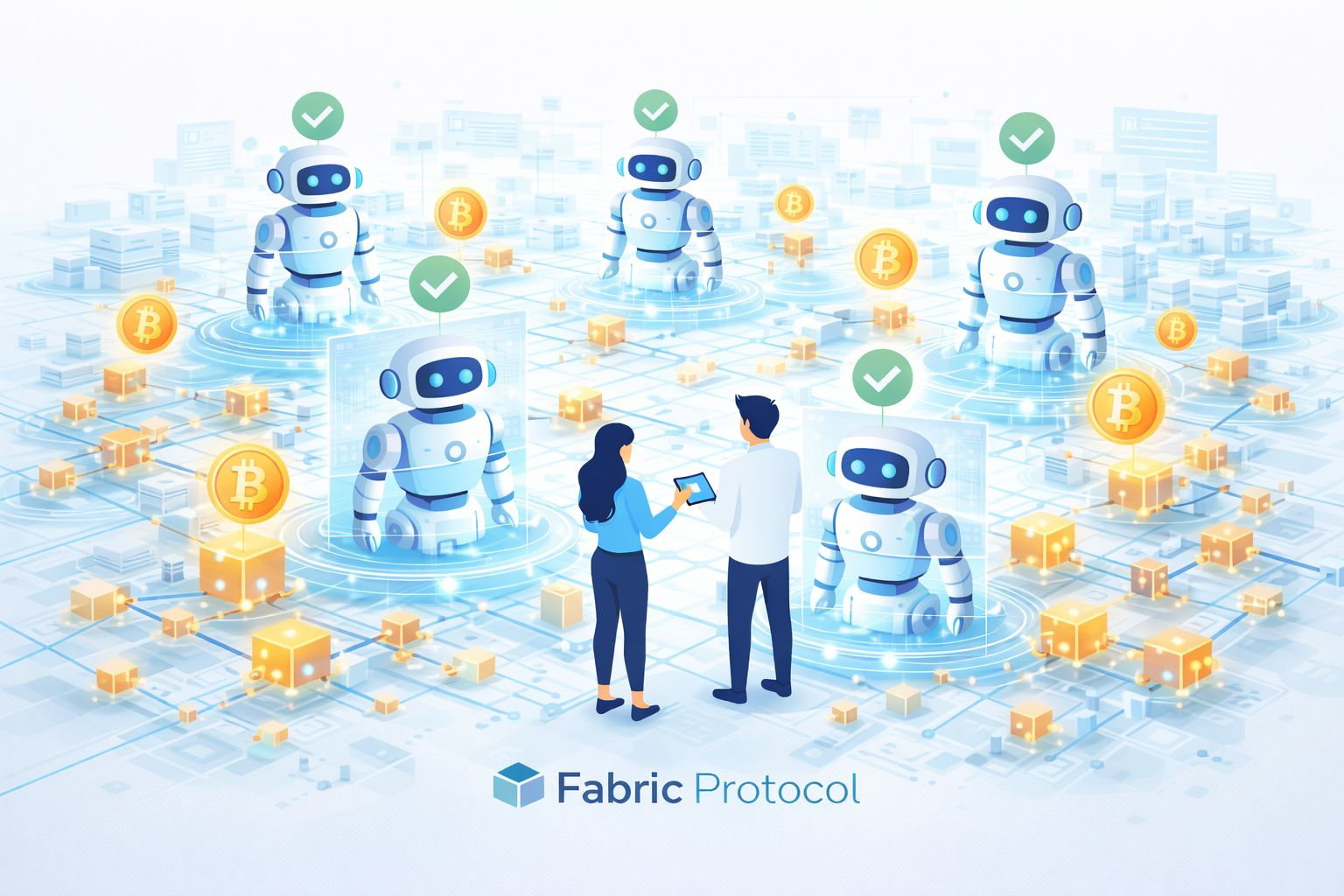
While researching different projects, I came across Fabric Protocol, supported by the Fabric Foundation. The idea behind this project made me pause for a moment.
Instead of focusing only on building AI tools or dashboards, the project is exploring how autonomous systems and robots can coordinate actions inside decentralized environments.
That might sound like a small difference, but it changes the perspective completely.
Rather than asking “What can AI predict?” the focus becomes “How can automated systems operate safely together?”
In other words, the goal is not just intelligence.
The goal is coordination.
Fabric Protocol is trying to build an open infrastructure where autonomous agents, machines, or robotic systems can share data, verify actions, and collaborate through a blockchain-based framework.
Think of it like creating a governance and coordination layer for intelligent systems.
This reminds me a lot of earlier crypto cycles.
During the early days of DeFi, everyone was focused on yield farming and trading opportunities. But over time, people realized that the real value came from the infrastructure underneath — liquidity systems, scaling networks, and security layers.
Those systems made everything else possible.
AI in crypto might follow a similar path.
Right now we are seeing many experiments: AI trading tools, autonomous agents, data analysis platforms, and governance assistants. As these systems grow more advanced, they will likely start interacting with multiple protocols at once.
And as complexity increases, coordination becomes critical.
Without proper infrastructure, automated systems could create unpredictable outcomes. But with the right frameworks, AI could help networks become more efficient, adaptive, and responsive.
That’s why the concept behind $ROBO caught my attention.
Instead of positioning itself as another flashy AI trading product, it appears to focus on the structural layer of the ecosystem — the part that allows intelligent systems to actually work together.
Of course, it’s important to stay realistic.
Infrastructure projects always face big challenges. Adoption is the biggest one. Developers and protocols need to integrate the technology for it to become useful. Without real usage, even the best architecture stays theoretical.
Competition will also grow. As AI becomes more important in blockchain ecosystems, many teams will likely start exploring similar coordination layers.
But the broader idea still feels important.
As AI continues evolving inside decentralized systems, the conversation will eventually move beyond predictions and automation. People will start asking deeper questions about how intelligent systems interact, govern, and coordinate actions across networks.
And when that shift happens, infrastructure may become one of the most valuable parts of the ecosystem.
Because intelligence can create opportunities.
But infrastructure is what allows those opportunities to actually work at scale.
That’s why I’ve started paying attention to projects exploring this direction. Not because they promise quick returns, but because they’re trying to solve a structural problem that could become very important as AI and blockchain continue merging.
It’s still early. The technology is evolving, and the market is still figuring out what works and what doesn’t.
But if decentralized systems become more automated in the future, frameworks that help those systems coordinate safely could end up playing a much bigger role than many people expect.
For now, it’s simply an idea worth watching as the AI chapter of crypto keeps developing.
#ROBO $ROBO @Fabric Foundation