Late one evening I was reading about the future of robotics and something unusual crossed my mind. For most of my life robots always felt simple in concept. They were machines built to follow instructions. They assembled cars in factories moved boxes in warehouses and cleaned floors in offices. They were impressive but they were still tools created to repeat tasks again and again.
But the more I read about modern robotics and artificial intelligence the more I started to feel that something was quietly changing. Machines today are not only moving and lifting things. They are sensing the world around them learning from data and making decisions without constant human direction. They operate for long periods on their own and sometimes even coordinate with other systems.
That small realization led me to discover something called Fabric Protocol. The more I explored the idea the more it felt like looking at the early shape of a new kind of infrastructure for machines.
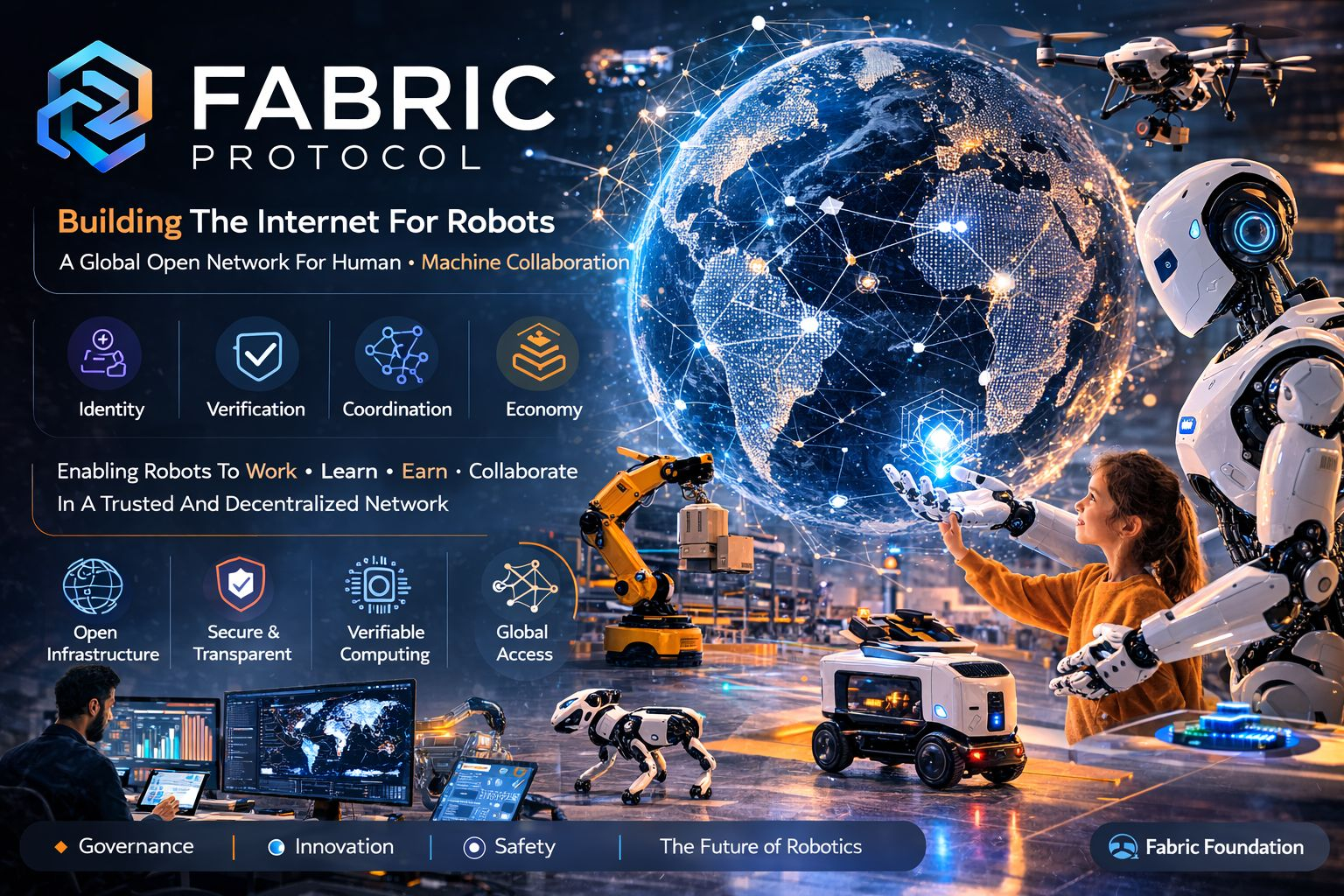
Fabric Protocol is not a company that builds robots. It focuses on something much less visible but far more important. It aims to create a global digital network where robots artificial intelligence agents and humans can coordinate through shared infrastructure. The project is supported by the Fabric Foundation which is a non profit organization working to develop open systems for human and machine collaboration.
When I first read about it I kept thinking about the early days of the internet. Before the internet computers were powerful but isolated. Each machine worked inside its own environment and communication between systems was limited. Once the internet appeared everything changed. Computers could finally connect through shared protocols and information could travel across the world.
Fabric Protocol imagines something similar but for machines operating in the real world.
Today most robots exist inside closed environments. A warehouse robot works only inside the logistics system of one company. A farming robot operates within software designed for a specific agricultural platform. Industrial robots inside factories are connected to control systems owned by manufacturers. These machines can perform complex tasks but they rarely communicate beyond their own systems.
Fabric Protocol explores the idea that robots might eventually need a shared coordination layer. It is a network where machines can identify themselves record their actions and interact with other machines through verifiable systems. Instead of existing as isolated tools robots could connect to a common infrastructure that records activity and enables cooperation.
One of the most interesting parts of the protocol is the way it approaches trust. When a machine claims it has completed a task there must be a reliable way to confirm that the action actually happened. Fabric Protocol introduces the concept of verifiable computing. This technology allows robots and artificial intelligence systems to generate mathematical proof that their computations or operations were performed correctly.
In simple terms it creates a system where machines can demonstrate what they have done rather than simply reporting it. The network can check the proof and confirm the result. This type of verification becomes extremely important if thousands of machines are performing tasks across different environments.
Another idea behind Fabric Protocol is something called agent native infrastructure. Most digital systems today are designed with human users in mind. Applications and platforms assume that people will interact with them directly. Fabric Protocol approaches infrastructure from a different direction. It is designed so that autonomous systems such as robots and artificial intelligence agents can interact with the network naturally.
Within such an environment machines can communicate with each other exchange information coordinate tasks and access resources through the protocol itself. Humans still guide the system and develop its technology but the infrastructure allows machines to operate more independently.
At the center of the protocol is a public ledger that records important activity within the network. The ledger stores machine identities computational proofs and economic transactions. Because the record exists on a distributed network it cannot easily be controlled or changed by a single organization. It becomes a transparent history of what machines are doing within the system.
Fabric Protocol also introduces the idea of machine identity sometimes described as digital DNA. Every robot connected to the network receives a unique cryptographic identity. Over time this identity can build a history that includes tasks completed capabilities demonstrated and updates installed. In a way robots begin to accumulate something similar to a professional reputation inside the network.
To support economic activity Fabric Protocol also includes a digital token known as ROBO. The token allows participants within the network to exchange value reward contributions and participate in governance decisions that shape the protocol. If robots perform tasks or provide services through the system payments can move through this digital economy.
This leads to one of the most fascinating ideas connected to the project. Some people describe it as a decentralized robot economy. In such a system machines can discover tasks complete work generate verifiable proof and receive payment through the network automatically. Instead of depending entirely on centralized platforms robots could operate within shared infrastructure that coordinates services.
Of course the idea is ambitious and the challenges are significant. Robotics alone is a complex field involving hardware engineering artificial intelligence and safety systems. Adding decentralized infrastructure and verification mechanisms increases that complexity.
Adoption is another important factor. Infrastructure only becomes meaningful when developers companies and researchers choose to build on it. Many technologies begin as experiments and take years to mature before they become widely used.
Still the reason Fabric Protocol captured my attention is not because it promises instant transformation. It is because it represents a quiet shift in how machines might fit into the world.
For centuries tools have been passive objects. They performed actions when humans used them but they never participated in larger systems on their own. As robotics and artificial intelligence continue to advance machines are slowly becoming more capable and more autonomous.
As that happens the systems coordinating them must also evolve.
Fabric Protocol offers one possible vision of that future. It imagines a world where robots are not isolated tools but connected participants in a shared network where their actions can be verified coordinated and trusted.
Whether that future arrives exactly this way remains uncertain. But exploring ideas like Fabric Protocol makes one thing clear. The future of robotics may depend not only on the machines themselves but also on the invisible infrastructure that allows them to work together.