
@MidnightNetwork #night $NIGHT
Most blockchain projects pitch privacy as a dramatic superpower a way to disappear or escape "the system." Midnight Network approaches it from a more pragmatic angle. Instead of asking how to hide everything, it asks: What if users could simply control who sees what?
This shift moves Midnight away from being a rebellious experiment and toward becoming essential infrastructure for the real world. In daily life, we share information selectively: you show your ID to a bank, but not to a coffee shop; you share your address with a delivery driver, but not the whole street. By making disclosure programmable, Midnight introduces nuance to a space that has historically been either completely transparent or totally opaque.
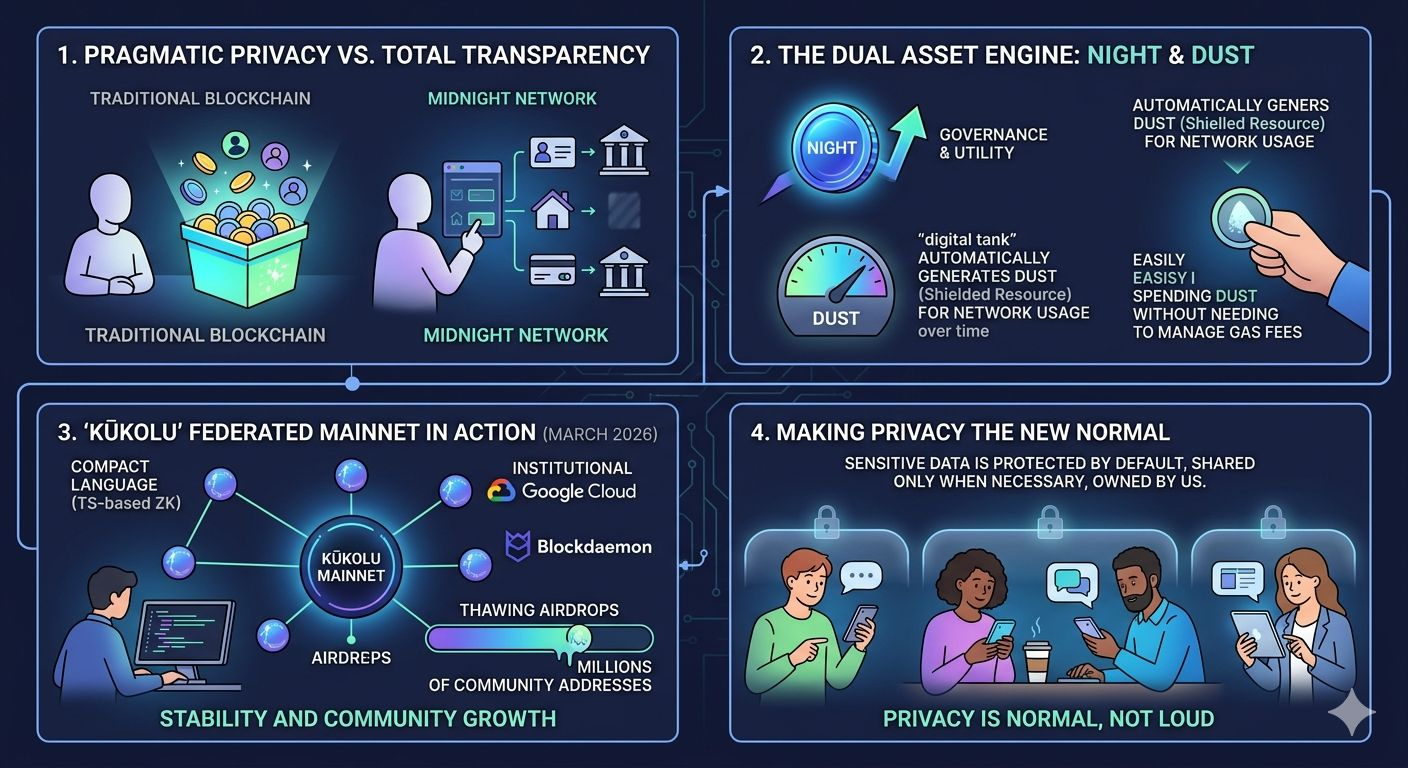
The project’s dual asset design NIGHT and DUST is where this logic becomes functional.
NIGHT is the tradable utility token, representing ownership and governance in the ecosystem.
DUST is a "shielded resource" generated by holding NIGHT. It acts like renewable network capacity.
This decoupling is a game-changer for user experience. Instead of forcing users to constantly calculate gas fees or swap tokens just to send a private message, developers can build applications where the infrastructure sits quietly in the background. If a user holds NIGHT, their "digital tank" refills with DUST automatically, making the experience feel as seamless as traditional software.
From Theory to "Kūkolu"
As of March 2026, Midnight is moving beyond the research phase into its Kūkolu (Federated Mainnet) stage. The network is no longer just a series of whitepapers; it’s a live environment supported by institutional partners like Google Cloud and Blockdaemon.
Rather than chasing a "hype cycle" launch, the team has taken a deliberately grounded path.
By starting with federated nodes, they ensure stability while the Compact programming language a TypeScript-based tool for writing ZK circuits matures in the hands of developers.
Programs like the Glacier Drop and Scavenger Mine distributed tokens to millions of addresses across eight different blockchains. This prevents the "centralization trap" that often kills privacy networks before they can grow.
To prevent market shocks, these airdropped tokens "thaw" gradually throughout 2026, ensuring that the community grows alongside the network’s actual utility.
The most compelling thing about Midnight is that it isn’t trying to make privacy louder it’s trying to make it normal.
If Midnight succeeds, the biggest indicator won't be a headline about "perfect anonymity." Instead, it will be the absence of the conversation entirely. We will simply use apps where sensitive data is protected by default, shared only when necessary, and owned exclusively by us. In a world that constantly demands more data than it needs, making privacy feel natural is the most valuable innovation of all.