
A robot can prove it hit bay 3 at 2:44pm and still tell you where the gold vault is by dinner. Thats the part that brothers.
The sales version is easy. Robot reaches checkpoint C, scans bay 3, crosses the right corridor, hits the rack, completes the route. Fabric wants that attested instead of guessed. So yes, location proof matters.
Fine...
The problem starts right after that. Ugly, fast.
The moment location enters the trust layer, it stops being background context. It starts teaching people things.
And the route starts talking.
One warehouse robot clears the same locked aisle five times before lunch. Another keeps dwelling near one storage cluster longer than the rest. A delivery unit keeps touching one loading corridor at odd hours. Hide the manifest if you want. Hide the task payload. Hide the object. At some point it barely matters. The movement already said enough.
Real operators know this problem before protocol people do.
Route sensitivity is not some decorative privacy concern. It is floor intelligence. Which zone moves expensive goods. Which corridor gets overloaded. Which checkpoint is secure for a reason. Which site wakes up early. Which corner of the building matters more than the others. Call it metadata if you want. The floor won’t.
And Fabric is dragging more of that closer to the protocol surface.
I keep thinking about an ops team staring at a clean robot dashboard and feeling good because every task is verified, every location proof looks tight, and payments reconcile nicely. Meanwhile somebody with enough route history no longer needs the inventory system. The pattern is already there. Where value concentrates. Where traffic bottlenecks. Which routes deserve attention.
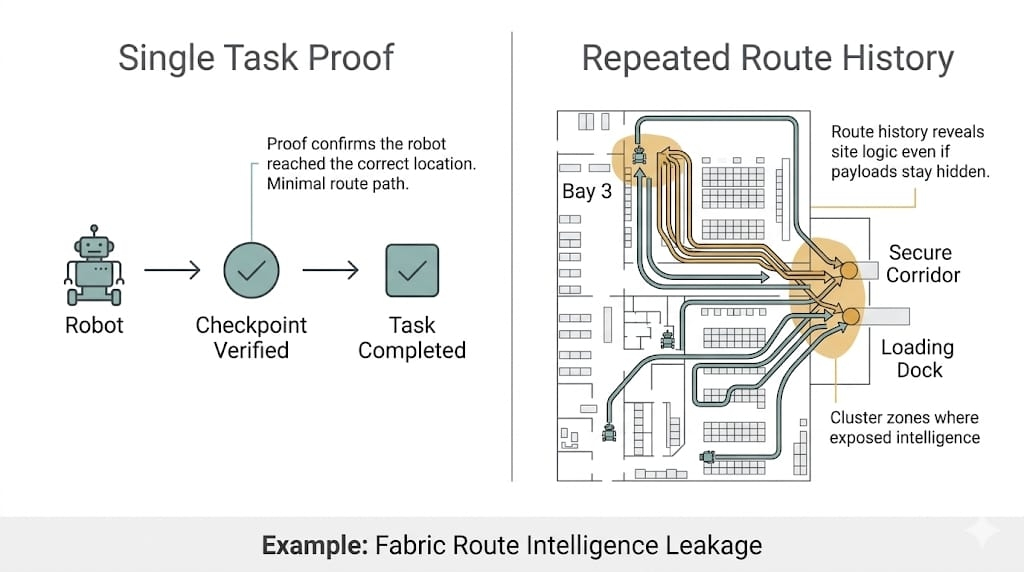
You donot need the payload once the path gets legible enough.
Somebody still pays when the route leaks the warehouse layout to competitors.
Too little location precision and the proof goes soft on @Fabric Foundation side.
Too much and the operation starts exposing itself through the very thing that was supposed to make trust stronger.
And it probably does not stay solved in one stable way either. One workflow might only need coarse zone proof. Another might need exact coordinates. Maybe delayed attestation is safer. Maybe real-time visibility is insane. Maybe the operator ends up proving just enough for payment while quietly hoping nobody aggregates enough history to reverse-engineer how the site actually runs.
That’s the question that matters.
Not can the robot prove it was there. That part is easy to narrate.
The harder part is what happens once physical position becomes protocol truth and the route starts leaking the logic of the site every time the proof gets stronger.
Fabric can't really shrug that one off. Not if proof of location is supposed to carry trust, settlement, and coordination all at once.
Because at some point the route stops being proof and starts being a map. And maps get sold.