
Midnight can keep a transaction private. Fine.
Then month-end happens and somebody has to reconcile it.
Thats the part I keep getting stuck on.
The execution story sounds clean on Midnight. Selective disclosure. Private smart contract logic. A proof verifies, a payment clears, the counterparty gets what it needs, and nobody had to throw the whole internal state onto a public chain just to settle one workflow.
Good. That part makes sense.
The mess starts later.
Because once the transaction is over, half the people around it are no longer asking whether the proof verified. They’re asking whether the books line up.
Treasury has one record.
The counterparty has another.
A banking partner has some partial settlement view.
The ERP wants a reason code.
A controller is staring at an exception bucket asking why this one moved under one condition and another one didn’t.
Nobody is asking to blow up the privacy model for fun. They just want the records to reconcile without three people joining a call to reconstruct what happened from fragments.
That’s operations. And operations is where the nice version of privacy starts getting tested.
Say a firm uses Midnight for a private settlement workflow between internal treasury and an outside partner. The proof says the condition was satisfied. Payment clears. Midnight did its job.
Now the controller tries to close the month and the internal approval path doesn’t map cleanly to the settlement report on the other side. The payment is valid. The books are still annoying.
That’s the kind of thing people skip when they talk about privacy like it only matters at execution time.
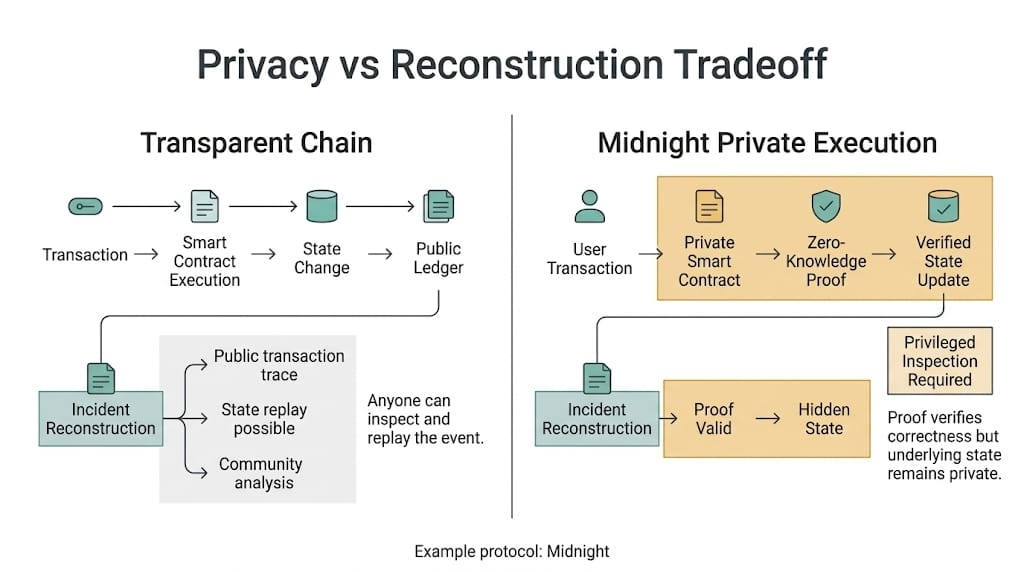
Execution wants minimal disclosure. Reconciliation wants enough context to make multiple systems tell the same story afterward. Those are not the same need.
And this is where I think @MidnightNetwork gets much more real.
Because selective disclosure can absolutely reduce unnecessary exposure during execution. Good. But it does not automatically reduce explanation burden later. Sometimes it helps. Sometimes it just moves that burden into slower, uglier back-office work where people now have to bridge hidden logic into accounting language, treasury language, partner-system language, all without casually reopening the whole private state every time something downstream looks off.
A proof being valid does not mean the reconciliation layer is suddenly simple.
Controllers don’t care that the zero-knowledge design was elegant if the exception log still needs manual translation.
Ops teams don’t care that raw data stayed hidden if someone now has to stitch together three partial system views and an internal memo just to explain one settlement line.
A partner does not say “beautiful privacy architecture” when their report still has a gap in it.
They say the process is messy.
That’s the friction point.
Not whether Midnight can keep the transaction private while it happens. I think it can.
The harder question is what happens after, when the privacy boundary has to coexist with bookkeeping, reporting, and counterparties who all need just enough explanation to move on — but never seem to need the same kind of explanation.
Maybe better tooling fixes some of that. Maybe translation layers get built around it.
But if Midnight succeeds, I don’t think the hardest operational pressure will be proving the transaction was valid.
I think it’ll be the moment after, when everybody’s system has a record of the same event and they still can’t make it line up without asking for more of the story than the workflow was designed to reveal.