
@MidnightNetwork #night $NIGHT
There’s a small behavioral pattern I keep noticing when new infrastructure lands in crypto: people split into two groups almost without meaning to. One half treats the announcement as a map — they read the whitepaper, note the partners, and start sketching where their apps or positions might fit. The other half treats the announcement like weather — a thing to observe, maybe complain about, and then move on until the next storm of headlines. Both reactions feel rational. One is driven by curiosity and opportunity; the other by fatigue and risk-aversion. Neither is wrong, and together they tell you more than any single press release about how a new protocol will actually be used.
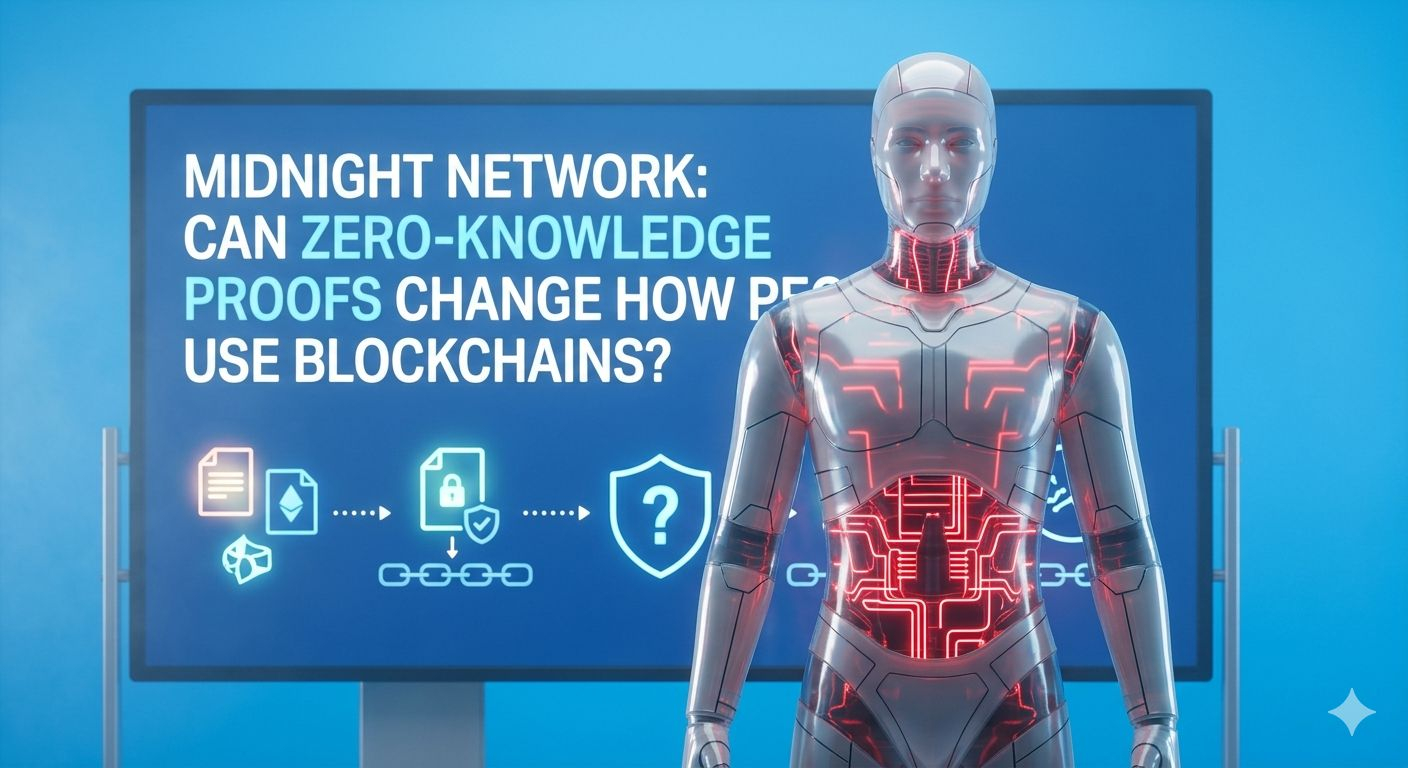
That quiet split is where my attention landed as I watched the conversation around Midnight Network deepen over the last few weeks. The chatter hasn’t been all fireworks and price charts; it’s been about what this chain asks users and builders to do differently — and what it promises to let them stop doing. That’s important because Midnight’s pitch isn’t theatrical privacy for its own sake, it’s a design trade: prove things without exposing everything. The practical consequences of that trade are where behavior, product choices, and market incentives will collide.
At a factual level, the project has begun to move from talk to operational readiness: there have been public notes about mainnet preparations and early infrastructure partners, and the team has detailed how they intend to bootstrap trusted node operators as the network comes alive. Those announcements matter less as PR and more as early evidence of the two things every new chain needs to answer for users: “Will this run reliably?” and “Who gets to run it?” The answers influence whether curious developers will test, whether wallets add support, and whether exchanges and custodians will even consider holdings and custody products.
A second practical cue that market participants are watching is partner signal: Midnight’s founders and team have leaned into conversations with established infrastructure players and communications platforms, and those relationships show up in how institutions and builders parse risk. Partnerships with big cloud and messaging platforms — the kind of names that lend operational comfort without solving governance questions — alter the psychological calculus for some institutional actors. It’s not that a logo guarantees anything; it’s that it shortens the distance between “experimental” and “operational” for teams that care about uptime, compliance, or customer support. That effect is real and measurable in adoption timelines.
Technically, Midnight is betting on a blend that’s increasingly familiar in ZK rhetoric but still unusual in practice: use zero-knowledge proofs and a layered resource model so that sensitive inputs can be validated off-disclosure, while a public value layer continues to secure consensus and coordination. Practically, that design pushes complexity downstream — from the average user’s mental model to the developer’s build-time tradeoffs. For users, the promise is cleaner: fewer awkward compromises about revealing identities or transaction details to get a service to work. For builders, the burden shifts toward thinking hard about UX for selective disclosure, key management, and what “privacy by default” means when you must also meet regulatory needs like auditability for sanctioned interactions. The net effect is that some classes of apps that previously felt impossible on a public chain suddenly have a plausible path — but they only do so if the developer tooling and developer mental models actually make that path straightforward.
The token and resource mechanics are an important part of those incentives, and they shape behavior in subtle ways. Midnight’s native token model separates an unshielded governance/utility token from a shielded, decaying transaction resource (sometimes described as a utility that powers privacy-preserving transactions). That design is meant to align three things: security (staking and governance incentives), user experience (preventing token exposure but enabling transactions), and economic friction (decay or non-transferability of the privacy resource to discourage hoarding). The practical consequence is that wallets, exchanges, and custodians must decide how they present balances: do you surface the shielded resources to users at all times, or do you abstract them away? That UI choice will determine whether people feel in control or feel confused — and confusion often becomes inertia, which in turn becomes lower active usage.
Market coverage — the stories, the takes, and the op-eds — matter too because they alter expectations. Platforms that host commentary and analysis have already begun to publish a steady stream of pieces about Midnight’s technical design, its token model, and what its launch might mean for privacy in web3. That coverage does two things: it educates a cohort of readers who will test and build, and it creates a frame for investors and product teams who are sizing risk. The pace and tone of that coverage will shape whether Midnight is primarily perceived as “an interesting research-grade tool” or “a platform you can plan product timelines around.”
So what are the realistic frictions that sit under the optimistic descriptions? First, developer ergonomics. ZK-first models create a new set of primitives that teams must integrate — commitment schemes, proof generation, shielding logic, and often off-chain synthesis of state. If the documentation and toolchain are tight, that’s a solvable onboarding problem. If not, teams will prototype elsewhere and only return when the market clearly demands privacy. Second, composability and cross-chain flows: a lot of real-world apps need to move assets or signals between chains; privacy-preserving proofs complicate that interoperability and demand well-defined bridges and clear security assumptions. Third, regulatory and custodial clarity: privacy-oriented primitives sit uncomfortably with compliance frameworks, so Midnight’s architecture explicitly tries to thread disclosure options and auditability into its design. That’s a sensible engineering posture, but it also invites scrutiny — and different jurisdictions will interpret that scrutiny differently. All of these are neither fatal flaws nor trivialities; they are the exact points where long-term product-market fit is decided.
Watching how the market adjusts to those frictions is instructive about user psychology. Early adopters — the devs, the privacy-focused shops, the projects with narrow use cases — tend to tolerate complexity for capability. Broader user groups, however, treat cognitive overhead as a tax. If a chain requires too many new mental models, adoption slows; if it reduces awkward tradeoffs people have been making for years, adoption can accelerate quickly. That acceleration rarely looks like a spike; it’s more like a slow steady shift in product design decisions, hiring choices, and where venture capital starts to angle product roadmaps. And because Midnight’s premise is practical privacy rather than absolute secrecy, it’s specifically courting builders who want to trade some publicness for utility. Whether that trade resonates depends on the degree to which the network’s primitives are integrated into everyday developer workflows and consumer UX patterns.
There’s also a social-institutional angle worth naming: when chains claim to offer “privacy,” institutions will test the claim along different axes than retail users. Exchanges, custodians, and enterprise partners care about operational integrity, recoverability, and legal compliance. Their acceptance hinges on proofs that the network will behave predictably under stress, that custody integrations won’t accidentally leak sensitive on-chain proofs, and that the governance process can respond to exigencies. Early signals — announcements about node operators, custody readiness, and infrastructure partners — therefore carry outsized weight for institutional adoption because they map directly onto operational risk assessments. In short, logos and partners aren’t just marketing; they’re pieces of a puzzle that help institutions decide whether to build or wait.
There are limits to what any single chain can deliver overnight. Building out a robust privacy-enabled ecosystem requires time: real-world apps, mature tooling, independent audits, and clear incident-response playbooks. The path from mainnet announcement to meaningful transaction volume is rarely linear. It’s shaped by incremental developer wins, a few non-trivial production use cases, and the mundane but critical work of integrating wallets, analytics, and compliance flows. That’s why the market one day cares less about the cleverness of cryptography and more about whether a small business can deploy a private payroll or a healthcare app can safely store and share attestations without exposing patient metadata. Those are the use-cases where the design tradeoffs pay dividends.
If you’re deciding how to act on this as an everyday participant — developer, product manager, or informed user — my advice would be quietly procedural rather than declarative. Watch for whether the tooling reduces cognitive overhead for common patterns; check that custody and exchange integrations don’t treat privacy as an afterthought; and look for real early-production use cases rather than just proofs-of-concept. Those signals predict whether the chain will make privacy routine or whether it will remain a niche engineering feat. The differences in user experience are subtle at first, but they compound quickly: a better developer SDK or a clearer wallet UX converts curiosity into daily usage, while unclear developer ergonomics convert curiosity into a cache of interesting experiments.
Why does any of this matter beyond technical neatness? Because blockchain adoption has always been less about cryptographic elegance and more about predictable human behavior under friction and reward. Midnight’s central proposition — enable verification without exposure — is meaningful precisely because modern users and businesses increasingly refuse to accept that utility must come with wholesale data surrender. If Midnight and other projects can make those verifications cheap, auditable, and usable, they nudge the ecosystem toward products that respect both privacy and practicality. If they can’t, privacy will remain an academic virtue rather than a daily reality.
That is the practical, earned reason to watch this moment closely: it asks us to recalibrate how we think about risk, design, and value in crypto. The question for everyday participants is not whether privacy is “good” — most of us already agree it is — but whether the protocols, the tooling, and the market incentives are aligned so that privacy becomes a low-friction default rather than a high-effort option. The market will answer that question slowly, through adoption patterns, tooling choices, and institutional behavior. For anyone who cares about clearer decisions, steadier products, and better risk perception in crypto, those slow answers matter more than the hottest headline.