
What first drew my attention to Fabric Protocol wasn’t the usual buzz that appears in crypto whenever a project starts mentioning AI, robotics, or the future of coordination. I’ve been around this space long enough to recognize the pattern. A strong narrative shows up, people quickly gather around it, early supporters begin speaking with certainty, and before long the market treats a rough idea like it’s already proven. I’ve seen that cycle play out more than once. So when I came across Fabric, my reaction wasn’t excitement. It was caution.
That caution comes from experience.
Crypto has a way of taking real ideas and covering them with too much hype. Sometimes the core concept is genuinely interesting, even important, but the market reaches it before the actual work is done. By the time most people hear about the project, the discussion has already been reduced to simple slogans. That’s why I usually focus more on what a project is actually trying to solve than on how it presents itself. With Fabric, what stood out to me wasn’t the branding around machines or the talk about a new robot economy. It was that the project seemed to be asking a tougher question than most people in this space are willing to face.
What kind of system do you need once machines stop acting like simple tools and start behaving more like participants?
That question felt different to me than it probably would have a few years ago. Earlier in my research work, I would have approached machine ethics in the usual way: better models, stronger safeguards, closer human oversight, fewer harmful outcomes, cleaner alignment. All of that still matters, of course. But after spending years watching crypto build systems that sometimes reward useful behavior and other times quietly reward the opposite, I’ve become less focused on ideals and more focused on structure. That’s where Fabric began to seem worth thinking about.
Because once a machine starts operating in the real world in a meaningful way, ethics stops being only about whether a model gives the right answer or behaves well in a controlled environment. It turns into a question of permissions, incentives, records, accountability, and enforcement. Who allowed the machine to act? What is it actually permitted to do? How can anyone confirm it finished the work it says it finished? Who gains when it performs well? Who absorbs the loss when it fails, drifts, or causes harm? Those aren’t abstract ideas. They’re institutional questions. And in my experience, crypto projects that ignore institutional questions usually end up collapsing under their own marketing.
That was the shift Fabric pushed me toward. It made me think less about machine ethics as a philosophical idea placed on top of intelligence and more as something that has to be built directly into the system that surrounds how machines behave. Over time, that has also become one of the ways I look at crypto projects in general. I don’t start by asking whether the idea sounds visionary. I start by asking what kind of behavior the system encourages, what kind it can actually detect, and what kinds of failure it’s built to handle. Those questions alone have saved me from believing a lot of promises too quickly.
Fabric, to its credit, seems to recognize that trust doesn’t come from good wording. It comes from mechanisms. In crypto, I’ve seen too many systems speak about fairness while rewarding insiders, talk about decentralization while quietly concentrating control, or talk about community while designing everything around speculation first and usefulness later. That’s why I’m naturally cautious whenever a project starts borrowing the language of ethics. Most of the time it’s just another layer of presentation. Fabric felt a bit different because it looks like it’s trying to turn accountability into actual infrastructure instead of just talking about it.
That matters.
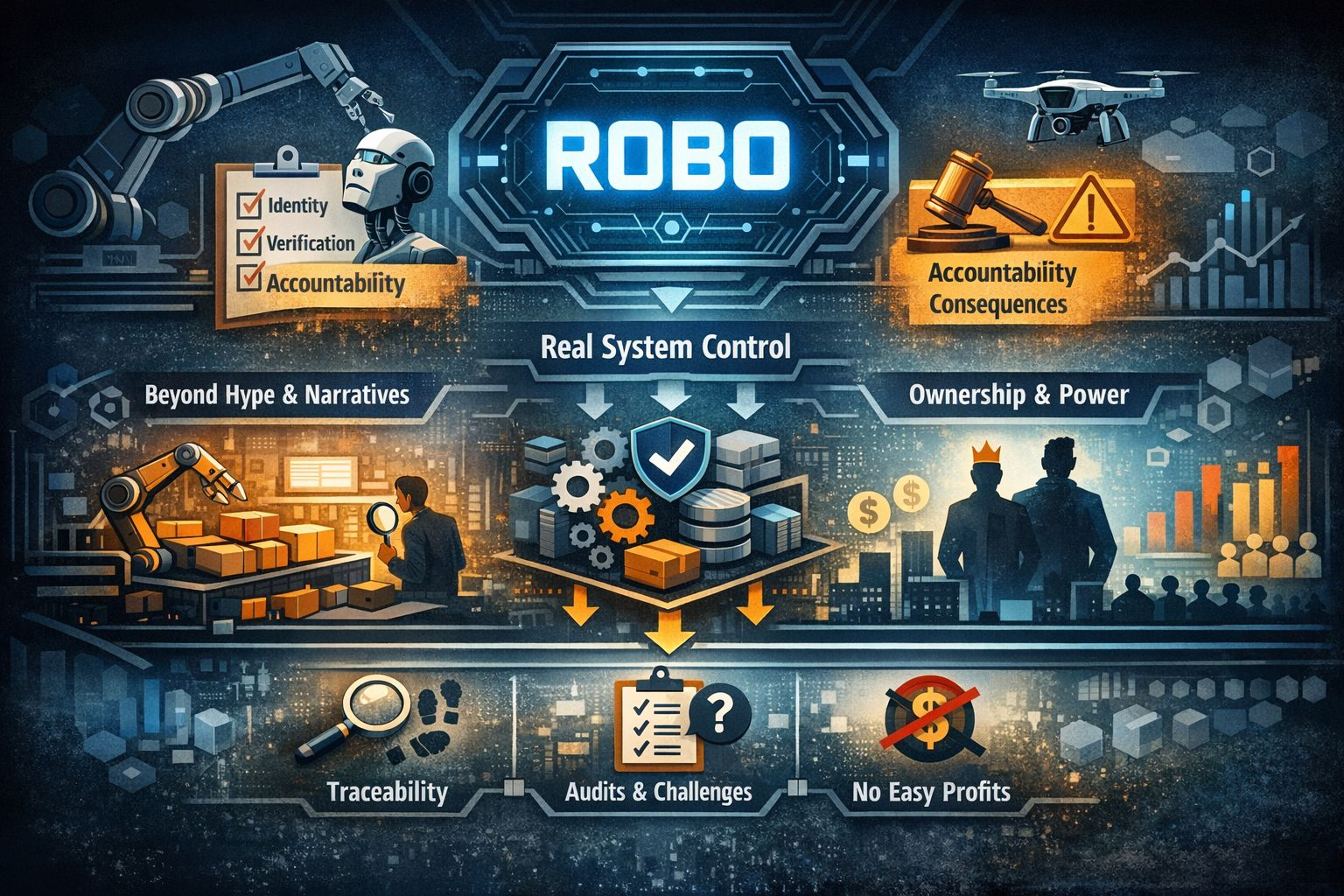
If a machine economy ever becomes real in any meaningful way, it won’t be able to run on reputation alone. It can’t depend on vague claims about safety or on the belief that operators will behave responsibly just because they say they will. Machines working in the world will need identity, traceable records, ways to verify what they’ve done, and some clear system for challenge and consequence. Otherwise people are simply being asked to trust a black box with more moving parts than they can actually see. I’ve watched enough of crypto’s history to know what usually happens when a system asks for trust without giving users real visibility. At first it works because excitement is high and belief moves faster than careful scrutiny. Then pressure appears. And that’s when the blind spots start to show.
That’s part of why Fabric pushed me to think about machine ethics in a more practical way. I’m no longer that interested in asking whether machines can be ethical in some big abstract sense. After years around crypto, I care much more about whether the systems around them make bad behavior easier to detect and harder to profit from. It may sound less inspiring, but it’s a far better test. This industry has shown me again and again that systems rarely collapse because people lacked principles. They collapse because the incentive structure quietly rewarded shortcuts, distortions, and selective honesty.
After watching enough cycles play out, you start losing patience with elegant theories that aren’t backed by real operational discipline.
That’s another reason Fabric stayed on my mind. The project seems built around the idea that contribution should be measured instead of simply assumed. That might not sound revolutionary, but in crypto it still is. Too many networks are designed in ways where capital, visibility, or good timing end up looking like contribution. Someone shows up early, positions themselves well, repeats the right language, and before long the market treats them as if they’re adding value whether they are or not. A system that aims to coordinate machines can’t afford to be that loose. If it can’t tell the difference between real work and carefully staged signals, it will start rewarding the wrong actors from the very beginning.
And once that happens, all the talk about ethics turns into decoration.
What Fabric seems to understand is that trust in machines isn’t only a technical result. It’s also a social and economic condition. People aren’t going to trust machine systems just because the interface looks good or because the team published a thoughtful paper. If trust develops at all, it will come from seeing how actions are approved, how work is checked, how quality is evaluated, and how conflicts are resolved. That kind of structure is far stronger than a narrative. It’s also far more difficult to build, which is probably why so few projects attempt it.
The project also made me think more clearly about modularity. One mistake people often make when discussing intelligent systems is treating them as if they are single moral objects, as though a robot or machine agent appears as one complete unit. Real systems don’t work that way. They are layered. They are made from pieces: capabilities, control logic, permissions, software updates, task structures, economic incentives, and human decisions made at different points by different people. After spending enough time around crypto infrastructure, that becomes obvious. What users see on the surface is rarely the whole story. The real nature of the system sits in the layers underneath.
Fabric pushed me to apply that same instinct to machine ethics. Instead of asking whether the machine itself is ethical, I started asking where accountability actually sits within the system. Which parts of the stack can be audited? Which actions leave a trace? Which capabilities can be questioned or taken away? Who introduced each component, and under what authority? These aren’t dramatic questions, but I trust them more. In my experience, the most useful analysis often begins where the dramatic framing stops.
The project also made me think more carefully about ownership, and that isn’t a small issue. Crypto has spent years talking about open networks, yet many ecosystems still drift toward concentration in practice, even when the language claims the opposite. If machines begin operating economically in a serious way, then the infrastructure coordinating them will shape who captures value, who defines the standards, who gets to participate, and who ends up pushed to the edges. I don’t see that as a side topic. I see it as one of the central ethical questions.
That’s another lesson this industry teaches if you stay around long enough. Power rarely presents itself openly. Most of the time it shows up dressed as convenience, efficiency, or smooth design. By the time people finally see where the real control sits, the structure is already hard to undo. Fabric pushed me to think about machine ethics not only in terms of what the machines do, but also in terms of the systems around them. Who controls the coordination layer matters. Who writes the rules matters. Who has the ability to challenge decisions matters. A machine system might behave “correctly” in a narrow sense and still exist inside a framework that is deeply unhealthy.
That kind of concern doesn’t come from casual cynicism. It comes from experience.
I’ve watched too many areas in crypto begin with the language of openness and eventually turn into versions of managed centralization with nicer branding. I’ve seen communities celebrate governance while the real authority stayed concentrated. I’ve seen token models described as alignment mechanisms when they were really extraction models with a longer timeline. So when I look at a project like Fabric, I don’t just ask whether the idea sounds compelling. I ask whether the structure will still hold once incentives sharpen, capital starts flowing in, and opportunistic actors begin optimizing around whatever the protocol rewards.
That’s why I find Fabric interesting, but not in the simple way this market usually frames interest. I don’t think a project’s value comes from how neatly it tells its story. I think it comes from whether it builds around the real points where systems tend to fail. Fabric seems to be trying to do that by focusing on identity, verification, quality, contribution, and accountability instead of relying on performance theater. That doesn’t mean it’s certain to succeed. If anything, experience usually suggests the opposite. The more ambitious the system, the more ways reality can break it.
And that’s the point where I naturally slow down.
At the conceptual level, Fabric is addressing a serious problem. But in practice, there’s still a long way between a thoughtful framework and a durable system people actually use. Measurement can be manipulated. Verification can become shallow. Governance can drift toward insiders. Networks that claim to reward contribution can still end up favoring those who are best at appearing to contribute. Anyone who has studied crypto through several cycles should understand those risks. Good ideas don’t fail only because they were bad ideas. Many fail because the incentive structure around them changes faster than the builders expected.
So I don’t look at Fabric as a finished story. I see it as a project trying to deal with a problem at the right level of difficulty. That alone makes it more serious than much of what passes for innovation in this space. It’s focusing on the parts of machine systems that people often skip because they’re less dramatic and much harder to deal with. Trust, accountability, proof, dispute, consequence. Those are the things that actually matter once the excitement fades and the market stops rewarding imagination by itself.
What Fabric changed for me wasn’t my belief that crypto can somehow solve machine ethics completely. I don’t believe that, and spending years in this industry has only made me more cautious about those kinds of sweeping claims. What it changed was how I think about the problem itself. I used to assume the center of machine ethics was intelligence. Now I think the harder and more important issue is the system surrounding that intelligence. The incentives. The visibility. The records. The authority structures. The ways decisions can be challenged. The penalties when things go wrong and the rewards when something genuinely useful happens.
That shift feels more honest to me.
When you spend enough time studying crypto, you start becoming cautious about polished visions of the future. You learn to focus on the parts of a system where behavior is actually shaped in practice, not just described in theory. Fabric pushed me further in that direction. It made me realize that once machines start taking part in economic life, ethics can’t stay as a set of aspirations. It has to be built directly into the structure of the system.
And structure is where promises either become real or quietly fall apart.
@Fabric Foundation #ROBO $ROBO
