
Privacy in Web3 has always been one of those ideas that looks neat in theory but gets messy when it meets real use. I’ve watched this industry go through enough cycles to recognize the pattern. A fresh narrative appears, people wrap it in big language, money floods in, and for a while everyone speaks as if a long-standing problem has finally been solved. Then reality shows up. Edge cases start appearing. Trade-offs become harder to ignore. And the story quietly changes.
Privacy has followed that pattern more than once.
For a long time the conversation kept swinging between extremes. Either full transparency was praised as the ultimate feature, or privacy was presented like some kind of perfect shield. Neither view ever felt complete. Systems that are public by default bring their own problems, and not small ones either. But the earlier privacy narrative often arrived packed with ideology and unrealistic expectations, which made it hard to see what part of it was actually useful. That’s been the issue all along. In crypto, good ideas often show up wearing costumes.
That’s part of the reason Midnight has started drawing attention.
Not because the core problem is new. It isn’t. People have been pointing out the limits of extreme onchain transparency for a long time. Traders understand it. Developers understand it. Institutions definitely understand it. Regular users usually realize it the moment they see how easily someone can track activity, study patterns, and connect details that probably were never meant to be public. The question was never whether privacy would matter. The real question was what kind of privacy could actually hold up when it meets markets, regulators, and real-world use.
That’s where Midnight becomes interesting, at least in theory.
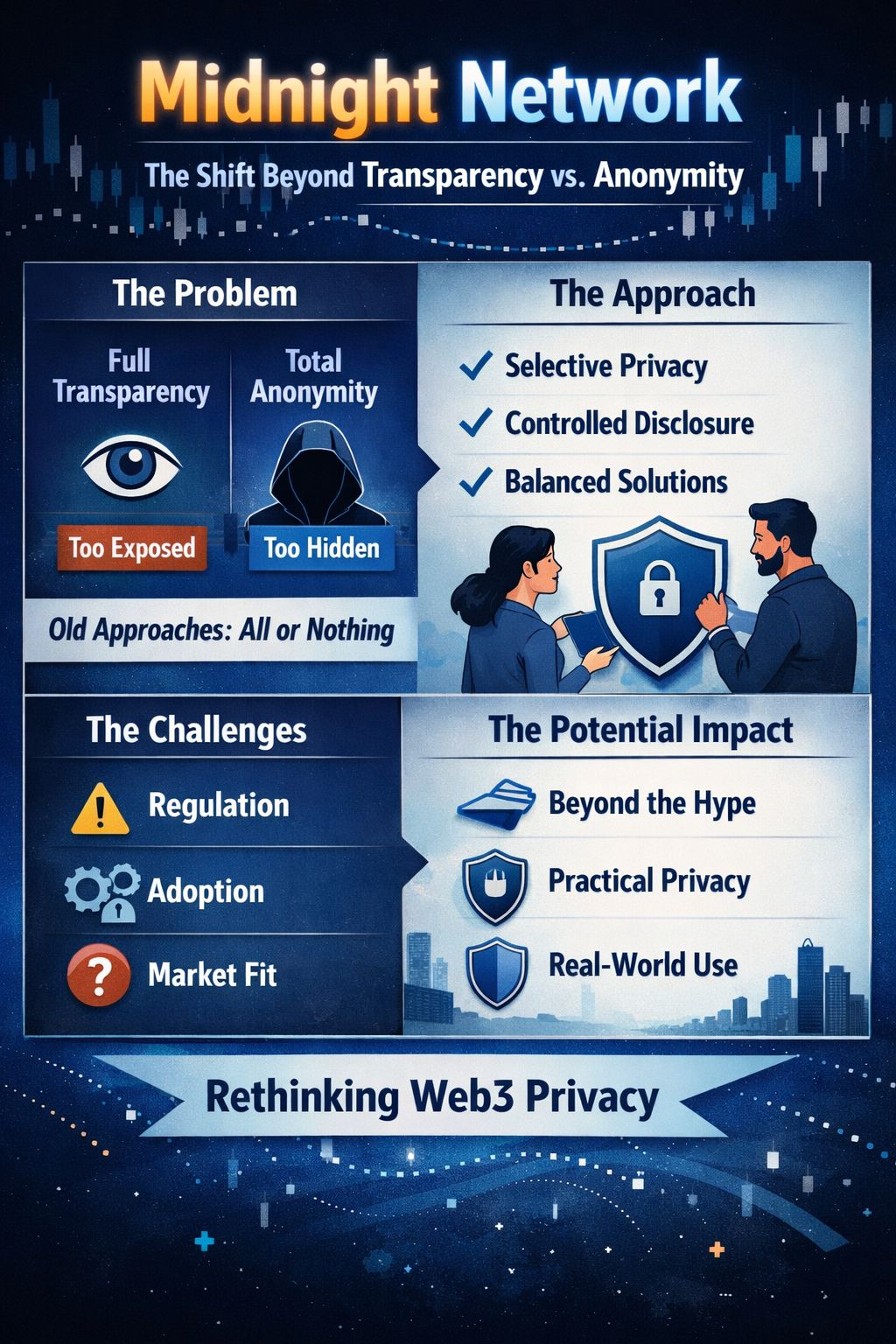
It isn’t really repeating the old promise of total invisibility. That difference matters. I’ve watched enough projects rely on vague privacy language to know how quickly that approach falls apart once people start examining it closely. Midnight seems to be aiming for something more measured than that, something more selective. Less about “nothing is visible,” and more about “only what needs to be visible should be revealed.” It’s a small distinction, but in this space those kinds of distinctions usually matter far more than slogans.
And honestly, the market has been overdue for that realization.
One of the odd habits in crypto’s early culture was the way transparency kept getting mistaken for trust. The idea seemed to be that if everything is visible, the system must automatically be fairer, cleaner, maybe even more honest. There is some truth behind that, of course. Public ledgers did introduce a level of auditability that many older systems didn’t have. But people pushed that idea too far. They behaved as if visibility alone could fix human behavior. It can’t. In some cases it just creates different problems.
A completely transparent system sounds admirable until you remember that people aren’t abstract concepts. They have incentives, weaknesses, competitors, reputations, routines, and things they’d rather not broadcast forever. Businesses make this even clearer. No company is going to run serious operations on infrastructure that exposes sensitive activity by default. That shouldn’t be controversial, yet for a long time the market acted as if wanting basic discretion somehow meant missing the point.
Midnight, from what it appears to be trying to build, looks like an attempt to correct that earlier overreach.
The reason that matters isn’t because “privacy” is some magic word. In crypto, if anything, the word has become heavy with assumptions. The moment people hear it, they bring their own interpretations. Some think of freedom. Others think of risk. Some immediately imagine a regulatory battle. Because of that, privacy-focused projects often struggle to stay grounded. Many end up exaggerating what they can do, while critics reduce the entire idea to a simple stereotype, assuming privacy must mean secrecy without responsibility.
Real systems rarely work that way.
What Midnight seems to be aiming for is a version of privacy that sits somewhere in the middle, which is often where the most durable ideas end up. The appeal isn’t that everything disappears from view. It’s that disclosure becomes more deliberate. A person proves only what needs to be proven without exposing every detail behind it. A company can confirm compliance without revealing all of its internal information. A governance process allows people to take part without turning every decision into a permanent public spectacle. When you describe it slowly, none of this sounds revolutionary. It sounds ordinary. And that might actually be its strongest advantage.
Because that’s often how this space evolves after enough cycles. It begins with rigid ideas, and then reality slowly pulls things back toward balance.
That’s probably why Midnight seems more likely to shape the conversation than many earlier privacy projects did. The market itself has changed. Enough time has passed, enough experiments have happened, and enough activity has taken place on public blockchains for people to understand what extreme transparency actually feels like. At first it seemed bold and principled. Later it began to look a bit naïve. In some cases, even a little dysfunctional. You can only tell users that total visibility is empowering for so long before they start wondering who it really benefits.
That question has been quietly sitting in the background for years.
Still, I’d be careful not to romanticize what Midnight is trying to do. Crypto has a tendency to take reasonable ideas and stretch them into something inevitable. That’s usually where the mistakes start. A project can point out a real problem and still fail to solve it in a way the market actually adopts. It can have a strong thesis and still struggle with adoption, user experience, regulatory pressure, or simply fading relevance. I’ve watched technically solid projects disappear because the timing was wrong. I’ve also seen weaker ones survive just because the story around them was stronger. That’s simply how this industry behaves.
So I don’t look at Midnight and assume it’s the solution. I look at it and think it’s asking a better question than many others in the space.
That question is whether Web3 has been thinking about privacy too simply from the beginning.
For much of its history, the industry treated privacy as if it had to be one of two extremes: total openness or near-complete secrecy. That kind of binary was never going to last. The real world doesn’t operate like that, and markets eventually push back against systems that ignore reality. If Midnight helps move the discussion toward selective disclosure, controlled visibility, and proving things without revealing everything behind them, then it could still matter even if it never ends up dominating the category.
That kind of impact is easy to overlook. A project doesn’t always need to “win” in the obvious sense to matter. Sometimes it only needs to make the old way of thinking feel outdated.
And I think Midnight might be doing that.
What keeps me cautious, though, is that crypto is full of projects that sound mature long before they’ve been tested in truly mature conditions. It’s easy to talk about balance. It’s much harder to build systems that protect privacy without creating friction, compliance headaches, liquidity problems, or gaps in trust. Harder still to make those systems appealing enough that developers and users adopt them for practical reasons rather than just curiosity. That’s usually where many reinvention stories start to struggle. The idea continues. The product fades.
So yes, there is something meaningful in Midnight’s direction. It reflects a wider shift in how people are starting to think about blockchain design. Less focus on visibility for its own sake. More attention to what should actually be visible, to whom, and for what reason. That line of thinking feels healthier. It sounds less like a slogan from an earlier cycle and more like the kind of question people ask after spending years dealing with the limits of existing systems.
But I’d hesitate to call it a breakthrough before the market actually shows it wants this kind of model. Early excitement can say a lot of things. What the market supports over time is often a different story.
That’s probably the most reasonable way to see it. Midnight may not end up redefining privacy in Web3 on its own, and I wouldn’t trust anyone who talks as if that outcome is already certain. This space has buried too many confident predictions for that kind of certainty. Still, it does seem to reflect a more grounded sense of where the industry might be heading. Not toward complete secrecy. Not toward total exposure. Something more focused, more deliberate, and probably more practical.
After enough years of watching crypto repeat its own patterns, that kind of measured ambition stands out.
Not because it guarantees success.
But because it sounds like it has learned something from the failures that came before it.
@MidnightNetwork #night $NIGHT
