
@Fabric Foundation #robo $ROBO
When I first encountered Fabric Protocol, it wasn’t through a loud marketing thread or a hyped announcement. It was one of those quiet, late night discoveries the kind that happens when you're digging through technical discussions and a single concept hits you differently.
At first glance, I’ll admit I was skeptical. We’ve seen the "AI + Robotics + Blockchain" narrative recycled a dozen times. Usually, the vision sounds exciting for five minutes until you realize the technical substance is paper thin. But Fabric made me pause.
I read a description of machines coordinating tasks through a decentralized network and realized: This isn't just another "faster blockchain" story. This is an architecture for a species that isn't human.
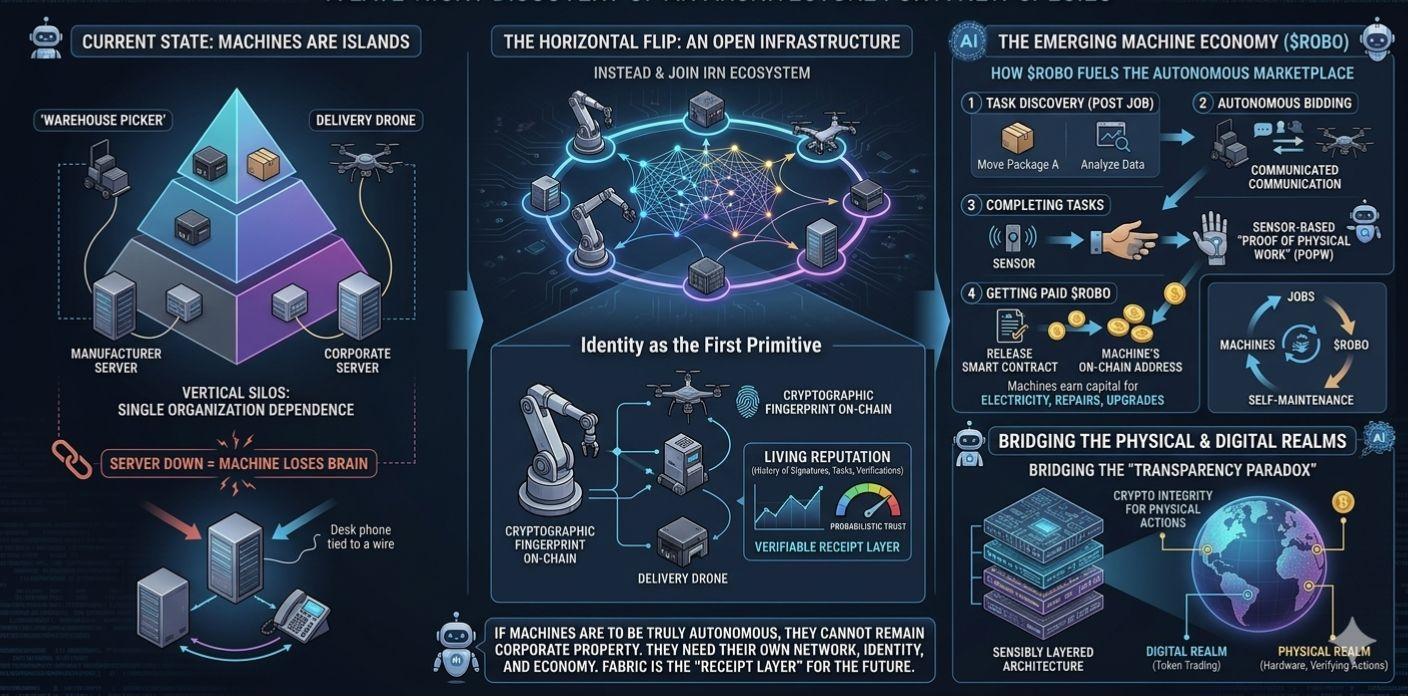
Right now, every robotic system is an island. A warehouse picker reports to its manufacturer, a delivery drone is tethered to a corporate server. Everything is a vertical silo. If the central server goes down, the machine loses its "brain."
Fabric proposes a Horizontal Flip. Instead of a robot depending on a single organization, it exists within an open, decentralized infrastructure. It’s the difference between a desk phone tied to a physical wire and a smartphone connected to the open internet.
Identity as the First Primitive
One of the first technical hurdles Fabric addresses is Machine Identity. It sounds trivial until you consider the scale. If an autonomous agent is going to participate in an economy, it needs a cryptographic "fingerprint."
In Fabric, each machine is assigned a unique identity on-chain. This isn't just a serial number; it’s a living reputation. Every signed message, every completed task, and every failed verification is recorded. Over time, machines develop probabilistic trust. The network doesn't need to "hope" a robot is reliable; it has a verifiable receipt of its entire history.
The most provocative shift is the introduction of the ROBO token. We're used to tokens as speculative assets or governance tools for humans. In Fabric, $ROBO is the literal fuel for an autonomous marketplace.
Task Discovery: A "job" is posted to the network (e.g., "Analyze this environmental data" or "Move Package A to Point B").
Machines scan the network for tasks they are physically equipped to handle.
Once a sensor based "Proof of Physical Work" is verified, the smart contract releases $ROBO directly to the machine's address.
We are not just talking about robots "freelancing." We're talking about machines earning the capital they need to pay for their own electricity, repairs, or software upgrades.
I appreciate that Fabric doesn't try to be a "monolith." Its architecture is sensibly layered.
Most of the blockchain world is comfortably tucked away in the digital realm trading tokens and signing JPEGs. Fabric is trying to bridge the "Transparency Paradox" by bringing cryptographic integrity to the physical world.
It’s an ambitious, perhaps even slightly crazy, goal. Verifying real world actions is infinitely harder than verifying digital transactions. Malicious actors, hardware spoofing, and massive scalability hurdles are all standing in the way.
But the core realization remains. If machines are to become truly autonomous, they cannot remain corporate property. They need their own network, their own identity and their own economy. Fabric Protocol feels like one of the first genuine attempts to build that "Receipt Layer" for the future.