
On Midnight, the contract can run, the user can press confirm, the wallet can look busy for a few seconds, and then nothing reaches the chain.
That gap is doing more work than people admit.
The usual explanation sounds clean enough. A Compact contract executes locally. Inputs stay private. The wallet generates witness data. The proof gets built. Midnight verifies the result. Fine. That part is easy to say.
What’s less clean is the point where witness generation slips and the whole flow dies before the ledger has anything to recognize.
Not a rejected transaction. Not a reverted state update. Not even a visible failed call sitting on-chain for someone to inspect later.
Just a user who thinks they tried something.
And a developer staring at a proving path that broke before Midnight ever had the chance to disagree.
That seems minor until it lands inside a real product.
A user opens the app, triggers a private action, waits, then tries again. Maybe the wallet surfaces a vague proving error. Maybe it doesn’t. Maybe support gets a screenshot that shows the action started but can’t show where it actually came apart. Product analytics may log intent. The chain logs nothing final. The user says the app failed. The network, technically, never saw a valid transaction.
So where exactly did the failure happen?
That question gets ugly fast on Midnight because the awkward step sits in the witness generation layer, right between local execution and proof submission, which is also the part most normal users will never know exists.
And developers absolutely know it exists.
Because this is where the contract witness has to line up with the circuit exactly. Same private inputs, same logic path, same expected result, until something small isn’t the same anymore. Then proof generation stalls or fails, and now the problem belongs to the wallet, or the proving environment, or the way the app packaged the inputs, or some mismatch in the circuit assumptions, or whatever name the team gives the problem at 2am when the ticket count starts moving.
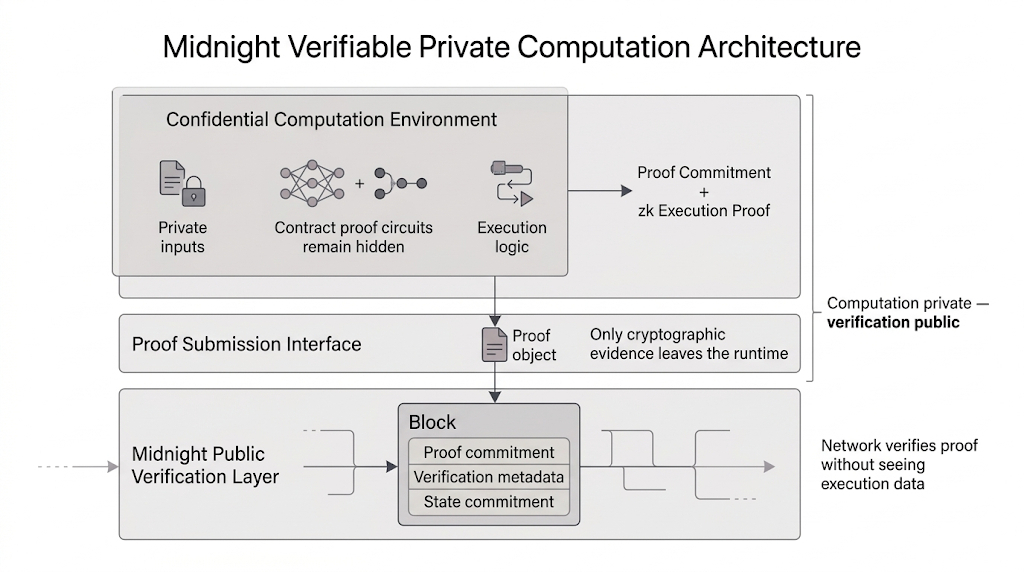
What keeps bothering me is not that this step is delicate. Of course it is. Midnight is built around private computation and execution proofs. Something has to bridge local execution into something the network can verify.
It’s the way the workflow feels from each side.
From the user side, something happened.
From the product side, maybe something almost happened.
From the Midnight's ledger side, maybe nothing happened at all.
That split is where the clean architecture story starts getting messy. Because once witness generation becomes the fragile point, the most sensitive failure surface is no longer the chain. It’s the handoff before the chain. And that handoff is quiet. Private. Hard to inspect. Easy to misunderstand in support. Easy to misread in analytics. Easy to flatten into “transaction failed” when that is not really what failed.
The contract may have already run locally.
The user may have already crossed the point where they think the action is underway.
But Midnight still has nothing final to verify.
And that leaves a strange kind of operational residue. The user feels an action. The developer sees a broken proving path. The ledger stays clean.
That cleanliness is probably the part that gets irritating.