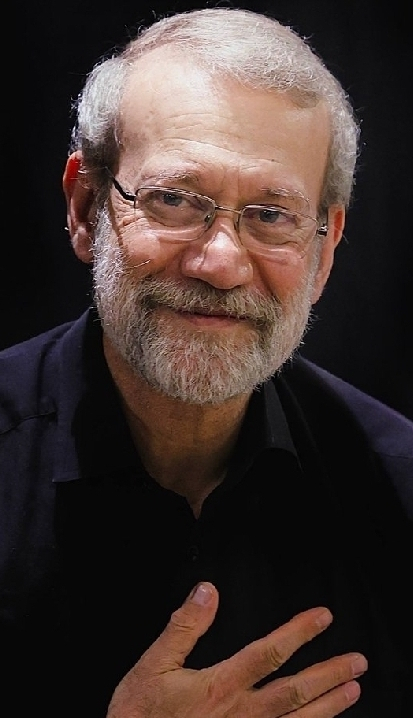
In an era where much of the Muslim world struggles to balance power, identity, and global pressure, figures like Ali Larijani stand out not through noise, but through intellect, discipline, and long-term strategic vision. He is not a product of political theatrics, but of deep thinking and calculated action, a man whose influence flows quietly through institutions rather than loudly through slogans.
A philosopher by training, a political strategist by profession, and a fighter by circumstance, Larijani represents a rare fusion of thought and action. His journey is not merely a personal rise; it reflects a leadership template one that many in the Muslim world seek but rarely find. In him, thought is not detached from reality, and power is not separated from principle.
Unlike many career politicians, Larijani’s foundation is deeply intellectual. With a PhD in philosophy, he engaged seriously with both Islamic and Western traditions, including the works of Immanuel Kant. This intellectual exposure did not dilute his identity; rather, it sharpened his ability to understand and counter global narratives. He does not react, he anticipates. He does not follow discourse, he reshapes it.
He has consistently emphasized that true sovereignty begins in the mind. As reflected in his policy thinking, a nation that depends intellectually on others can never be politically independent. This belief shaped his approach to governance, where clarity replaced confusion, and strategy replaced impulse. In a political climate often driven by slogans, Larijani introduced depth, discipline, and analytical rigor.
His early association with the Islamic Revolutionary Guard Corps placed him within the most difficult phase of Iran’s post-revolutionary struggle. This was not simply an institutional role—it was a commitment to defending a vision of independence for the Muslim world. Yet, his understanding of struggle evolved beyond conventional warfare. When he later led the Islamic Republic of Iran Broadcasting, he recognized that modern conflicts are fought as much through narratives as through weapons. Controlling the message meant protecting identity, and shaping perception meant strengthening resistance.
This dual exposure to hard power and soft power transformed him into a complete strategist one who understands that lasting influence requires both strength and story.
At the height of international tension, as Secretary of Iran’s Supreme National Security Council, Larijani stepped into the complex arena of nuclear negotiations. His approach was neither rigid nor submissive, but calculated. He operated on a principle that defined his diplomatic philosophy:
“Negotiation is not surrender; it is a method to defend national interests with reason and prudence.” (Iranian policy discussions, mid-2000s)
He maintained that engagement must never come at the cost of dignity, and resistance must never lead to isolation. During the presidency of Mahmoud Ahmadinejad, strategic differences became evident. Larijani chose to step aside rather than dilute his vision an uncommon move in power politics. This decision reinforced a defining trait: he is guided by thought, not position.
For more than a decade as Speaker of Parliament, he functioned not as a public performer, but as a system stabilizer. Working alongside figures like Hassan Rouhani, he played a central role in managing internal tensions and external pressures. His support for the nuclear agreement was not an act of compromise, but of calculation an effort to align national resilience with global realities. As he articulated in a parliamentary context:
“A nation that balances resistance with diplomacy secures its future.” (Majlis address, Tehran, 2015)
Calling Larijani a “fighter” extends far beyond the battlefield. His real struggle lies in the intellectual and political domains defending sovereignty in a world shaped by powerful external forces. He has consistently argued that the real conflict for Muslim nations is not only fought on borders, but within minds, economies, and decision-making frameworks. In one of his widely circulated statements, he observed:
“Emotional decisions may win moments, but only calculated strategies protect nations.”
As a writer and thinker, his discourse revolves around independence, wisdom, and strategic resistance. His message is consistent: reaction weakens, strategy strengthens. Through speeches, writings, and public statements including those circulated via official platforms he has emphasized:
“The strength of the Muslim world lies in unity, awareness, and resistance against domination.”
Yet, his position has never been without challenge. Reformist voices often see him as part of the established order, while some conservatives question his pragmatic engagement with global powers. But this very tension defines his uniqueness, he does not belong to extremes. He operates in the narrow, complex space where real decisions are made, where ideology meets reality.
Ali Larijani’s legacy is not built on popularity, but on structure; not on rhetoric, but on outcomes. His approach can be summarized simply: knowledge before action, strategy before reaction, stability before chaos. In a time when leadership is often reduced to visibility, he represents depth. In a world chasing immediate gains, he embodies long-term vision.
For many across the Muslim world, he represents a powerful idea that true leadership is not loud. It is deliberate, disciplined, and deeply aware of both history and the future.
Ali Larijani’s journey was not only of thought and strategy but ultimately of sacrifice. In the wake of targeted strikes by foreign powers, including Israel and the United States, he gave his life defending the dignity, independence, and sovereignty of the Muslim world. His martyrdom stands as a final testament to the principles he lived by: wisdom over impulsiveness, strategy over chaos, and steadfast resistance against domination.
“Indeed we belong to Allah, and indeed to Him we will return” (Inna Lillahi wa inna ilayhi raji’un).
For the Muslim world, his legacy is eternal a guide for leaders and a symbol of courage, intellect, and unwavering commitment to justice.