
I have noticed something odd about modern technology. The more digital our systems become, the more they ask us to reveal by default. Not always in a dramatic way. Sometimes it is just little things. Metadata. Transaction history. behavior patterns. enough pieces that, taken together, start to feel like a full picture. That has been bothering me more lately, maybe because so much of the internet now runs on the assumption that verification requires exposure.
That is probably why Midnight Network caught my attention in a different way than most crypto projects do. My first reaction was actually a little dismissive. I assumed it was another privacy chain trying to sell secrecy as innovation. Crypto does that a lot. But the more I looked at Midnight, the less I thought this was mainly about hiding things. My personal read is that it is really about controlling disclosure. That feels much more serious.What interests me is the basic tension it is trying to deal with. In most systems, if you want to prove something, you end up showing far more than the proof itself should require. That is true in finance, in apps, in identity systems, in compliance. Midnight uses zero knowledge proofs to approach that differently. The simple version is that you can prove a claim is valid without revealing all the underlying data. I know that sounds abstract at first. But to me the real point is not the cryptography. It is the shift in logic. Instead of making transparency the default cost of trust, the system tries to make trust possible with less exposure.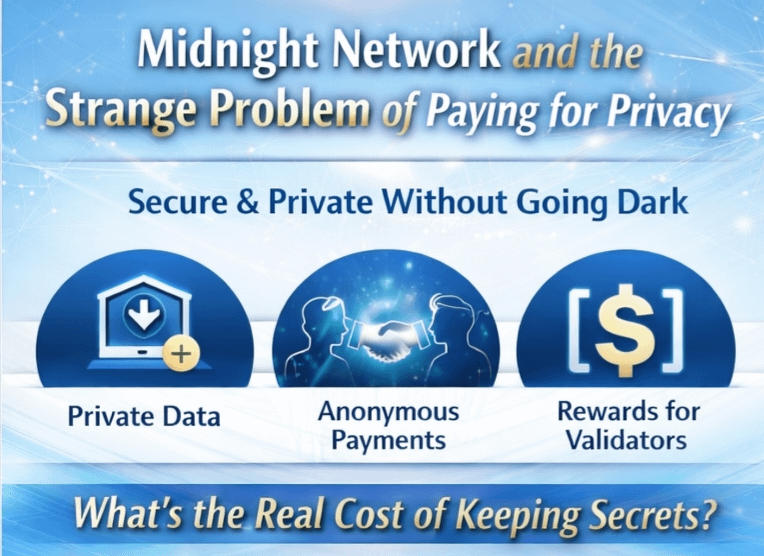
That is where my opinion on Midnight changed. I stopped seeing it as a privacy product and started seeing it as infrastructure for selective visibility. Those are not the same thing. Privacy as a slogan is easy. Selective disclosure is much harder because it has to satisfy conflicting demands at once. Users want protection. Institutions want compliance. Networks want verifiability. Markets want clarity. Usually one of those wins and the others get compromised. Midnight seems to be trying to negotiate between them rather than choosing only one side.
I also think the NIGHT and DUST model says a lot about how the team sees the problem. NIGHT is the public token. DUST is the non transferable resource used for execution, and it is generated from holding NIGHT. At first, honestly, I thought that sounded like unnecessary complexity. My instinct in crypto is usually to distrust clever token design because it often exists to decorate weak fundamentals. But here I can at least see the reasoning. If usage depends on DUST rather than direct spending pressure on the main token every time, then the network is trying to separate owning the asset from paying for computational activity.
To me, that matters because it changes the feel of the system. On a lot of chains, using the network feels like constantly paying unpredictable tolls. Midnight seems to be reaching for something more stable, almost like reserved access instead of pure transaction-by-transaction friction. I am not saying that guarantees a better user experience. It may not. Sometimes these designs look elegant until real people touch them. Still, I find the intention behind it more thoughtful than the usual fee model.
The token distribution also shaped my impression. NIGHT has a fixed supply of 24 billion, with about 16.61 billion already circulating. I think that matters because it reduces the sense that the market is being built around artificial scarcity theater. There was also broad distribution through Glacier Drop, Scavenger Mine, and exchange programs. In my view, distribution is never a side detail. It affects who cares, who experiments, and who gets enough exposure to become part of the network’s actual social base rather than just its audience.
The recent network updates made the project feel more real to me, though not proven. Growth in block producers, smart contract deployments, addresses, and developer activity suggests the system is moving beyond concept stage. I do not read those numbers as evidence of success yet. Early metrics can flatter almost any new network if you stare at them long enough. But they do suggest that Midnight is at least being tested as a working environment, which matters much more to me than polished branding.
What keeps me interested, in the end, is pretty simple. I do not think the internet has a shortage of systems that can expose data. It has a shortage of systems that know how to reveal only what is necessary. Midnight seems to be built around that exact problem. Maybe it works. Maybe it turns out to be too complicated, too early, or too hard to integrate at scale. I think those risks are real.
Still, my own view is that Midnight is asking a better question than most crypto projects ask. Not how to hide everything. Not how to monetize privacy as an aesthetic. But how to prove enough, coordinate enough, and protect enough without making exposure the price of participation. That feels more grounded to me. And honestly, more relevant.