
@SignOfficial I started thinking about Sign in a fairly unglamorous moment. I was tracing a workflow that had technically succeeded, yet still created hesitation downstream. The transaction had settled, the message had landed, but the surrounding claim was weak enough that every other participant behaved as if nothing final had happened. That gap stayed with me. In crypto, we still talk as if settlement is the hard part. More often now, it is credibility.
One assumption gets repeated so often that it barely sounds like an assumption anymore: that Web3 becomes credible simply by putting more activity on-chain. I do not think that is quite right. Public visibility can show that something happened, but it does not automatically show who was authorized to do it, what schema defined it, whether the record can be reused across systems, or how a regulator, institution, or counterparty is supposed to interpret it later. That is a narrower problem than “trustlessness,” and in some ways a harder one.
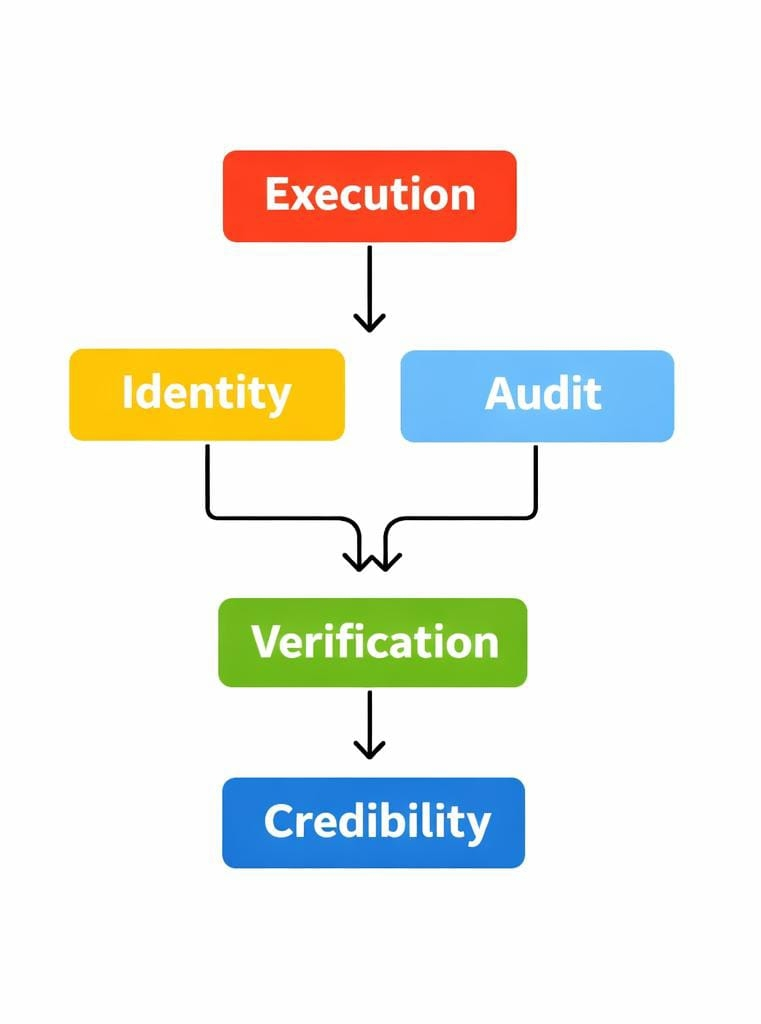
That is why Sign is more interesting to me as an evidence system than as a token story. Its own documentation has moved well beyond the earlier framing of an attestation tool and now presents S.I.G.N. as a broader architecture for money, identity, and capital, with Sign Protocol positioned as the shared evidence layer inside those deployments. Surface-level observers may see a project broadening its narrative. Underneath, the more important shift is that Sign is trying to define where verification sits in the stack: not at the edge, not as an app feature, but as a reusable substrate between execution, identity, and audit.
Attestations, in that model, are not really about posting certificates to a chain. At the surface, an attestation looks like a signed claim. Underneath, Sign breaks that into schemas and attestations, then lets those records live fully on-chain, fully off-chain with anchors, or in hybrid form, while making them queryable later through indexing layers like SignScan. The practical consequence is not elegance. It is lower coordination cost. Different parties can stop rebuilding the same verification logic every time a record crosses a boundary. The tradeoff is that this only works if issuers, verifiers, and indexers converge on common expectations, which is exactly where crypto systems often stall.
There is also a quiet but important interoperability point here. Sign’s published network list shows the protocol deployed across multiple mainnets, including Ethereum, Base, Arbitrum One, BNB Chain, Celo, Cyber, Degen, and Gnosis, with query infrastructure exposed through REST and GraphQL interfaces. The visible story is multichain support. The structural story is different: credibility is being treated as data that must survive movement across environments, not as something native to one chain’s social graph. That is useful, because actual institutions do not organize themselves around chain maximalism. It also introduces a tension, because every extra layer of aggregation and indexing makes the system easier to use while creating fresh dependencies that purists tend to understate.
What makes this feel less theoretical is that Sign already has a distribution product sitting nearby. TokenTable’s own materials claim more than $2 billion unlocked to 40 million unique addresses across 200-plus projects. Those numbers matter less as a brag and more as a clue. They suggest the team has spent time where crypto credibility usually breaks first: eligibility, distribution logic, vesting schedules, and proof that a program actually ran the way it said it would. Moving tokens is easy. Showing that they reached the right people under the right rules, and that someone can inspect the process afterward, is a much more stubborn problem.
That brings me to the token itself, which is where the story becomes less comfortable. SIGN currently sits around a $72 million market cap, with roughly 1.64 billion tokens circulating out of a 10 billion maximum supply, and about $46.7 million in 24-hour trading volume. On the surface, that volume makes the token look liquid and alive. Underneath, it also shows how quickly market attention can outrun infrastructure adoption. When a token’s daily turnover starts to approach a large fraction of its market cap, price discovery is telling you as much about rotational trading as it is about durable usage. The official Sign token page also describes a 40/60 allocation split between earlier participants and future growth, which reinforces the point: this is still a system trying to socialize future utility before the market can fully measure it. (
The regulatory posture is similarly revealing. In its MiCA white paper, Sign states that the document has not been approved by an EU authority, while also stating it complies with Title II of MiCA. The same document says the token confers no ownership rights, no dividend rights, and no automatic governance rights unless holders operate as network validators; it classifies SIGN as an “other crypto-asset,” not an e-money or asset-referenced token. Surface-level readers may treat this as routine legal housekeeping. I read it differently. It is a narrowing exercise. The project is trying to make fewer grand promises about what the token is, which is often a healthier foundation for credibility than pretending every utility token is a miniature sovereign asset.
The timing of that matters because the broader market is drifting toward a harsher definition of credibility. The global crypto market is about $2.46 trillion, with Bitcoin dominance above 56% and stablecoins near $312 billion. At the same time, spot bitcoin ETFs have pulled in more than $1.3 billion this month even after volatile daily swings, which tells you where institutional demand currently feels safest: in simple, legible exposure, not in application-layer nuance. That is the environment Sign has to operate in. It is trying to sell evidence infrastructure during a cycle where capital still rewards the cleanest wrappers around scarce assets.
And yet user behavior is moving in a direction that quietly supports Sign’s thesis. Electric Capital pointed to $13.59 trillion in stablecoin transaction volume across Ethereum, Base, BSC, Tron, and Solana from July through September 2025 alone. I do not read that as a victory lap for crypto payments. I read it as proof that users will adopt blockchain rails when they solve practical settlement and dollar-access problems. Once that happens, the next bottleneck is not moving value. It is attaching durable claims to that value: who is eligible, who is compliant, who approved it, and whether those answers can travel across institutions without becoming a manual reconciliation exercise.
Recent U.S. policy signals make the same point from another angle. The SEC and CFTC have now moved toward a token taxonomy that separates digital commodities, digital tools, stablecoins, collectibles, and digital securities, while the SEC has also approved Nasdaq’s proposal to support tokenized versions of certain securities settled through mainstream market infrastructure. These are not just regulatory headlines. They show a market structure leaning toward finer distinctions around rights, claims, and operational evidence. That is the world an attestation architecture wants to live in. It is also the world where public-token middleware faces its hardest question: whether open crypto networks will own the credibility layer, or whether regulated incumbents will absorb the same function behind permissioned rails.
None of this guarantees that Sign wins. Attestations can make false information portable just as efficiently as true information if issuer trust, revocation, and governance are weak. Sign’s own stack leans on standards such as W3C verifiable credentials, DIDs, OIDC issuance and presentation flows, privacy-preserving proofs, and audit-oriented querying. That is the right vocabulary for serious systems. But standards are not adoption, and evidence layers only matter when multiple institutions accept the burden of interpreting them the same way under pressure.
What keeps the project interesting, then, is not that it makes Web3 look more official. It is that it points to a quieter change in what crypto infrastructure is for. As automation spreads, as tokenized assets move closer to regulated markets, and as more economic activity depends on machine-readable permissions and proofs, networks will be judged less by how loudly they settle and more by how credibly they explain themselves afterward.
That is the deeper thing Sign seems to represent: not trust without institutions, but verification that can survive between them.$SIGN #SignDigitalSovereignInfra