
@SignOfficial I was staring at a chipped mug on my desk after 6 a.m. and listening to the radiator click when I realized why Sign is on my mind. Everybody talks about digital sovereignty but few systems explain how trust works once the stakes become national. Am I finally looking at one that tries?
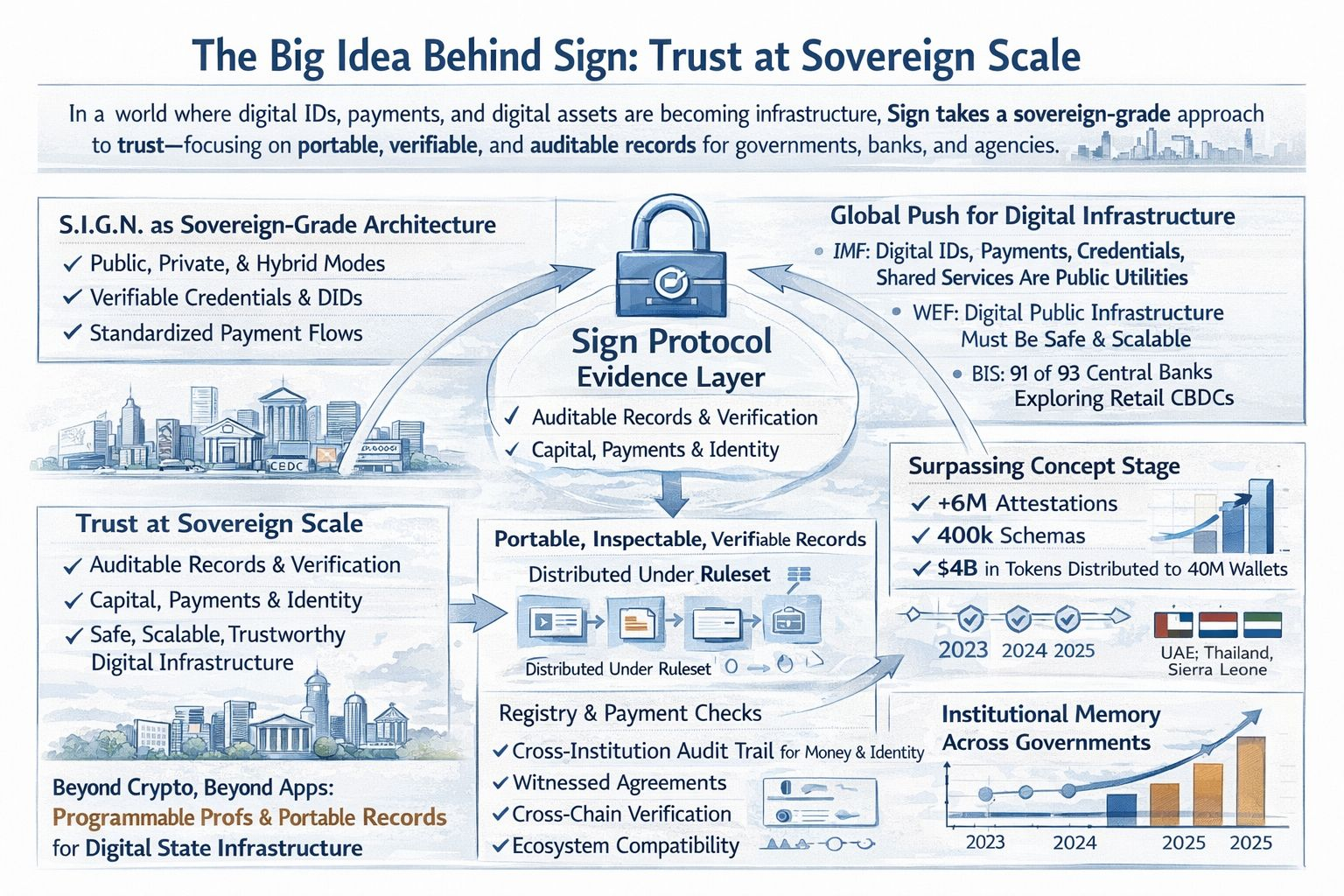
What catches me about Sign is that it no longer presents itself as a crypto protocol or a signing tool. In its framing S.I.G.N. is a sovereign-grade architecture for money identity and capital with Sign Protocol acting as the evidence layer. That shift matters because it signals a different ambition. The project does not want to sit at the surface like an app. It wants to sit underneath like infrastructure.
When I strip away the branding the core idea is straightforward. Trust at sovereign scale is not about asking citizens banks regulators and agencies to feel confident. It is about giving them a way to verify claims across time and institutions. A payment happened and an identity was checked. A registry update was approved and a subsidy was distributed under a ruleset. Sign’s argument is that these actions need portable inspectable records rather than closed databases and promises.
I think that lands right now because the wider conversation has changed. In March 2026 the IMF argued that finance ministries should think about digital IDs payments credentials and shared services the way they think about roads or power grids. The World Economic Forum made a similar point last year when it said digital public infrastructure has to be safe scalable and trustworthy. The BIS noted that 91 of 93 surveyed central banks are exploring retail CBDCs. I read that mix of signals as a clue that the market is no longer debating crypto products. It is debating digital rails. I notice that shift everywhere.
That is why Sign feels timely beyond its own ecosystem. This week Mastercard said it would buy infrastructure firm BVNK for up to $1.8 billion which is a reminder that programmable payment rails are moving into mainstream finance. But when I look at Sign I do not think the interesting question is speed alone. I think the real question is whether a country can run digital money identity checks and capital programs without giving up control privacy choices or auditability.
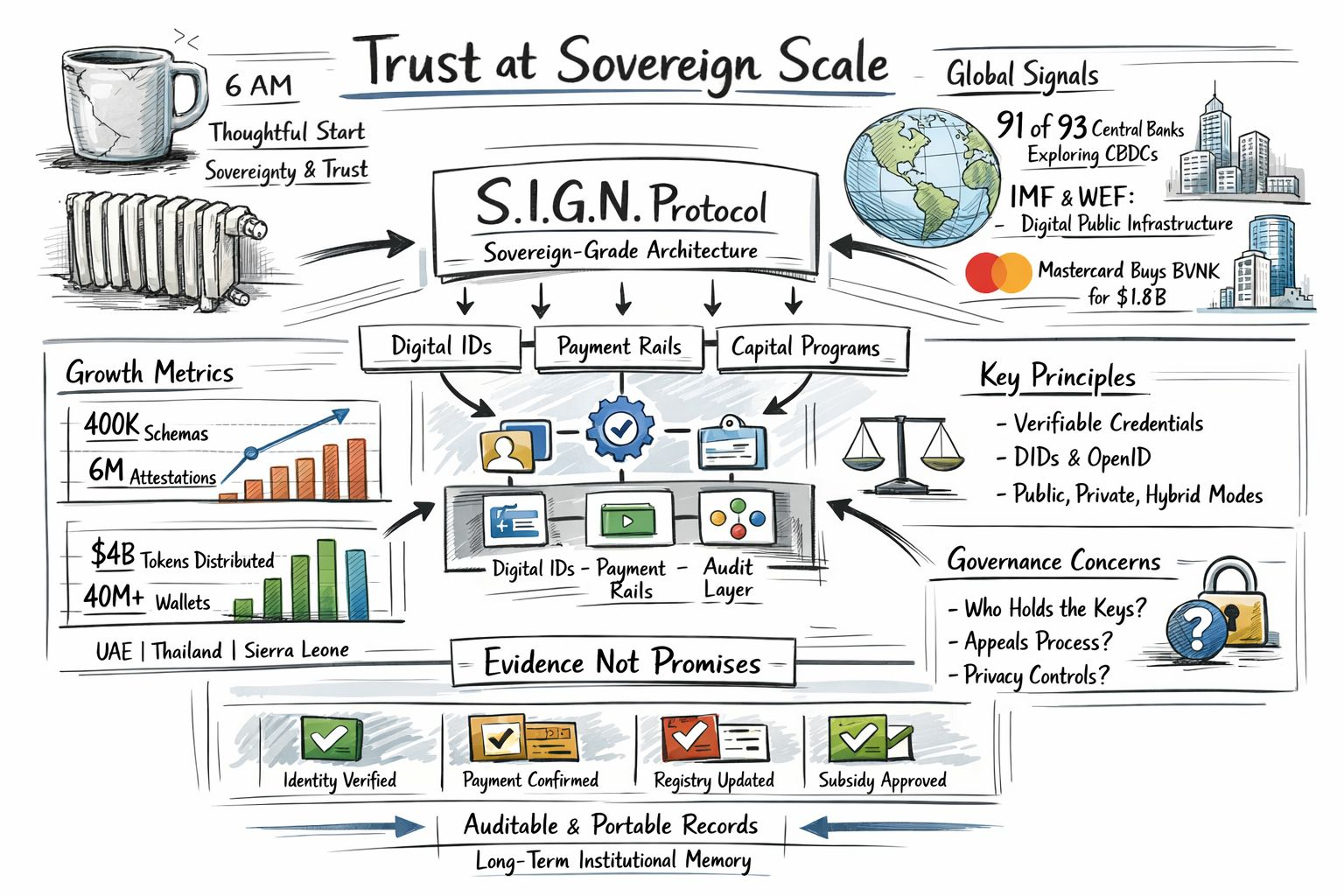
The part I find convincing is the attention to system design. Sign’s documentation says S.I.G.N. is not a single blockchain ledger or vendor platform. It can run in public private or hybrid modes and it leans on standards like verifiable credentials DIDs and OpenID flows. That sounds dry but I like the dryness. At sovereign scale compatibility matters more than novelty because ministries and regulated operators rarely rebuild from zero.
There is also some evidence of traction even if I read the numbers cautiously. Binance Research said Sign Protocol’s schema adoption grew from 4,000 to 400,000 in 2024 while attestations rose from about 685,000 to more than 6 million. The same report said TokenTable had distributed over $4 billion in tokens to more than 40 million wallets and described the product as live in places including the UAE Thailand and Sierra Leone. Those figures do not prove long-term success but they do suggest Sign has moved past the concept stage.
What keeps me interested though is a quieter angle. Sign seems to understand that governments do not merely need software. They need institutional memory that can survive staff turnover vendor changes disputes and audits. That is where an evidence layer becomes more important than a token or a dashboard. If a system can show who approved what under which authority and under which version of the rules then trust stops being rhetorical. It becomes operational.
I still have reservations. Any sovereign tech story can slide into surveillance over-centralization or abstraction. Sign’s own materials talk about controllable privacy and avoiding dependence on one ledger or one vendor which is the right ambition. But ambition is not governance. I would still want to know who holds keys who can pause the system how appeals work and what citizens can actually see or challenge.
Still I think the idea behind Sign is sharper than most blockchain language. I read it as an attempt to turn trust into a shared public utility that is verifiable auditable portable and usable across money identity and public programs. That is why it is drawing attention now. The trend is not about tokens. It is about whether digital states can scale legitimacy and whether their records can hold when belief alone no longer does.