
The dominant pricing model in blockchains today is simple but flawed: every computation has a visible price, typically expressed as gas. While this transparency helps with validation and security, it becomes inefficient in real-world usage. Users are forced to think like machine operators calculating fees, timing transactions, and reacting to congestion rather than simply interacting with applications. The idea behind a “DUST economy,” especially within the context of the Midnight Network and its Night Token, reframes this problem by treating execution costs as micro-frictions rather than explicit tolls.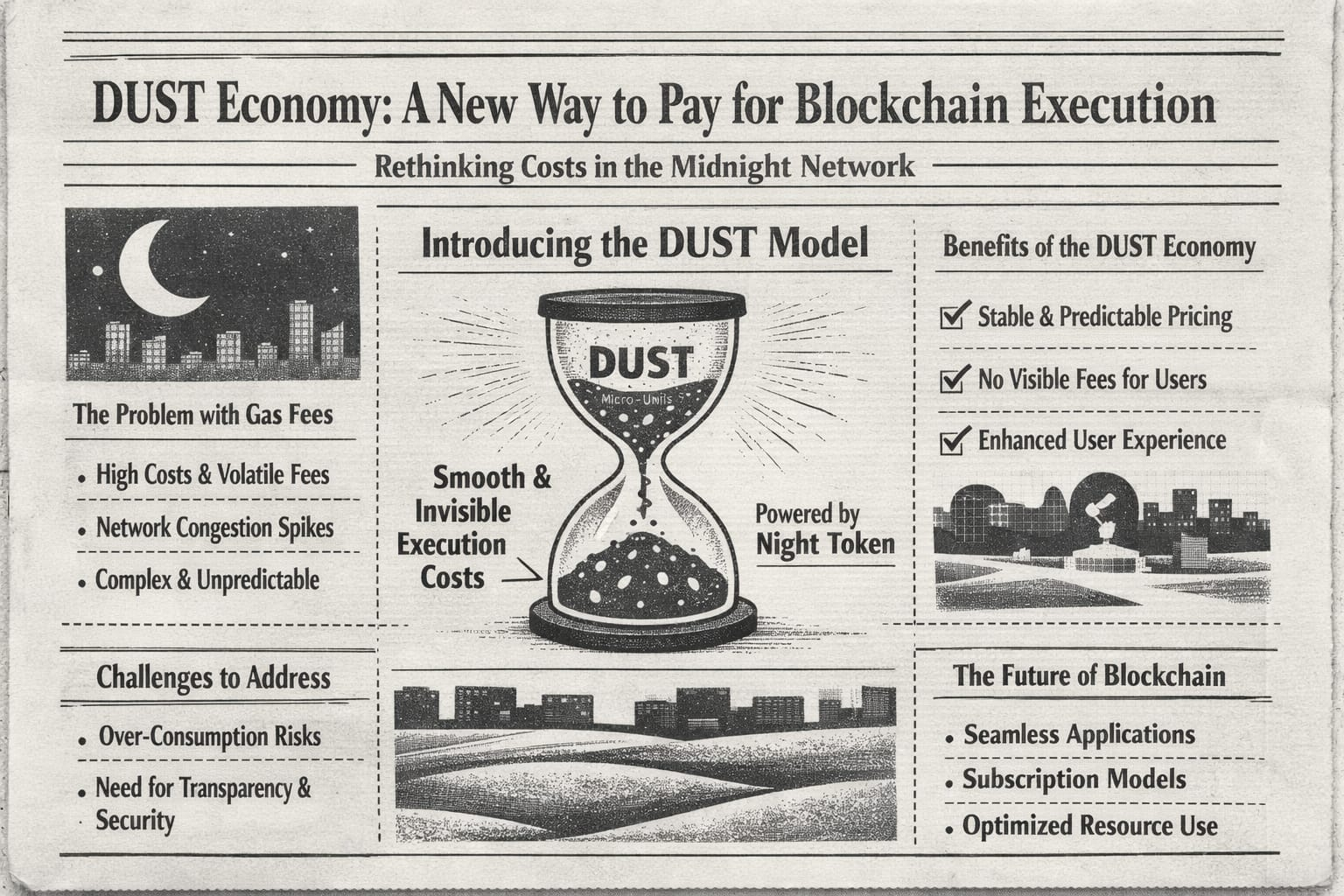
The problem with gas-based systems is not just cost it is unpredictability and cognitive burden. During network congestion, fees spike sharply, often making simple transactions uneconomical. At the same time, during periods of low demand, valuable blockspace remains underutilized. This creates a structural mismatch between actual computational demand and how affordability is perceived by users. Midnight Network approaches this differently by embedding cost into the system design itself, rather than exposing it at every interaction point.
A DUST-based model can be understood as a shift from transaction pricing to resource smoothing. Instead of charging users per action in a volatile fee market, execution costs are abstracted into tiny, near-invisible units “dust.” Within the Midnight Network, the Night Token plays a key role in facilitating this abstraction, acting as the underlying economic layer that absorbs and redistributes execution costs. These micro-units can be accumulated, managed, or integrated into applications, allowing developers to design experiences where users are no longer directly exposed to fee mechanics.
This approach is similar to how cloud computing evolved. Users do not pay for every CPU instruction or memory cycle; instead, they subscribe to service tiers or bundled resources. Midnight applies a comparable model to blockchain execution. By doing so, it enables price predictability, as costs are smoothed over time rather than fluctuating block by block. It also allows demand aggregation, where applications batch and optimize execution internally. Most importantly, it improves user experience people interact with services, not with fee markets.
Market trends already point in this direction. Layer 2 rollups have shown how execution costs can be amortized across batches, significantly lowering per-transaction expenses. Account abstraction has introduced the concept of sponsored transactions, where third parties cover user fees. Additionally, some decentralized applications are experimenting with subscription-based pricing models. Midnight Network, powered by Night Token, extends these fragmented innovations into a cohesive and native economic system, rather than relying on external patches or temporary solutions.
However, abstraction introduces new challenges. When users no longer see costs directly, there is a risk of overconsumption of resources. Hidden or bundled fee models can also reduce trust if they are not transparent or auditable. In the context of Midnight, ensuring that the Night Token’s role in cost distribution remains verifiable will be critical. There is also the possibility that new attack vectors emerge, particularly if malicious actors attempt to exploit subsidized or abstracted execution layers. Furthermore, traditional pricing signals essential for efficient markets may weaken if DUST becomes too detached from actual resource usage.
Despite these risks, the implications are significant. For traders, especially those relying on high-frequency strategies, reducing visible gas friction can preserve margins and improve execution consistency. For builders, it opens the door to entirely new business models, such as freemium decentralized applications, bundled services, or seamless onboarding experiences. For the Midnight Network itself, this model helps create a more stable and predictable demand curve for blockspace, strengthening the long-term utility of the Night Token.
Ultimately, the DUST economy is not just about making transactions cheaper it is about changing how cost is perceived, managed, and distributed. Midnight Network’s approach suggests that the future of blockchain adoption will not be driven solely by lower fees, but by making those fees invisible, predictable, and intelligently integrated into the system. The real innovation lies in shifting user focus away from infrastructure mechanics and toward meaningful interaction with decentralized applications.
@MidnightNetwork #night $NIGHT
